Results by title
78 books match the query 'Fascism & Totalitarianism' and 3 start with p
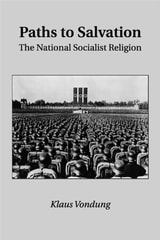
Paths to Salvation
The National Socialist ReligionKlaus Vondung
St. Augustine's Press, 2017
In order to understand National Socialism one must recognize its religious nature. Many Germans were attracted to the party by its pledge to re-establish a true community of the people, a goal that was celebrated as “holy”.
Not only did Hitler promise to solve political, social, and economic problems, he also responded to a widely felt need for salvation. The prospect of salvation elevated politics into the realm of religion and lent meaning to the lives of those who embraced it.
In this work Klaus Vondung explores the various forms in which the elevation of politics into the sphere of religion was expressed in the Third Reich: in the faith of committed National Socialists, in the party’s cult events which celebrated the “community of the people” as a “community of faith” and the Fuhrer as “savior”, and in the persecution of the Jews that was ‘justified’ in religious terms by demonizing Jews as the “evil enemies of humanity” responsible for the world’s ills. This apocalyptic worldview was the extreme manifestation of the religious nature of National Socialism and, in the final analysis, the only plausible explanation for the intention of exterminating the Jews that led to the holocaust.

Persecution and Rescue
The Politics of the “Final Solution” in France, 1940-1944Wolfgang Seibel
University of Michigan Press, 2016
Drawing on German and French sources, Wolfgang Seibel traces the twisted process of political decision-making that shaped the fate of the Jews in German-occupied France during World War II. By analyzing the German-French negotiations, he reveals the underlying logic as well as the actual course of the bargaining process as both the Vichy Regime and the Germans sought a stable relationship. Yet that relationship was continually reshaped by the progress of the war, Germany’s deteriorating prospects, France’s economic and geopolitical position, and the Vichy government’s quest for domestic political support. The Jews’ suffering intensified when the Germans had the upper hand; but when the French felt empowered, the Vichy Regime stopped collaborating in the completion of the “final solution.” Persecution and Rescue: The Politics of the “Final Solution” in France, 1940–1944 demonstrates the ways in which political circumstances can mitigate—or foster—mass crime.

Playing Patriot
Inside Florida’s Alt-RightAlexander Lowie
Rutgers University Press, 2027
What draws ordinary Americans into extremist political movements, and why do they stay? Playing Patriot takes readers inside the contemporary Patriot Movement through immersive ethnographic fieldwork conducted with members of the Patriot Movement in Central Florida (including those active in the Proud Boys and Three-Percenters) following January 6. Over months of participant observation, conversations, and firsthand experiences, anthropologist Alexander Lowie explores how humor, play, alternative media, conspiracy narratives, and performances of masculinity shape political belonging. Rather than portraying these organizations as collections of abstract beliefs alone, the book reveals them as communities built through everyday relationships, shared rituals, and stories about national decline and renewal. Written as a first-person narrative ethnography, Playing Patriot offers an accessible, deeply human account of political extremism while providing fresh insight into the emotional and cultural forces shaping contemporary American populism.