Results by title
3388 books match the query 'Fiction' and 99 start with p
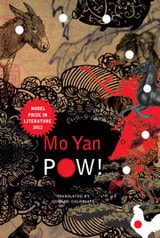
POW!
Mo Yan
Seagull Books, 2012
In this novel by the 2012 Nobel Laureate in Literature, Mo Yan, a benign old monk listens to a prospective novice’s tale of depravity, violence, and carnivorous excess while a nice little family drama—in which nearly everyone dies—unfurls. But in this tale of sharp hatchets, bad water, and a rusty WWII mortar, we can’t help but laugh. Reminiscent of the novels of dark masters of European absurdism like Günter Grass, Witold Gombrowicz, or Jakov Lind, Mo Yan’s POW! is a comic masterpiece.
In this bizarre romp through the Chinese countryside, the author treats us to a cornucopia of cooked animal flesh—ostrich, camel, donkey, dog, as well as the more common varieties. As his dual narratives merge and feather into one another, each informing and illuminating the other, Mo Yan probes the character and lifestyle of modern China. Displaying his many talents, as fabulist, storyteller, scatologist, master of allusion and cliché, and more, POW! carries the reader along quickly, hungrily, and giddily, up until its surprising dénouement.
Mo Yan has been called one of the great novelists of modern Chinese literature and the New York Times Book Review has hailed his work as harsh and gritty, raunchy and funny. He writes big, sometimes mystifying, sometimes infuriating, but always entertaining novels—and POW! is no exception.
Pachacuti
World OverturnedLori Eshleman
Arizona Center for Medieval and Renaissance Studies, 2015
Pacific Tremors
Richard Stern
Northwestern University Press, 2001
Pacific Tremors
Richard Stern
Northwestern University Press, 2007
Paint
Grace Tiffany
Arizona Center for Medieval and Renaissance Studies, 2013
Paper Sons and Daughters
Growing up Chinese in South AfricaUfrieda Ho
Ohio University Press, 2011
Papi
A NovelRita Indiana
University of Chicago Press, 2016
Drawing on her memories of a childhood split between Santo Domingo and visits with her father amid the luxuries of the United States, Rita Indiana mixes satire with a child’s imagination, horror with science fiction, in a swirling tale of a daughter’s love, the lure of crime and machismo, and the violence of the adult world. Expertly translated into English for the first time by Achy Obejas, who renders the rhythmic lyricism of Indiana’s Dominican Spanish in language that propels the book forward with the relentless beat of a merengue, Papi is furious, musical, and full of wit—a passionate, overwhelming, and very human explosion of artistic virtuosity.
ParaSpheres
Edited by Ken E. Keegan and Rusty Morrison
Omnidawn, 2006
With Fabulist and New Wave Fabulist stories by 44 Literary and Genre authors, this anthology follows in the footsteps of Conjunctions 39 (from Bard College, New York), the Fall 2002 issue, which focused on New Wave Fabulist writers.
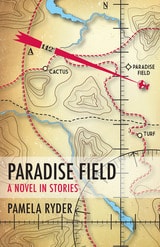
Paradise Field
A Novel in StoriesPamela Ryder
University of Alabama Press, 2017
When life dwindles to its irrevocable conclusion, recollections are illuminated, even unto the grave. Such is the narrative of Paradise Field: A Novel in Stories, whose title is taken from a remote airfield in the American Southwest, and while the father recalls his flying days, his daughter—who nurses the old man—reflects as well.
Pamela Ryder’s stories vary in style and perspective, and time lines overlap as death advances and retreats. This unique and shifting narrative explores the complexities of a relationship in which the father—who has been a high-flying outsider—descends into frailty and becomes dependent upon the daughter he has never really known.
The opening story, “Interment for Yard and Garden,” begins as a simple handbook for Jewish burial and bereavement, although the narrator cannot help but reveal herself and her motives. From there, the telling begins anew and unfolds chronologically, returning to the adult daughter’s childhood: a family vacation in France, the grotesqueries of the dinner table, the shadowy sightings of a father who has flown away.
A final journey takes father and daughter back to the Southwest in search of Paradise Field. Their travels through that desolate landscape foreshadow the father’s ultimate decline, as portrayed in the concluding stories that tell of the uneasy transformation in the bond between them and in the transcendence of his demise. Taken together, the stories in Paradise Field are an eloquent but unsparing depiction of infirmity and death, as well as solace and provocation for anyone who has been left to stand graveside and confront eternity.
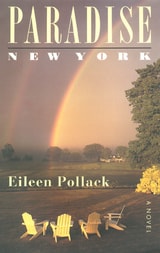
Paradise, New York
A NovelEileen Pollack
Temple University Press, 2000
In the course of that season, Lucy comes to realize her love for the hotel's black handyman, Mr. Jefferson -- and the difficulties she faces in overcoming the barriers between them. She battles her grandmother's not-so-subtle attempts to sabotage her success, her parents' superstitious fear of anything that attracts attention to the Jews, and her brother's contention that what Lucy is doing is more a matter of ego than authentic religious feeling.
On top of all this, Lucy must contend with the Hasid who buys the chicken farm next door, a cell of ancient Jewish Communist who foment a strike among Eden's overworked young staff, and a gay chef and a gay baker who want to prove to the world that kosher cuisine can satisfy the most sophisticated gourmet.
Among the novel's characters are Shirley and Nat Feidel, who barely survived the Holocaust but refuse to allow bitterness to rule their lives; Mami Goshgarian, the Eden's tumeler; and Jimmy Kilcoin, and Irish Catholic insurance adjustor who has earned a reputation as "the Don Juan of the Catskills" and is determined to seduce Lucy before summer's end.
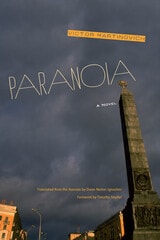
Paranoia
A NovelVictor Martinovich
Northwestern University Press, 2013
Immediately banned after it was published, Paranoia is a novel about how dictatorships survive by burrowing into the minds of those they rule, sowing distrust and blurring the boundaries between the state’s and the individual’s autonomy. Although Minsk and Belarus are never mentioned, they are clearly the author’s inspiration for the novel’s setting. The plot focuses on a doomed romance between a young man whose former lover has disappeared and a young woman whose other lover is the minister of state security. The novel evokes classic dissident literature while artfully depicting the post-Soviet, globalized world.
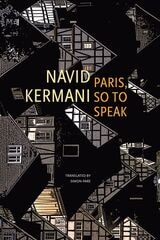
Paris, So to Speak
Navid Kermani
Seagull Books, 2022
A writer has penned a novel about the great love of his youth. After a public reading, he is approached by a woman he doesn’t recognize—but it’s his lover. He is the author; she, the figure in his novel. The young girl from back then has turned into an interesting and attractive woman—but she’s also married. Soon the situation becomes a little strange: they sit down together, have a glass of wine, talk about French romantic novels, ask each other what one expects of love when one grows older. And all the while her husband is sitting in the next room. How is this going to end? Navid Kermani has written a romantic novel like no other—surprising, witty, profound—and one can barely put it down.
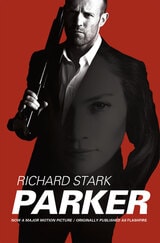
Parker
Movie Tie-in Edition, Originally Published as "Flashfire"Richard Stark
University of Chicago Press, 2012
Participatory Composition
Video Culture, Writing, and ElectracySarah J. Arroyo
Southern Illinois University Press, 2013
Like. Share. Comment. Subscribe. Embed. Upload. Check in. The commands of the modern online world relentlessly prompt participation and encourage collaboration, connecting people in ways not possible even five years ago. This connectedness no doubt influences college writing courses in both form and content, creating possibilities for investigating new forms of writing and student participation. In this innovative volume, Sarah J. Arroyo argues for a “participatory composition,” inspired by the culture of online video sharing and framed by theorist Gregory Ulmer’s concept of electracy.
Electracy, according to Ulmer, “is to digital media what literacy is to alphabetic writing.” Although electracy can be compared to digital literacy, it is not something shut on and off with the power buttons on computers or mobile devices. Rather, electracy encompasses the cultural, institutional, pedagogical, and ideological implications inherent in the transition from a culture of print literacy to a culture saturated with electronic media, regardless of the presence of actual machines.
Arroyo explores the apparatus of electracy in many of its manifestations while focusing on the participatory practices found in online video culture, particularly on YouTube. Chapters are devoted to questions of subjectivity, definition, authorship, and pedagogy. Utilizing theory and incorporating practical examples from YouTube, classrooms, and other social sites, Arroyo presents accessible and practical approaches for writing instruction. Additionally, she outlines the concept of participatory composition by highlighting how it manifests in online video culture, offers student examples of engagement with the concept, and advocates participatory approaches throughout the book.
Arroyo presents accessible and practical possibilities for teaching and learning that will benefit scholars of rhetoric and composition, media studies, and anyone interested in the cultural and instructional implications of the digital age.
Partisan Wedding
StoriesStories by Renata Vigano & Translated by Suzanne Branciforte
University of Missouri Press, 1999
A generation of Italian authors dedicated their lives, their works, and their voices to the primary driving force behind twentieth-century narratives of World War II. Renata Viganò was an active member of the Italian Resistance during World War II, and, like many of her male counterparts, she depicted the actions of the brave people who contributed to and participated in the partisan movement. Unlike her counterparts, however, Viganò vividly portrayed the experiences of women, notably women on the front line, in her posthumously published Matrimonio in brigata, here translated for the first time in English as Partisan Wedding.
"If it had not been for them, the women . . . who got used to `men's business,' . . . the partisan army would have lost a vital, necessary force." The women in Partisan Wedding joined the struggle for many reasons; some for their husbands, others for their fathers, brothers, or sons; some for a sense of justice and the desire to do what was right. Whatever the cause, Viganò demonstrates that women maintained the ability to nurture and to care, to preserve their female qualities in the face of war.
Because of her own role as a partisan, the stories in Partisan Wedding are based on Viganò's personal experiences. Two stories in the collection are specifically autobiographical: "Acquitted" and "My Resistance." Relating her own plight to find her husband, a partisan commander, after his sudden arrest, "Acquitted" aptly conveys Viganò's struggle to maintain her strength in the face of complete helplessness. "My Resistance" is a personal account of her own experiences during the war and the women she met along the way.
Partisan Wedding is an invaluable contribution to the literature of the Second World War, completing the picture of those involved in the struggle for freedom. Viganò's remarkable prose, equally beautiful and terrible in its description of the minute details of human suffering and sacrifice, opens a window to a world that has rarely been seen, and a world not easily forgotten.
Parts of a World
A NovelA. G. Mojtabai
Northwestern University Press, 2011
Tom’s life changes when he takes on the case of Michael, who is known as “Saint Francis of the Dumpster” for his peaceful disposition and practice of eating from garbage cans. Tom is at first haunted by, then obsessed with, this uncommunicative young man who holds a precious secret which causes him to risk his survival by living on the street. Tom is determined to discover and expose Michael’s secret (“his faith/his delusion”) as a necessary first step before any treatment can begin. Tom cannot reason his way out of his own obsession when he finds himself bending the rules, abandoning therapeutic norms and, before long, stalking his client. Parts of a World is a book about doubt—doubt, faith, and delusion.
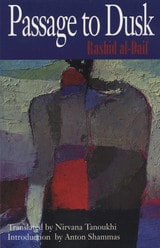
Passage to Dusk
By Rashid al-Daif
University of Texas Press, 2001
Passage to Dusk deals with the Lebanese civil war of the 1970s in a postmodern, poetic style. The narrative focuses on the deranged, destabilized, confused, and hyper-perceptive state of mind created by living on the scene through a lengthy war. The story is filled with details that transcend the willed narcissism of the main character, while giving clues to the culture of the time. It is excellent fiction, written in a surrealistic mode, but faithful to the characters of the people of Lebanon, their behavior during the war, and their contradictions. Issues of gender and identity are acutely portrayed against Lebanon's shifting national landscape.
The English-language reader has not been much exposed to Lebanese literature in translation, and Rashid al-Daif is one of Lebanon's leading writers. He has been translated into eight languages, including French, German, Italian, Polish, and Spanish. Translator Nirvana Tanoukhi manages to preserve Daif's unusual, moving, and at times humorous style in her English rendition.
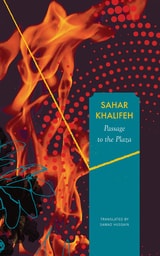
Passage to the Plaza
Sahar Khalifeh
Seagull Books, 2020
In the furnace of conflict at the heart of the 1987 Intifada, notions of freedom, love, respectability, nationhood, the rights of women, and Palestinian identity—both among the reluctant residents of the house and the inhabitants of the quarter at large—will be melted and re-forged. Vividly recounted through the eyes of its female protagonists, Passage to the Plaza is a groundbreaking story that shatters the myth of a uniform gendered experience of conflict.
Passes Through
Rob Stephenson
University of Alabama Press, 2010
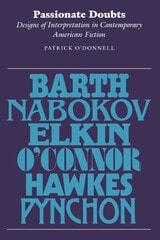
Passionate Doubts
Interpretation In FictionPatrick O'Donnell
University of Iowa Press, 1986
In an introductory dialogue and a closing chapter on the reader in contemporary fiction, O'Donnell shows that the formation of the reader's self, like character, plot, or any other element in fiction, is also part of the experience of the text, requiring a distinctive conception of interpretation. Calling upon a wide assemblage of modern theorists including Foucault, Derrida, Serres, Binswanger, Geertz, and Gadamer, O'Donnell elicits a broad range of interpretive possibilities—philosophical, psychological, archaeological, and linguistic—which speak to each novel's central concern with the act of reading as a form of signification.
While Passionate Doubts is broadly a hermeneutic study of contemporary fiction, the heart of this intriguing work resides in the close scrutiny of six modern novels which so richly evoke the very elements from which theories derive: language, form, and impulse. It is this specific application of theory that sets Passionate Doubts apart from other works in the field, yielding a series of important insights on the subject of language, sign, and the self in modern literature.
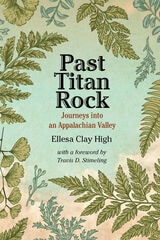
Past Titan Rock
Journeys into an Appalachian ValleyEllesa Clay High
West Virginia University Press, 2021
Past Titan Rock, a winner of the Appalachian Award for Literature, is available in a new edition as part of the series Sounding Appalachia, with an introduction by series editor Travis D. Stimeling.
In 1977 Ellesa Clay High thought she would spend an afternoon interviewing Lily May Ledford, best known as the lead performer of an all-female string band that began playing on the radio in the 1930s. That meeting began an unexpected journey leading into the mountains of eastern Kentucky and a hundred years into the past. Set in Red River Gorge, an area of steep ridges and box canyons, Past Titan Rock is a multigenre, multivocal re-creation of life in that region. With Ledford’s guidance, High traveled and lived in the gorge, visiting with people who could remember life there before the Works Progress Administration built roads across the ridges and into the valleys during the New Deal. What emerges through a unique combination of personal essay, oral history, and short fiction is a portrait of a mountain culture rich in custom, oral tradition, and song. Past Titan Rock demonstrates the depth of community ties in the Red River Gorge and raises important questions about how to resist destructive forces today.
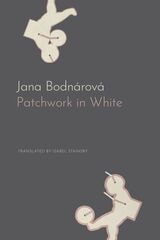
Patchwork in White
Jana Bodnárová
Seagull Books, 2026
An intimate story of otherness and care by a major voice in Slovak literature.
For more than three decades, Jana Bodnárová has been one of Slovak literature’s most distinctive voices, writing with a lyricism that is at once tender and unflinchingly harsh. Patchwork in White is a brief yet powerful novel that stitches together fragments of lives bound by intimacy, difference, and care, set against the social fabric of Czechoslovakia from the mid-1950s to the present.
At the center of the novel are Ota and Andrej, a couple whose shared memories unfold through shards of childhood, marriage, and parenthood. Their lives are irrevocably shaped by the decision to adopt albino twins—children marked by abuse and exclusion because of their otherness. As these fragments accumulate, the novel becomes a meditation on motherhood, femininity, love, and the quiet imminence of death.
Poetic, restrained, and brutally honest, Bodnárová’s prose finds resonance in what is left unsaid. Illustrations by Eva Moflárová deepen the book’s emotional texture, creating a work of rare intimacy and moral force.
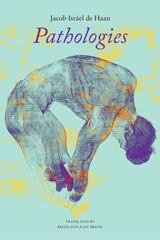
Pathologies
The Downfall of Johan van Vere de WithJacob Isräel de Haan
Seagull Books, 2024
At the start of the twentieth century, Jewish anti-Zionist Jacob Israël de Haan led an eventful life as a poet, journalist, teacher, and lawyer in the Netherlands. His autobiographical novella Pipelines caused a storm of controversy in 1904 with its portrayal of a subject that was considered scandalous at the time—a romantic relationship between two young men. He lost his teaching job, and the entire print run was pulped.
In his iconic 1908 novel Pathologies, he once again openly and radically explored the topic of homosexuality. The story centers around adolescent Johan, who lives a secluded life with his father and their elderly housekeeper in a large house. For a while, Johan has been plagued by erotic fantasies about his classmates. When, to make matters worse, he finds himself feeling attracted to his father—first in a dream, and then in real life—he grows desperate. Johan moves out, finding room and board with an older married couple in Haarlem, where he meets René, a young confident artist. Johan falls head-over-heels in love, and the two men enter a sadomasochistic relationship that soon begins to spiral out of control.
Johan is one of world literature’s most tragic, troubled young heroes, at par with Goethe’s Werther and Dostoevsky’s Raskolnikov. His struggle to come to terms with his fantasies and desires—rife with taboos that continue to resonate today—forms the beating heart of this daring novel. Written in De Haan’s precise, lyrical prose, Pathologies has lost none of its force more than a century after it was first published.
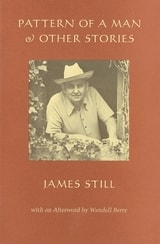
Pattern of a Man and Other Stories
James Still
Ohio University Press, 0
Published in 2001 by Gnomon Press
This reissue of a 1976 collection, featuring a new afterword by Wendell Berry, showcases James Still’s enduring mastery of the short story form. Set in the Appalachian region, these twelve stories reflect the rhythms, dialects, and deep-rooted traditions of mountain life, rendered with quiet power and poetic precision.
Still’s characters—rural craftsmen, widows, children, and wanderers—navigate the complexities of isolation, kinship, and survival. Stories like “The Nest,” “The Scrape,” and “Maybird Upshaw” reveal a landscape both stark and tender, where the natural world and human spirit intertwine. With language shaped by the unique dialect of eastern Kentucky, Still’s prose honors the dignity of his subjects without sentimentality or condescension.
This collection affirms Still’s place among the great chroniclers of American regional life, offering readers a poignant and authentic portrait of a vanishing world.
Peltse and Pentameron
Volodymyr Dibrova
Northwestern University Press, 1996
Peltse portrays the formation of an average apparatchik. Both funny and alarming, it provides a psychological portrait of an individual trapped in a system he simultaneously dislikes and depends upon for survival. Pentameron tells the story of one day in the life of five colleagues at a Soviet research institute. Each is dissatisfied, yet all are trapped in and by a system that has taken away their ability to act decisively.
Peony Red
A Case for Milena LukinChristian Schünemann and Jelena Volic
Haus Publishing, 2018
When a young couple is murdered in their home in Kosovo, police are perplexed: there seems to be no motive. But when Milena Lukin’s uncle realizes that the murdered woman was his first love, his niece decides to investigate. All too soon, she is embroiled in the twisted world of Balkan politics, where the past always weighs heavy on the present, and nowhere more so than in her hometown of Belgrade. Old prejudices and new hatreds, merciless profiteers and mendacious politicians—all come together to try to keep Lukin from finding the truth.
A fast-paced, deftly told thriller Peony Red drops readers into the murky Balkan underworld. Fortunately, in Milena Lukin, they have a strong, capable, no-nonsense guide, one whose adventures will always keep the pages turning.
People Of The Valley
A NovelFrank Waters
Ohio University Press, 1941
One of Frank Waters’s most popular novels, People of the Valley takes place high in the Sangre de Cristo Mountains where an isolated Spanish-speaking people confront a threatening world of change.
Perfection in Bad Axe
StoriesStories by Craig Bernthal
University of Missouri Press, 2003
You could find out anything at Jim's, and Larry and I liked to be in the know. Information (not gossip) was passed back and forth constantly. Did you hear about the four couples engaged in "wife- swapping" in town? The mechanics and gas pumpers at Jim's could fill you in. Were you interested in the last time the Baptist minister beat his wife? Who your cute French teacher slept with a couple nights ago? Jim's had the answers. The place held another attraction for me: if you were under twenty-one and wanting some liquor for Friday night, Jim's son, Jimmy the Bomb, just out of the Marine Corps, had no problem picking up a bottle or two for you at the liquor store on the east side of town.
Set mainly in the Midwest, these tales are inhabited by ordinary, decent people who, often to their surprise, find joy and meaning under difficult circumstances. Many of the stories depict isolated moments of perfection in a world that routinely forces its imperfections on us. A teenager wrestles with guilt over an accident he caused in “Perfection in Bad Axe.” In “A Knight Pursued,” a young prosecuting attorney confronts on the same day his first autopsy and his wife’s unexpected desire to have a baby. A devout, hardworking business owner is drawn into a lawsuit that threatens his marriage and leads him to question his most deeply felt principles. “Center of Gravity” finds a middle-aged law professor overcome by his chaotic life and searching for a degree of peace. These are the finely developed characters of Bernthal’s stories—people we recognize, but who never seem overly familiar. Interesting, substantial, and utterly engrossing, each one could be just like any one of us, an ordinary Jane or Joe, trying to maintain or find order in a life sometimes filled with disorder.
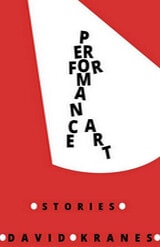
Performance Art
StoriesDavid Kranes
University of Nevada Press, 2021
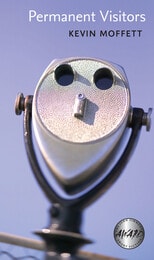
Permanent Visitors
Kevin Moffett
University of Iowa Press, 2006
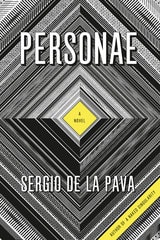
Personae
A NovelSergio De La Pava
University of Chicago Press, 2013
This book is nothing like that one. Just look at it: A Naked Singularity was a brick of a book, 678 pages, and this one’s slim--lean and focused. A Naked Singularity locked us into the unforgettable voice of its protagonist, Casi, while Personae shimmers and shifts among different perspectives, locations, and narrative techniques.
But sharp readers will quickly see that the two books are the work of the same hand. The sheer energy of De La Pava’s sentences, his eye for absurd humor, his commitment to the idea of justice--all will be familiar here as they carry us from the tale of an obsessive, damaged psychic detective consumed by a murder case, into a Sartrean drama that raises questions (and jokes) about responsibility, fate, death, and more. And when De La Pava eventually returns us to the investigation, this time seen from the other side, the lives and deaths bound up in it feel all the more real, and moving, even as solid answers slip away into mist.
Shelf Awareness declared that A Naked Singularity "heralded the arrival of a tremendous talent." In some ways, despite its brevity, Personae is even more surprising and challenging--and, in its ambition and fierce intelligence, it’s proof that Sergio De La Pava is here to stay.
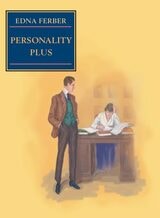
Personality Plus
Some Experiences of Emma McChesney and Her Son, JockEdna Ferber
University of Illinois Press, 2002
In this second of three volumes chronicling the travels and trials of Emma McChesney, the plucky heroine trades in her traveling bag and coach tickets for an office and a position a T. A. Buck Jr.'s business partner. Along with this well-earned promotion comes the home–-with a fireplace–-that she had longed for during her ten years on the road.
Her dashing son Jock, now twenty-one, has just entered the business world himself with the Berg, Shriner Advertising company. His colleagues believe that with his heritage he "ought to be able to sell ice to an eskimo." Indeed, Jock dazzles them with his keen business sense and exemplary work ethic, but goes overboard on the charm and ends up alienating clients, unnerving his boss, and even patronizing his business-savvy mother. When his company takes on the challenge of creating a zippy advertising campaign for T. A. Buck's no-frills petticoats, Jock comes through, but not without a reminder that mother always knows best.
In this bracingly modern novel, first published in 1914, Ferber contrasts the virtues of talent with those of experience to provide a fresh, readable, and smartly entertaining contest between a mother and her adult son.
Perverzion
Yuri Andrukhovych
Northwestern University Press, 2005
Or, then again, it may not.
Perverzion constructs Perfetsky's final days using a mishmash of relics, from official documents to recorded interviews to scraps of paper. Perfetsky, the personification of the Ukrainian artistic superman—he used his masterful musicianship in a collaboration with Elton John during the pop star's secret sojourn in Ukraine—is bound for Venice to participate in a seminar to save the world from absurdity. On the way he becomes a Ukrainian Orpheus descending into the decadence of the West, navigating through surrealistic adventures and no less surrealistic seminar topics as he charges head up (and pants down) toward his fate.
Photographic Memories
Selected Essays, Playlets, and StoriesWilly Conley
Gallaudet University Press, 2023
Original photographs taken by the author accompany his writings and invite the reader to contemplate the often-blurred lines between reality and memory.

Picture Books for Children
Fiction, Folktales, and PoetryMary Northrup
American Library Association, 2012
Pictures from an Institution
A ComedyRandall Jarrell
University of Chicago Press, 1952
A finalist for the National Book Award, this classic novel of midcentury campus life is demonically funny and brutally cutting
Beneath the unassuming surface of a progressive women’s college lurks a world of intellectual pride and pomposity awaiting devastation by the pens of two brilliant and appalling wits. Randall Jarrell’s classic novel was originally published to overwhelming critical acclaim in 1954, forging a new standard for campus satire—and instantly yielding comparisons to Dorothy Parker’s razor-sharp barbs. Like his fictional nemesis, Jarrell cuts through the earnest conversations at Benton College—mischievously, but with mischief nowhere more wicked than when crusading against the vitriolic heroine herself.
“A most literate account of a group of most literate people by a writer of power. . . . A delight of true understanding.”—Wallace Stevens
“I’m greatly impressed by the real fun, the incisive satire, the closeness of observation, and in the end by a kind of sympathy and human warmth. It’s a remarkable book.”—Robert Penn Warren
“Move over Dorothy Parker. Pictures . . . is less a novel than a series of poisonous portraits, set pieces, and endlessly quotable put-downs. Read it less for plot than sharp satire, Jarrell’s forte.”—Mary Welp
“One of the wittiest books of modern times.”—New York Times
“[T]he father of the modern campus novel, and the wittiest of them all. Extraordinary to think that ‘political correctness’ was so deliciously dissected 50 years ago.”—Noel Malcolm, Sunday Telegraph
“A sustained exhibition of wit in the great tradition. . . . Immensely and very devastatingly shrewd.”—Edmund Fuller, Saturday Review
“[A] work of fiction, and a dizzying and brilliant work of social and literary criticism. Not only ‘a unique and serious joke-book,’ as Lowell called it, but also a meditation made up of epigrams.”—Michael Wood
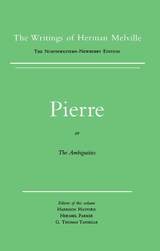
Pierre, or The Ambiguities
Volume SevenHerman Melville
Northwestern University Press, 1995
This scholarly edition aims to present a text as close to the author's intention as the surviving evidence permits. Based on collations of the two issues and the two impressions of the single edition publishing in Melville's lifetime, it incorporates necessary emendations made by the series editors. This text of Pierre is an Approved Text of the Center for Editions of American Authors (Modern Language Association of America).
Pierre, or The Ambiguities
Volume Seven, Scholarly EditionHerman Melville
Northwestern University Press, 1971
This scholarly edition aims to present a text as close to the author's intention as the surviving evidence permits. Based on collations of the two issues and the two impressions of the single edition publishing in Melville's lifetime, it incorporates necessary emendations made by the series editors. This text of Pierre is an Approved Text of the Center for Editions of American Authors (Modern Language Association of America).

Pike's Peak
A Mining SagaFrank Waters
Ohio University Press, 1987
During the fabulous reign of Colorado Silver, innumerable prospectors passed by Pike’s Peak on their way to the silver strikes at Leadville, Aspen, and the boom camps in the Saguache, Sangre de Cristo, and San Juan mountains. Then, in 1890, a carpenter named Winfield Scott Stratton discovered gold along Cripple Creek. By 1900, this six square mile area on the south slope of Pike’s Peak supported 475 mines and led the world in gold production. Against this backdrop of frenzied mining and gold fever, Pike’s Peak tells the story of Joseph Rogier, a man who seeks and finds his fortune in Colorado, and then loses everything in pursuit of something more important.
Arriving in Colorado Springs in the 1870s, Rogier becomes a successful contractor and builder and helps to raise a little mountain town into the Saratoga of the west. He rears a large family and scoffs at the “alfalfa miners” chasing silver strikes everywhere. But with the discovery of gold at nearby Cripple Creek, Rogier is shaken and methodically squanders his prosperous business and all his property attempting to reach the “great gold heart” of Pike’s Peak.
Waters’ is a psychologically modern novel whose universal theme is expressed on the grand scale of the opening of a territory. It is both a marvelously colorful and detailed account of the days when Colorado boomed and Denver became a big town, and an allegory of one man’s furious pursuit of the truth within himself.
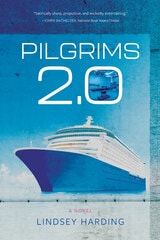
Pilgrims 2.0
A NovelLindsey Harding
Acre Books, 2023
PILGRIM, Canterbury Cruise Line’s flagship, promises its passengers not just a luxurious fortnight away but the opportunity for reinvention. This extraordinary journey is made possible by the captain and visionary plastic surgeon Dr. Walter Heston, by the vessel’s self-learning artificial intelligence called BECCA, and an all-male crew of room stewards, deck hands, technicians, and cosmetic practitioners.
Pilgrims 2.0 begins on the eve of Cruise #52 and follows four women eager for transformation. Meet Bianca, the aging athlete determined to resume the competitive tennis career that motherhood sidelined. Meet Nicole, whose mommy makeover will mean she can stop hiding herself, and her debt, from her husband. Meet Lyla, an infertile maternity-ward nurse desperate to experience pregnancy, and Annalie, who wants only to stop seeing her dead twin every time she looks in the mirror. At the center of the story is Dr. Heston himself, driven to do with bodies what his late wife, Rebecca, could do with computer code—make the impossible, possible.
But “excursions” like these aren’t always smooth sailing—especially on this voyage, where the hopes, histories, and obsessions of clients and crew members collide. When a disruptive crewman’s pranks turn dangerous, it becomes clear that some of those who embarked won’t return to the Port of Los Angeles—at least not fully, at least not as themselves, and maybe not with their lives.
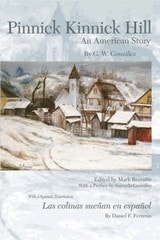
Pinnick Kinnick Hill
An American StoryBy G. W. González, Edited by Mark Brazaitis, with a Preface by Suronda González, with a Spanish translation Las colinas sueñan en español by Daniel Ferreras
West Virginia University Press, 2006
Nearly a century ago, hundreds of families journeyed from Spain to the United States, to search for a better life in the growing zinc-industry towns of Harrison County, West Virginia. As they created a new culture and a new home in this strange land, they added another thread to the rich fabric of our nation. Writing from his perspective as a first-generation son of this immigrant community, González recounts his childhood memories of his neighborhood, where these immigrants raised their families, worked in the often insufferable conditions of the zinc factories, and celebrated "romerias" and feast days with their neighbors.
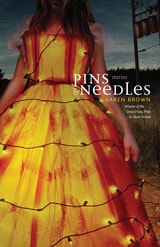
Pins and Needles
StoriesKaren Brown
University of Massachusetts Press, 2007
In "She Fell to Her Knees," Nell inherits the neglected house in which her mother died years before, and begins an affair with the neighbor. The narrator of "Apparitions," who has recently returned the blind grandson she was raising to the care of his mother, invites a confused young man into her home. In "The Ropewalk," a bartender haunted by her abandonment of her own child aids a customer in a struggle for custody of her daughters. A pregnant teenager in "Unction" comes to accept the reality of her situation while working a summer job counting parts in a bookbinding machine shop. Annie, the young mother with a tragic past in "Pins and Needles," leaves her infant daughter to go on an errand in a snowstorm, and picks up a boy she doesn't know.
What remains a constant in these stories is the tangible presence of the natural world. Each story moves toward the moment in which its characters, navigating loss, learn acceptance. Like the single mother in "Destiny," they see their lives happen—"all around, just then, forever.
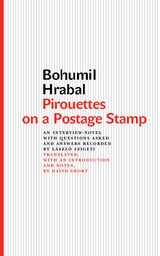
Pirouettes on a Postage Stamp
An Interview-Novel with Questions Asked and Answers Recorded by László SzigetiBohumil Hrabal
Karolinum Press, 2008
Pirouettes on a Postage Stamp carried Hrabal’s experimentation to the field of autobiography. On its surface a verbatim record of an oral interview conducted by Hungarian journalist László Szigeti, the book confuses and confounds with false starts, digressions, and philosophical asides. Yet despite all the games and distractions, Hrabal’s personality shines through, compelling and unforgettable, making Pirouette on a Postage Stamp an unexpected treat for any lover of Czech literature.
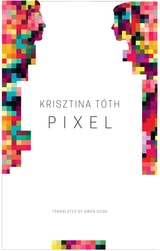
Pixel
Krisztina Tóth
Seagull Books, 2018
Like stars in the sky, pixels may seem like tiny, individual points. But, when viewed from a distance, they can create elaborate images. Each pixel contributes to this array, but no individual point can create the whole. The thirty stories that comprise Krisztina Tóth’s book similarly produce an interconnected web. While each tale of love, loss, and failed self-determination narrates the sensuousness of an individual’s life, together, the thirty stories tell a more complicated tale of relationships. Circumstances that appear unrelated may converge in harmony or heartbreak, just as the events that loom largest may fail to produce a longed-for outcome. These threads often determine the course of lives in unpredictable ways—sometimes comic, sometimes tragic, but rarely in the ways we originally anticipated.
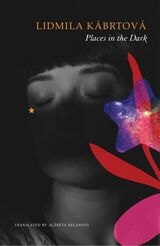
Places in the Dark
Short StoriesLidmila Kábrtová
Seagull Books, 2025
Following her divorce, Tereza shuts off emotionally and flits from one faceless lover to the next, until an unexpected visitor shakes her existence to the core. Klara is a bird trapped in a golden cage slowly suffocating her. Eva has sacrificed herself for her children and family. Life is one big party for Karla—or is it? Alice is doing everything she can not to be a crybaby like her mother. Petra has finally had enough and takes drastic measures. Magdalena’s true yearnings bubble up to the surface.
The stories of these six characters may be different, but these women’s paths converge throughout Places in the Dark, weaving a vivid tapestry of interconnected lives. Czech author Lidmila Kábrtová is a master of writing stories of astonishing clarity. Echoing the brilliance of Alice Munro, Kábrtová’s words act as translucent veils, allowing the essential truths to shimmer through. Moments move about on tectonic plates somewhere beneath the surface of the everyday, and nothing will be as it used to be. Yet, in this kaleidoscope of narratives, the question lingers: Was it ever truly as it seemed?
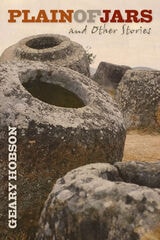
Plain of Jars
and Other StoriesGeary Hobson
Michigan State University Press, 2011
In the opening story of Geary Hobson’s riveting new collection, Plain of Jars, a young private confides to his friend that he’s trying to leave the Marine Corps. “I am not doing this just because I find the Marine Corps too tough,” Warren Needham says, but because violence is contradictory to his faith. The story’s surprising climax, however, reveals a different side of Needham’s contradictory nature. It’s this acute understanding of conflict that characterizes Plain of Jars, a book populated by bullies, men in combat, abusive spouses, and Native Americans seeking a sense of personal identity in an environment where conformity is law. The U.S. Marine Corps sets the stage for a number of these stories, whose protagonists combat racism, post-traumatic stress syndrome, and the looming reality of the Vietnam War. With pitch perfect dialogue and a sense of the unexpected, Plain of Jars tests the depths of complex lives.
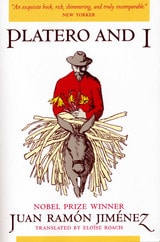
Platero and I
By Juan Ramón Jiménez
University of Texas Press, 1957
This lyric portrait of life—and the little donkey, Platero—in a remote Andalusian village is the masterpiece of Juan Ramón Jiménez, the Spanish poet awarded the 1956 Nobel Prize for Literature.
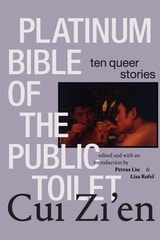
Platinum Bible of the Public Toilet
Ten Queer StoriesCui Zi'en. Edited and with an introduction by Petrus Liu and Lisa Rofel
Duke University Press, 2024
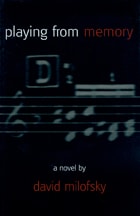
Playing from Memory
David Milofsky
University Press of Colorado, 1999
Ben Seidler, an intense, passionately committed violist, is at the height of his career as a member of the Casa Bella Quartet, one of the foremost string quartets in the nation. His gifts as a concert artist had always been intuitive, but love did not come so easily. It took determination to win the hand of his wife, Dory, who was reluctant to set aside her ambitions of becoming an artist.
Their marriage is at once complex and ordinary, balancing the rigors of long rehearsal sessions against the daily round of family life with their two sons. Then suddenly the rhythm of their lives is shattered when Ben falls victim to multiple sclerosis. Stubbornly independent, Ben refuses to rely on others until necessity forces him to see that there are things beyond his control. Through a new closeness with his aging father, his older son, and, most importantly, Dory, he learns to accept help and to appreciate human frailty and affection.
As Ben's health declines, Dory is forced to resume her career and compete in a world dominated by men, and to re-examine her feelings and commitment to her husband. As their lives change, so does their marriage, and Ben and Dory forge a new kind of love, a fierce love that sustains them through everything.
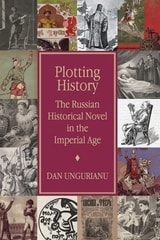
Plotting History
The Russian Historical Novel in the Imperial AgeDan Ungurianu
University of Wisconsin Press, 2007
Balanced precariously between fact and fiction, the historical novel is often viewed with suspicion. Some have attacked it as a mongrel form, a “bastard son” born of “history’s flagrant adultery with imagination.” Yet it includes some of the most celebrated achievements of Russian literature, with Alexander Pushkin, Nikolai Gogol, Leo Tolstoy, and scores of other writers contributing to this tradition.
Dan Ungurianu’s Plotting History traces the development of the Russian historical novel from its inception in the romantic era to the emergence of Modernism on the eve of the Revolution. Organized historically and thematically, the study is focused on the cultural paradigms that shaped the evolution of the genre and are reflected in masterpieces such as The Captain’s Daughter and War and Peace. Ungurianu examines the variety of approaches by which Russian writers combined fact with fiction and explores the range of subjects that inspired the Russian historical imagination.
Outstanding Academic Title, Choice Magazine
“Ungurianu has produced a most valuable work for literary scholars.”—Andrew M. Drozd, Slavic and East European Journal
“[Ungurianu’s] overwhelming knowledge, impeccable documentation, erudite notes, and valuable addenda make for a treasure house of information and keen analysis. . . . Essential.”—Choice