Results by title
106 books match the query 'Grammar' and 6 start with p
Paninian Studies
Professor S. D. Joshi Felicitation VolumeMadhav Deshpande and Saroja Bhate, Editors
University of Michigan Press, 1991
Peacocks, Chameleons, Centaurs
Gay Suburbia and the Grammar of Social IdentityWayne Brekhus
University of Chicago Press, 2003
In this first-ever ethnography of American gay suburbanites, Wayne H. Brekhus demonstrates that who one is depends at least in part on where and when one is. For many urban gay men, being homosexual is key to their identity because they live, work, and socialize in almost exclusively gay circles. Brekhus calls such men "lifestylers" or peacocks. Chameleons or "commuters," on the other hand, live and work in conventional suburban settings, but lead intense gay social and sexual lives outside the suburbs. Centaurs, meanwhile, or "integrators," mix typical suburban jobs and homes with low-key gay social and sexual activities. In other words, lifestylers see homosexuality as something you are, commuters as something you do, and integrators as part of yourself.
Ultimately, Brekhus shows that lifestyling, commuting, and integrating embody competing identity strategies that occur not only among gay men but across a broad range of social categories. What results, then, is an innovative work that will interest sociologists, psychologists, anthropologists, and students of gay culture.

Pois não
Brazilian Portuguese Course for Spanish Speakers, with Basic Reference GrammarBy Antônio Roberto Monteiro Simões
University of Texas Press, 2008
Spanish speakers can learn Brazilian Portuguese much more rapidly than any other language, and thousands of students have used Antônio Simões's text/workbook Com licença: Brazilian Portuguese for Spanish Speakers to make the transition between the two languages. Recognizing the need for a text that incorporates current cultural references and the latest language pedagogy, Simões now offers Pois não: Brazilian Portuguese Course for Spanish Speakers, with Basic Reference Grammar.
Pois não contrasts Portuguese and Spanish, which accomplishes two main goals. It teaches the equivalent of one year of college Portuguese in one semester, three times a week, to Spanish speakers who also have a solid understanding of English. Additionally, the book serves as a basic reference guide to Brazilian Portuguese for the same audience.
Pois não can be used by students in the classroom or by independent learners. Users of the book may focus on the drills alone, concentrate on both the explanations and drills, or use the book as a reference for consultation only. Answers to all of the exercises are included in the book. Audio and video recordings by native Brazilian speakers of dialogues that appear in the book can be downloaded at https://utexas.box.com/v/PoisNaoAudio.
Portuguese
A Reference ManualBy Sheila R. Ackerlind and Rebecca Jones-Kellogg
University of Texas Press, 2011
An essential, comprehensive guide for all who are interested in learning the Portuguese language and mastering its complexities, Portuguese: A Reference Manual supplements the phonetic and grammatical explanations offered in basic textbooks. While the Manual focuses on Brazilian Portuguese, it incorporates European Portuguese variants and thus provides a more complete description of the language. Accessible to non-linguists and novice language learners, as well as informative for instructors of Portuguese and specialists in other languages, this guide incorporates the Orthographic Accord (in effect since 2009–2010), which attempts to standardize Portuguese orthography.
The Manual reflects the language as it is currently taught at both the undergraduate and graduate levels by providing detailed explanations of the sound and writing systems and the grammar of the principal Portuguese dialects. A reference guide rather than a textbook, the Manual also provides extensive verb charts, as well as comparisons of Portuguese with English and Spanish.
Principles of Grammar and Learning
William O'Grady
University of Chicago Press, 1987
To support this thesis, O'Grady develops a well-articulated, single level, categorial-type grammar that he uses to analyze syntactic categories, extraction, anaphora, extraposition, and quantifier placement in English and other languages. He shows that such grammars can be constructed via general learning strategies from notions such as dependency, adjacency, precedence, and continuity, and that the available acquisition data points to the emergence of the principles he proposes.
While exploratory, this book provides one of the few serious attempts to develop a theory of grammar and learning that does not posit faculty-specific innate principles. Principles of Grammar and Learning is an exemplary attempt to bring together issues and data from syntactic theory, language acquisition, and the more general study of the human mind.
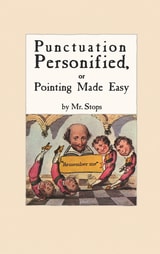
Punctuation Personified, or Pointing Made Easy by Mr. Stops
A FacsimileEdited by the Bodleian Library
Bodleian Library Publishing, 2004
A series of larger-than-life characters in the book, including Mr. Stops, Counsellor Comma, and the hero, Young Robert, humorously bring its lessons to life with witty and amusing verse such as: "See, how Semicolon is strutting with pride; Into two or more parts he'll a sentence divide." Lively and colorful engravings, meanwhile, infuse the book with an entertaining spirit, while also reinforcing the lessons laid out in its cheerful rhymes.
It is evident to see how a child would have enjoyed learning about grammar through Punctuation Personified, as its simple but instructive verse and vibrant illustrations skillfully open up a fresh world of knowledge. This new edition, featuring a modern introduction, will delight and amuse readers of all ages.