Results by title
75 books match the query 'Historic Preservation' and 5 start with p
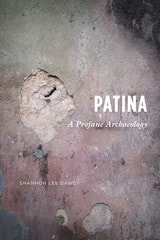
Patina
A Profane ArchaeologyShannon Lee Dawdy
University of Chicago Press, 2016
When Hurricane Katrina struck New Orleans, the world reacted with shock on seeing residents of this distinctive city left abandoned to the floodwaters. After the last rescue was completed, a new worry arose—that New Orleans’s unique historic fabric sat in ruins, and we had lost one of the most charming old cities of the New World.
In Patina, anthropologist Shannon Lee Dawdy examines what was lost and found through the destruction of Hurricane Katrina. Tracking the rich history and unique physicality of New Orleans, she explains how it came to adopt the nickname “the antique city.” With innovative applications of thing theory, Patina studies the influence of specific items—such as souvenirs, heirlooms, and Hurricane Katrina ruins—to explore how the city’s residents use material objects to comprehend time, history, and their connection to one another. A leading figure in archaeology of the contemporary, Dawdy draws on material evidence, archival and literary texts, and dozens of post-Katrina interviews to explore how the patina aesthetic informs a trenchant political critique. An intriguing study of the power of everyday objects, Patina demonstrates how sharing in the care of a historic landscape can unite a city’s population—despite extreme divisions of class and race—and inspire civil camaraderie based on a nostalgia that offers not a return to the past but an alternative future.
In Patina, anthropologist Shannon Lee Dawdy examines what was lost and found through the destruction of Hurricane Katrina. Tracking the rich history and unique physicality of New Orleans, she explains how it came to adopt the nickname “the antique city.” With innovative applications of thing theory, Patina studies the influence of specific items—such as souvenirs, heirlooms, and Hurricane Katrina ruins—to explore how the city’s residents use material objects to comprehend time, history, and their connection to one another. A leading figure in archaeology of the contemporary, Dawdy draws on material evidence, archival and literary texts, and dozens of post-Katrina interviews to explore how the patina aesthetic informs a trenchant political critique. An intriguing study of the power of everyday objects, Patina demonstrates how sharing in the care of a historic landscape can unite a city’s population—despite extreme divisions of class and race—and inspire civil camaraderie based on a nostalgia that offers not a return to the past but an alternative future.
[more]
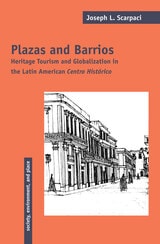
Plazas and Barrios
Heritage Tourism and Globalization in the Latin American Centro HistóricoJoseph L. Scarpaci
University of Arizona Press, 2004
In recent years the travel industry has promoted trips to cultural landscapes that contain great historical and symbolic landmarks, and Latin American towns and cities are anything but isolated from this trend. Many historic city centers in Latin America have been preserved intact from the colonial era and today may serve institutional, commercial, or residential needs. Now economic forces from outside the region have created a demand for the preservation of historically "authentic" districts.
This book explores how heritage tourism and globalization are reshaping the Latin American centro histórico, analyzing the transformation of the urban core from town plaza to historic center in nine cities: Bogotá, Colombia; Buenos Aires, Argentina; Cartagena, Colombia; Cuenca, Ecuador; Havana, Cuba; Montevideo, Uruguay; Puebla, Mexico; Quito, Ecuador; and Trinidad, Cuba. It tells how these pressures, combined with the advantage of a downtown location, have raised the potential of redeveloping these inner city areas but have also created the dilemma of how to restore and conserve them while responding to new economic imperatives.
In an eclectic and interdisciplinary study, Joseph Scarpaci documents changes in far-flung corners of the Latin American metropolis using a broad palette of tools: urban morphology profiles, an original land-use survey of 30,000 doorways in nine historic districts, numerous photographs, and a review of the political, economic, and globalizing forces at work in historic districts. He examines urban change as reflected in architectural styles, neighborhood growth and decline, real estate markets, and local politics in order to show the long reach of globalization and modernity.
Plazas and Barrios spans all of Spanish-speaking America to address the socio-political dimensions of urban change. It offers a means for understanding the tensions between the modern and traditional aspects of the built environment in each city and provides a key resource for geographers, urban planners, architectural historians, and all concerned with the implications of the emerging global economy.
[more]
Preservation Education
Sharing Best Practices and Finding Common GroundEdited by Barry L. Stiefel and Jeremy C. Wells
University Press of New England, 2014
Over the past twenty years, there has been a fundamental shift in the institutional organization of historic preservation education. Historic preservation is the most recent arrival in the collection of built environment disciplines and therefore lacks the pedagogical depth and breadth found in allied endeavors such as architecture and planning. As the first degree programs in preservation only date to the 1970s and the first doctoral programs to the 1990s, new faculty are confronted with pedagogical challenges that are unique to this relatively nascent field. Based on a conference that included educators from around the world, Barry L. Stiefel and Jeremy C. Wells now present a collection that seeks to address fundamental issues of preservation pedagogy, outcome-based education and assessment, and global issues of authenticity and significance in historic preservation. The editors argue that the subject of the analysis has shifted from, “What is the best way to fix a historic building?” to, “What are the best ways for teaching people how to preserve historic properties (and why) according to the various standards that have been established?” This important reconsideration of the state of the field in historic preservation education will appeal to a broad audience across numerous disciplines.
[more]
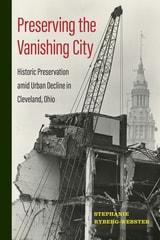
Preserving the Vanishing City
Historic Preservation amid Urban Decline in Cleveland, OhioStephanie Ryberg-Webster
Temple University Press, 2023
Preserving the Vanishing City considers the unique challenges, conditions, and opportunities facing Cleveland’s historic preservation community during the 1970s and 1980s. While pro-preservationists argued for the economic and revitalization benefits stemming from saving and repurposing older buildings, population loss and economic contraction prompted decades of deterioration, underinvestment, vacancy, and abandonment.
Stephanie Ryberg-Webster uncovers the motivations, strategies, and constraints driving Cleveland’s historic preservation sector, led by the public-sector Cleveland Landmarks Commission, nonprofit Cleveland Restoration Society, and a cadre of advocates. She sheds light on the ways in which preservationists confronted severe, escalating, and sustained urban decline, which plagued Cleveland, a prototypical rust-belt industrial city.
Preserving the Vanishing City chronicles the rise of the historic preservation profession in Cleveland and provides six case studies about targeted projects and neighborhood efforts, including industrial heritage, housing preservation and restoration, commercial district revitalization, securing local historic district designations, as well as grassroots organizing, coalition building, and partnerships. Ryberg-Webster also addresses the complexities of historic preservation within the context of rapid racial change in Cleveland’s neighborhoods.
A comprehensive history of preservation within the context of one city’s urban decline, Preserving the Vanishing Cityrecounts the successes, failures, and creative strategies employed to save Cleveland’s built environment.
[more]
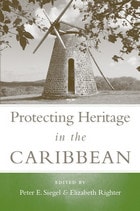
Protecting Heritage in the Caribbean
Peter E. Siegel
University of Alabama Press, 2011
Heritage preservation is a broad term that can include the protection of a wide range of human-mediated material and cultural processes ranging from specific artifacts, ancient rock art, and features of the built environment and modified landscapes. As a region of multiple independent nations and colonial territories, the Caribbean shares a common heritage at some levels, yet at the same time there are vast historical and cultural differences. Likewise, approaches to Caribbean heritage preservation are similarly diverse in range and scope.
This volume addresses the problem of how Caribbean nations deal with the challenges of protecting their cultural heritages or patrimonies within the context of pressing economic development concerns. Is there formal legislation that requires cultural patrimony to be considered prior to the approval of development projects? Does legislation apply only to government-funded projects or to private ones as well? Are there levels of legislation: local, regional, national? Are heritage preservation laws enforced? For whom is the heritage protected and what public outreach is implemented to disseminate the information acquired and retained?
In this volume, practitioners of heritage management on the frontline of their own islands address the current state of affairs across the Caribbean to present a comprehensive overview of Caribbean heritage preservation challenges. Considerable variability is seen in how determined and serious different nations are in approaching the responsibilities of heritage preservation. Packaging these diverse scenarios into a single volume is a critical step in raising awareness of the importance of protecting and judiciously managing an ever-diminishing fund of Caribbean heritage for all.
Contributors
Todd M. Ahlman / Benoît Bérard / Milton Eric Branford / Richard T. Callaghan / Kevin Farmer / R. Grant Gilmore III / Jay B. Haviser / Ainsley C. Henriques / William F. Keegan / Bruce J. Larson / Paul E. Lewis / Vel Lewis / Reg Murphy / Michael P. Pateman / Winston F. Phulgence / Esteban Prieto Vicioso / Basil A. Reid / Andrea Richards / Elizabeth Righter / Kelley Scudder-Temple / Peter E. Siegel / Christian Stouvenot / Daniel Torres Etayo
[more]