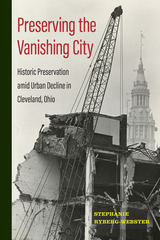
Preserving the Vanishing City: Historic Preservation amid Urban Decline in Cleveland, Ohio
Temple University Press, 2023
Cloth: 978-1-4399-2385-6 | Paper: 978-1-4399-2386-3 | eISBN: 978-1-4399-2387-0
Library of Congress Classification F499.C68A256 2023
Dewey Decimal Classification 363.690977132
Cloth: 978-1-4399-2385-6 | Paper: 978-1-4399-2386-3 | eISBN: 978-1-4399-2387-0
Library of Congress Classification F499.C68A256 2023
Dewey Decimal Classification 363.690977132
ABOUT THIS BOOK | AUTHOR BIOGRAPHY | REVIEWS | TOC | REQUEST ACCESSIBLE FILE
ABOUT THIS BOOK
Preserving the Vanishing City considers the unique challenges, conditions, and opportunities facing Cleveland’s historic preservation community during the 1970s and 1980s. While pro-preservationists argued for the economic and revitalization benefits stemming from saving and repurposing older buildings, population loss and economic contraction prompted decades of deterioration, underinvestment, vacancy, and abandonment.
Stephanie Ryberg-Webster uncovers the motivations, strategies, and constraints driving Cleveland’s historic preservation sector, led by the public-sector Cleveland Landmarks Commission, nonprofit Cleveland Restoration Society, and a cadre of advocates. She sheds light on the ways in which preservationists confronted severe, escalating, and sustained urban decline, which plagued Cleveland, a prototypical rust-belt industrial city.
Preserving the Vanishing City chronicles the rise of the historic preservation profession in Cleveland and provides six case studies about targeted projects and neighborhood efforts, including industrial heritage, housing preservation and restoration, commercial district revitalization, securing local historic district designations, as well as grassroots organizing, coalition building, and partnerships. Ryberg-Webster also addresses the complexities of historic preservation within the context of rapid racial change in Cleveland’s neighborhoods.
A comprehensive history of preservation within the context of one city’s urban decline, Preserving the Vanishing Cityrecounts the successes, failures, and creative strategies employed to save Cleveland’s built environment.
See other books on: Buildings, structures, etc | Cleveland | Historic Preservation | Ohio | Urban renewal
See other titles from Temple University Press