Results by title
131 books match the query 'History, Local' and 8 start with p
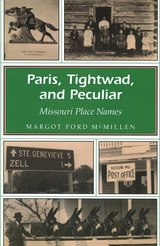
Paris, Tightwad, and Peculiar
Missouri Place NamesMargot Ford McMillen
University of Missouri Press, 1994
Paris, Tightwad, Peculiar, Neosho, Gasconade, Hannibal, Diamond, Quarantine, Zif, and Zig. These are just a few of the names Margot Ford McMillen covers in her lively book on the history of place names in Missouri. The origins behind the names range from humorous to descriptive:
•Tightwad, Missouri, is said to have been named after a store owner who cheated a mailman out of his rightful watermelon to make an extra fifty cents. •Plad, Missouri, was supposed to be named "Glad," but the post office printed the name wrong, and it was too much trouble to get it changed. •Some place names describe a location, such as Big Spring or Flat River. •Other names show the influence of immigrants to the state, like Hermann, which is a German name, or the Maries River, which was derived from the French. •Many places are named for people or wildlife found nearby, while others are backed up by legend or simply picked out of thin air.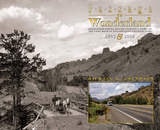
Passage to Wonderland
Rephotographing Joseph Stimson's Views of the Cody Road to Yellowstone National Park, 1903 and 2008Michael A. Amundson
University Press of Colorado, 2012
Amundson examines the physical changes along "the most scenic fifty miles in America" and explores the cultural and natural history behind them. This careful analysis of the paired images make Passage to Wonderland more than a "then and now" photography book--it is a unique exploration of the interconnectedness between the Old West and the New West. It will be a wonderful companion for those touring the Cody Road as well as those armchair tourists who can follow the road on Google Earth using the provided GPS coordinates.
The University Press of Colorado gratefully acknowledges the generous support of the Charles Redd Center for Western Studies at Brigham Young University toward the publication of this book.
Pembroke
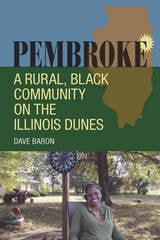
A Rural, Black Community on the Illinois DunesDave Baron
Southern Illinois University Press, 2016
With a population of about two thousand, Pembroke Township, one of the largest rural, black communities north of the Mason-Dixon Line, sits in an isolated corner of Kankakee County, Illinois, sixty-five miles south of Chicago. It is also one of the poorest places in the nation. Many black farmers from the South came to this area during the Great Migration; finding Chicago to be overcrowded and inhospitable, they were able to buy land in the township at low prices. The poor soil made it nearly impossible to establish profitable farms, however, and economic prosperity has eluded the region ever since. Pembroke: A Rural, Black Community on the Illinois Dunes chronicles the history of this inimitable township and shows the author’s personal transformation through his experiences with Pembroke and its people. A native of nearby Kankakee, author Dave Baron first traveled to Pembroke on a church service trip at age fifteen and saw real poverty firsthand, but he also discovered a community possessing grace and purpose.
Baron begins each chapter with a personal narrative from his initial trip to Pembroke. He covers the early history of the area, explaining how the unique black oak savanna ecosystem was created and describing early residents, including Potawatomi tribes and white fur traders. He introduces readers to Pap and Mary Tetter, Pembroke’s first black residents, who—according to local lore—assisted fugitives on the Underground Railroad; details the town’s wild years, when taverns offered liquor, drugs, and prostitution; discusses the many churches of Pembroke and the nearby high school where, in spite of sometimes strained relations, Pembroke’s black students have learned alongside white students of a neighboring community since well before Brown v. Board of Education; outlines efforts by conservation groups to preserve Pembroke’s rare black oak savannas; and analyzes obstacles to and failed attempts at economic development in Pembroke, as well as recent efforts, including organic farms and a sustainable living movement, which may yet bring some prosperity.
Based on research, interviews with residents, and the author’s own experiences during many return trips to Pembroke, this book—part social, cultural, legal, environmental, and political history and part memoir—profiles a number of the colorful, longtime residents and considers what has enabled Pembroke to survive despite a lack of economic opportunities. Although Pembroke has a reputation for violence and vice, Baron reveals a township with a rich and varied history and a vibrant culture.
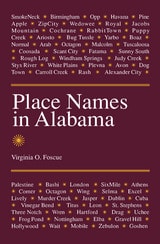
Place Names in Alabama
Virginia O. Foscue
University of Alabama Press, 1988
Discover the stories, people, and histories behind the names on Alabama's map.
Place Names in Alabama is the first comprehensive and systematic study of the names that define Alabama's geographic landscape. In this indispensable reference work, Virginia O. Foscue examines more than 2,600 place names drawn from across the state, including counties, cities, towns, rivers, lakes, streams, mountains, and other significant geographic features. Each entry provides detailed information on location, historical development, etymology, naming history, and documented sources, creating a rich portrait of the people, cultures, and events that have shaped Alabama over time.
Drawing upon archival records, historical documents, maps, and interviews with local informants, Foscue uncovers the stories behind the names that appear on Alabama's maps. The volume reveals the influence of Native American languages, European settlement, transportation networks, natural features, political leaders, local families, and regional traditions on the state's evolving identity. By tracing how communities and landmarks acquired their names, the book illuminates broader patterns of migration, settlement, economic development, and cultural exchange throughout Alabama's history.
More than a dictionary of place names, this work offers a unique window into Alabama's social and cultural heritage. Readers discover not only the origins of familiar names but also the histories of the individuals and communities that helped build the state. Whether used as a scholarly resource, a genealogical tool, or a source of fascinating historical insights, Place Names in Alabama remains an essential guide to understanding the connections between geography, language, and history in the American South.
Valuable for historians, genealogists, geographers, librarians, educators, students, journalists, and local history enthusiasts, this landmark volume continues to serve as the definitive reference on Alabama's geographic names and the stories they preserve.
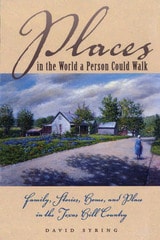
Places in the World a Person Could Walk
Family, Stories, Home, and Place in the Texas Hill CountryBy David Syring
University of Texas Press, 2000
Spring-fed creeks. Old stone houses. Cedar brakes and bleached limestone. The Hill Country holds powerful sway over the imagination of Texans. So many of us dream of having our own little place in the limestone hills. The Hill Country feels just like home, even if you've never lived there.
This beautifully written book explores what the Hill Country has meant as a homeplace to the author, his family, and longtime residents of the area, as well as to newcomers. David Syring listens to the stories that his aunts, uncles, and cousins tell about life in the Hill Country and grapples with their meaning for his own search for a place to belong. He also collects short stories focused around Honey Creek Church to consider how places become containers for memory. And he draws upon several years of living in Fredericksburg to talk about the problems and opportunities created by heritage tourism and the development of the town as a "home" for German Americans. These interconnected stories illuminate what it means to belong to a place and why the Texas Hill Country has become the spiritual, if not actual, home of many people.

Playa Works
The Myth of the EmptyWilliam L. Fox
University of Nevada Press, 2024
In eight brilliant essays, Fox explores many of the major playas of the American West , examining locations as diverse as Nellis Air Force Base and Frenchman Flat, where the federal government has tested experimental aircraft and atomic weaponry; the Great Salt Lake Desert, where land-speed records have been broken; and the Black Rock Desert of Northern Nevada, site of the colorful Burning Man arts festival. He analyzes the geological and climatological conditions that created the playas and the historical role that playas played in the exploration and settlement of the West. And he offers lucid and keenly perceptive discussions of the ways that artists have responded to the playas, from the ancient makers of geoglyphs to the work of contemporary artists who have found inspiration in these enigmatic spaces, including earthworks builder Michael Heizer, photographer Richard Misrach, and painter Michael Moore. The ensemble is a compelling combination of natural history, philosophy, and art criticism, a thoughtful meditation on humankind's aversion to and fascination with the void.
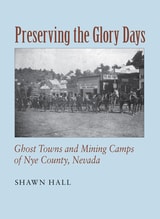
Preserving The Glory Days
Ghost Towns And Mining Camps Of Nye County, NevadaShawn Hall
University of Nevada Press, 1999
Nye County is Nevada’s largest and least populated county, but it is also the site of many of the state’s most colorful ghost towns and mining camps. The county’s economy throughout its history has been largely based on its mines--first, exploiting veins of gold and silver, and more recently deposits of raw materials for modern industry, such as molybdenum and barite. It was here that famous boomtowns like Tonopah and Rhyolite sprang up after the discovery of nearby lodes brought in rushes of prospectors and the merchants who supported them. But the county includes many smaller, shorter-lived camps and numerous abandoned stagecoach and railroad stops associated with defunct mining operations.This book offers a lively, informative record of Nevada’s isolated interior. Hall first published a guide to Nye County’s ghost towns in 1981. Since then, he has continued his research into the county’s past and has uncovered much new information and corrected some errors. To prepare this revised and greatly expanded edition, he revisited all 175 sites recorded earlier and has added more than 20 previously unlisted sites.
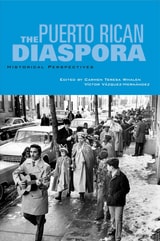
Puerto Rican Diaspora
Historical PerspectivesCarmen Teresa Whalen
Temple University Press, 2005