Results by title
86 books match the query 'Home' and 4 start with p
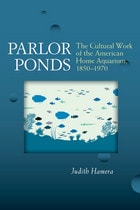
Parlor Ponds
The Cultural Work of the American Home Aquarium, 1850 - 1970Judith Hamera
University of Michigan Press, 2012
Parlor Ponds: The Cultural Work of the American Home Aquarium, 1850–1970 examines the myriad cultural meanings of the American home aquarium during the nineteenth and twentieth centuries and argues that the home aquarium provided its enthusiasts with a potent tool for managing the challenges of historical change, from urbanization to globalization. The tank could be a window to an alien world, a theater for domestic melodrama, or a vehicle in a fantastical undersea journey. Its residents were seen as inscrutable and wholly disposable “its,” as deeply loved and charismatic individuals, and as alter egos by aquarists themselves.
Parlor Ponds fills a gap in the growing field of animal studies by showing that the tank is an emblematic product of modernity, one using elements of exploration, technology, science, and a commitment to rigorous observation to contain anxieties spawned by industrialization, urbanization, changing gender roles, and imperial entanglements. Judith Hamera engages advertisements, images, memoirs, public aquarium programs, and enthusiast publications to show how the history of the aquarium illuminates complex cultural attitudes toward nature and domestication, science and religion, gender and alterity, and national conquest and environmental stewardship with an emphasis on the ways it illuminates American public discourse on colonial and postcolonial expansion.
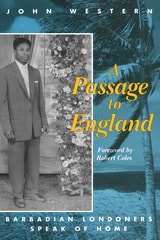
Passage To England
Barbadian Londoners Speak of HomeJohn Western
University of Minnesota Press, 1992
Since World War II London has become a significantly multiracial city. Some of the earliest agents of its transformation were young men and women recruited in the late 1950s from Barbados, then a British colony, to work in the metropolis’s nationalized public transportation system and in its hospitals. These Barbadians met, married, settled in London, and raised Londoner children. In 1987-88 John Western conducted a series of interviews with twelve such families--both parents and children. Their vivid words fill A Passage to England with insight, human, and, often, poignancy. Here is a rich perspective on thirty years or more of London social history.
Western structured the interviews to allow the Barbadians a lot of freedom to discuss whatever came to mind concerning either their own life histories and achievements, or wider themes of culture, politics, and society. Topics covered range from matters of “race” to Margaret Thatcher and the change her decade in power has wrought in Britain. One development, for example, is the strikingly entrepreneurial spirit now embraced by some of the young British blacks, veritably “Mrs. Thatcher’s Children.” Ultimately, many of the interviewees focused on the changes they see in their ancestral island in the Caribbean, to which all of them have returned for visits. For this migrant generation especially, as the prospect of retirement begins to grow increasingly important, inevitable questions regard the definitions of “home” and “belonging” must be confronted: Does one stay in London--with one’s children and grandchildren--or does one return to Barbados, which for many seems no longer the same island as the one they left a working lifetime ago? Within the context of an ever-increasing complement of geographically mobile people worldwide, Western’s study provides unique insights into the particular ambiguities a particular set of person have wrestled with at a particular moment in history...but the import of the Barbadian Londoners’ story is universal.
Peruvian Lives across Borders
Power, Exclusion, and HomeM. Cristina Alcalde
University of Illinois Press, 2018
Alcalde draws on interviews, surveys, participant observation, and textual analysis to argue that to belong is to exclude. To that end, transnational Peruvians engage in both subtle and direct policing along the borders of belonging. These acts allow them to claim and maintain the social status they enjoyed in their homeland even as they profess their openness and tolerance. Alcalde details these processes and their origins in Peru's gender, racial, and class hierarchies. As she shows, the idea of return—whether desired or rejected, imagined or physical—spurs constructions of Peruvianness, belonging, and home.
Deeply researched and theoretically daring, Peruvian Lives across Borders answers fascinating questions about an understudied group of migrants.
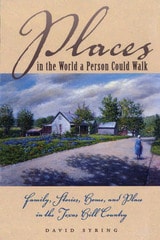
Places in the World a Person Could Walk
Family, Stories, Home, and Place in the Texas Hill CountryBy David Syring
University of Texas Press, 2000
Spring-fed creeks. Old stone houses. Cedar brakes and bleached limestone. The Hill Country holds powerful sway over the imagination of Texans. So many of us dream of having our own little place in the limestone hills. The Hill Country feels just like home, even if you've never lived there.
This beautifully written book explores what the Hill Country has meant as a homeplace to the author, his family, and longtime residents of the area, as well as to newcomers. David Syring listens to the stories that his aunts, uncles, and cousins tell about life in the Hill Country and grapples with their meaning for his own search for a place to belong. He also collects short stories focused around Honey Creek Church to consider how places become containers for memory. And he draws upon several years of living in Fredericksburg to talk about the problems and opportunities created by heritage tourism and the development of the town as a "home" for German Americans. These interconnected stories illuminate what it means to belong to a place and why the Texas Hill Country has become the spiritual, if not actual, home of many people.