Results by title
125 books match the query 'Human-animal relationships' and 6 start with p
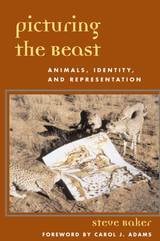
Picturing the Beast
Animals, Identity, and RepresentationSteve Baker
University of Illinois Press, 1993
From Mickey Mouse to the teddy bear, from the Republican elephant to the use of "jackass" as an all-purpose insult, images of animals play a central role in politics, entertainment, and social interactions. In this penetrating look at how Western culture pictures the beast, Steve Baker examines how such images--sometimes affectionate, sometimes derogatory, always distorting--affect how real animals are perceived and treated.
Baker provides an animated discussion of how animals enter into the iconography of power through wartime depictions of the enemy, political cartoons, and sports symbolism. He examines a phenomenon he calls the "disnification" of animals, meaning a reduction of the animal to the trivial and stupid, and shows how books featuring talking animals underscore human superiority. He also discusses how his findings might inform the strategies of animal rights advocates seeking to call public attention to animal suffering and abuse. Until animals are extricated from the baggage of imposed images, Baker maintains, neither they nor their predicaments can be clearly seen.
For this edition, Baker provides a new introduction, specifically addressing an American audience, that touches on such topics as the Cow Parade, animal imagery in the presidential race, and animatronic animals in recent films.
[more]
Plantation Worlds
Maan Barua
Duke University Press, 2024
In Plantation Worlds, Maan Barua interrogates debates on planetary transformations through the histories and ecologies of plantations. Drawing on long-term research spanning fifteen years, Barua presents a unique ethnography attentive to the lives of both people and elephants amid tea plantations in the Indian state of Assam. In the nineteenth and early twentieth centuries, nearly three million people were brought in to Assam’s plantations to work under conditions of indenture. Plantations dramatically altered the region’s landscape, plundered resources, and created fraught worlds for elephants and people. Their extractive logics and colonial legacies prevail as durations, forging the ambit of infrastructures, labor, habitability, and conservation in the present. And yet, as the perspectives of the Adivasi plantation worker community and lifeworlds of elephants show, possibilities for enacting a decolonial imaginary of landscape remain present amid immiseration. From the margins of the Global South, Barua offers an alternative grammar for articulating environmental change. In so doing, he prompts a rethinking of multispecies ecologies and how they are structured by colonialism and race.
[more]
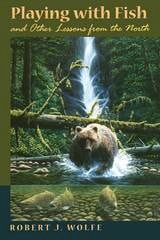
Playing with Fish and Other Lessons from the North
Robert J. Wolfe
University of Arizona Press, 2006
According to the Yup’ik Eskimo of Alaska, fish are not to be played with. It’s an adage instilled in children that’s as basic as looking both ways before crossing the street, but at its heart lies a concern for nature. Yup’ik traditions are tested each generation by this people’s struggle for survival, the admonition not to play with fish has been further tested by the arrival of sport fishing from the south. Worlds are colliding—whose will emerge unscathed? Robert J. Wolfe, a cultural anthropologist from California, spent twenty years in Alaska documenting the traditional hunting and fishing practices of Alaska Natives. During that northern sojourn he discovered much about sustainable relationships between people and nature and about the basis of meaningful communities. In Playing with Fish he has crafted a series of thought-provoking essays on nature, culture, and the human condition that convey unsuspected lessons from the North. In contrasting California and Alaska—worlds far apart yet connected by peoples, cultural traditions, and ecology—Wolfe not only draws distinctions between compass points, he also conveys memorable stories about nature and life. He depicts bears and humans as both neighbors and ancient adversaries, and how cultural views about bears can destroy or preserve those relationships. He shows us Alaskan villages where security is found not in locks but in neighbors, unlike electronically sealed suburban California homes, their lawns studded with security signs. And he describes the peaceful resolution of conflict between California bird hunters and Eskimos of the Bering Sea coast over declining geese numbers, where small humanizing acts tipped the balance in favor of cooperation. Blending insights into subjects as diverse as music and chaos theory, Wolfe challenges readers to reflect on their own personal conduct within nature and within our multicultural world. Playing with Fish is a delightful and insightful collection of modern parables that offer a new way of looking at cultural and ecological issues, reminding us that the road between two worlds is always a two-way street.
[more]
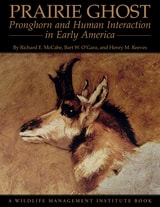
Prairie Ghost
Pronghorn and Human Interaction in Early AmericaRichard E. McCabe
University Press of Colorado, 2010
A Wildlife Management Institute Book
In this lavishly illustrated volume Richard E. McCabe, Bart W. O'Gara and Henry M. Reeves explore the fascinating relationship of pronghorn with people in early America, from prehistoric evidence through the Battle of Little Bighorn in 1876. The only one of fourteen pronghorn-like genera to survive the great extinction brought on by human migration into North America, the pronghorn has a long and unique history of interaction with humans on the continent, a history that until now has largely remained unwritten.With nearly 150 black-and-white photographs, 16 pages of color illustrations, plus original artwork by Daniel P. Metz, Prairie Ghost: Pronghorn and Human Interaction in Early America tells the intriguing story of humans and these elusive big game mammals in an informative and entertaining fashion that will appeal to historians, biologists, sportsmen and the general reader alike.
Winner of the Wildlife Society's Outstanding Book Award for 2005
[more]
Precarious Partners
Horses and Their Humans in Nineteenth-Century FranceKari Weil
University of Chicago Press, 2020
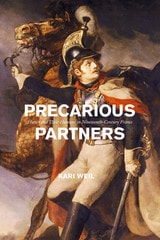
From the recent spate of equine deaths on racetracks to protests demanding the removal of mounted Confederate soldier statues to the success and appeal of War Horse, there is no question that horses still play a role in our lives—though fewer and fewer of us actually interact with them. In Precarious Partners, Kari Weil takes readers back to a time in France when horses were an inescapable part of daily life. This was a time when horse ownership became an attainable dream not just for soldiers but also for middle-class children; when natural historians argued about animal intelligence; when the prevalence of horse beatings led to the first animal protection laws; and when the combined magnificence and abuse of these animals inspired artists, writers, and riders alike.
Weil traces the evolving partnerships established between French citizens and their horses through this era. She considers the newly designed “races” of workhorses who carried men from the battlefield to the hippodrome, lugged heavy loads through the boulevards, or paraded women riders, amazones, in the parks or circus halls—as well as those unfortunate horses who found their fate on a dinner plate. Moving between literature, painting, natural philosophy, popular cartoons, sports manuals, and tracts of public hygiene, Precarious Partners traces the changing social, political, and emotional relations with these charismatic creatures who straddled conceptions of pet and livestock in nineteenth-century France.
Weil traces the evolving partnerships established between French citizens and their horses through this era. She considers the newly designed “races” of workhorses who carried men from the battlefield to the hippodrome, lugged heavy loads through the boulevards, or paraded women riders, amazones, in the parks or circus halls—as well as those unfortunate horses who found their fate on a dinner plate. Moving between literature, painting, natural philosophy, popular cartoons, sports manuals, and tracts of public hygiene, Precarious Partners traces the changing social, political, and emotional relations with these charismatic creatures who straddled conceptions of pet and livestock in nineteenth-century France.
[more]
Prosthetic Memories
Postcolonial Feminisms in a More-Than-Human WorldHyaesin Yoon
Duke University Press, 2025
In Prosthetic Memories, Hyaesin Yoon examines the entanglements of humans, animals, and technologies across South Korea and the United States at the turn of the twenty-first century. Interrogating a variety of body-technology interfaces, Yoon outlines an emergent mode of prosthetic memory in which human memory is extended into both machines and animals. Prosthetic memory overflows and provides an alternative to familiar human perception, Western scientific reason, and other senses of knowledge in ways that can foster networks of solidarity, care, and empathy between human and nonhuman subjects. Among other sites and subjects, Yoon examines tongue surgery to correct English pronunciation in Korea, Asian American poetry that engages the human-machine divide, transnational dog cloning, and stem cell research, each of which activates potent postcolonial feminist mnemonics and alliances. In so doing, Yoon narrates the countermemories of racialized, gendered, diasporic, queer, and marginalized human and nonhuman others that work against the violent and isolating biopolitical and neoliberal forces in contemporary society.
[more]