Results by title
468 books match the query 'Identity' and 37 start with p
PERFORMING THE VICTORIAN
JOHN RUSKIN AND IDENTITY IN THEATER, SCIENCE, AND EDUCATIONSHARON ARONOFSKY WELTMAN
The Ohio State University Press, 2007
Palestinian Music
Modernity, Culture, and Identity from the Arab Revolt to Black SeptemberIssa Boulos
University of Texas Press, 2027
An exploration of how Palestinian music—from village songs to urban broadcasts—adapted to political upheaval, colonial pressure, and diaspora life, serving as both a cultural anchor and a vehicle for regional identity during the mid-twentieth century.
Palestinian music has long been embedded in everyday life, shaping and reflecting social, cultural, and political identities. It has served as a means of storytelling and news-sharing, a part of ritual and community life, and a connection to the broader musical traditions of the Near East. As displacement scattered Palestinians across Lebanon, Syria, Jordan, and beyond, musicians carried folk and urban musical traditions into new political and cultural contexts, blending them with various modernities and transforming the process of music-making. In the decades that followed, music and dance were increasingly folklorized and mobilized as symbols of Palestinian identity.
Palestinian Music traces these transformations from the British Mandate through the rise of the Palestine Liberation Organization in the 1970s. Drawing on rare recordings, oral histories, archival materials, and original musical transcriptions, ethnomusicologist Issa Boulos examines two dozen artists across five countries and follows the composers, producers, and performers whose innovations helped shape the musical scene of the entire region. Palestinian music emerges as a dynamic medium through which Palestinians continually negotiated identity, solidarity, and hope—balancing preservation and innovation, rootedness and displacement.
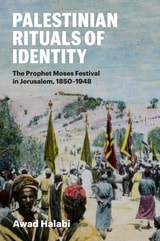
Palestinian Rituals of Identity
The Prophet Moses Festival in Jerusalem, 1850-1948Awad Halabi
University of Texas Press, 2023
Members of Palestine’s Muslim community have long honored al-Nabi Musa, or the Prophet Moses. Since the thirteenth century, they have celebrated at a shrine near Jericho believed to be the location of Moses’s tomb; in the mid-nineteenth century, they organized a civic festival in Jerusalem to honor this prophet. Considered one of the most important occasions for Muslim pilgrims in Palestine, the Prophet Moses festival yearly attracted thousands of people who assembled to pray, conduct mystical forms of worship, and hold folk celebrations.
Palestinian Rituals of Identity takes an innovative approach to the study of Palestine’s modern history by focusing on the Prophet Moses festival from the late Ottoman period through the era of British rule. Halabi explores how the festival served as an arena of competing discourses, with various social groups attempting to control its symbols. Tackling questions about modernity, colonialism, gender relations, and identity, Halabi recounts how peasants, Bedouins, rural women, and Sufis sought to influence the festival even as Ottoman authorities, British colonists, Muslim clerics, and Palestinian national leaders did the same. Drawing on extensive research in Arabic newspapers and Islamic and colonial archives, Halabi reveals how the festival has encapsulated Palestinians’ responses to modernity, colonialism, and the nation’s growing national identity.
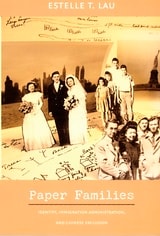
Paper Families
Identity, Immigration Administration, and Chinese ExclusionEstelle T. Lau
Duke University Press, 2006
Drawing on these documents as well as immigration case files, legislative materials, and transcripts of interviews and court proceedings, Lau reveals immigration as an interactive process. Chinese immigrants and their U.S. families were subject to regulation and surveillance, but they also manipulated and thwarted those regulations, forcing the U.S. government to adapt its practices and policies. Lau points out that the Exclusion Acts and the pseudo-familial structures that emerged in response have had lasting effects on Chinese American identity. She concludes with a look at exclusion’s legacy, including the Confession Program of the 1960s that coerced people into divulging the names of paper family members and efforts made by Chinese American communities to recover their lost family histories.
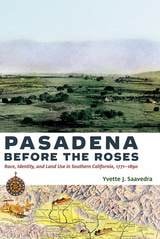
Pasadena Before the Roses
Race, Identity, and Land Use in Southern California, 1771–1890Yvette J. Saavedra
University of Arizona Press, 2018
But what existed before the roses? Before it was Pasadena, this land was Hahamog’na, the ancestral lands of the Tongva people. Later, it comprised the heart of the San Gabriel Mission lands, and in the Mexican period, it became Rancho San Pascual. The 1771 Spanish conquest of this land set in motion several colonial processes that would continue into the twentieth century and beyond.
In Pasadena Before the Roses, historian Yvette J. Saavedra examines a period of 120 years to illustrate the interconnectedness of power, ideas of land use, and the negotiation of identity within multiple colonial moments. By centering the San Gabriel Mission lands as the region’s economic, social, and cultural foundation, she shows how Indigenous, Spanish, Mexican, and American groups each have redefined the meanings of land use to build their homes and their lives. These visions have resulted in competing colonialisms that framed the racial, ethnic, gender, and class hierarchies of their respective societies.
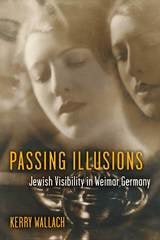
Passing Illusions
Jewish Visibility in Weimar GermanyKerry Wallach
University of Michigan Press, 2017
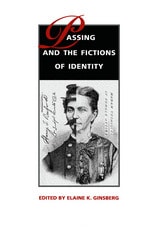
Passing and the Fictions of Identity
Elaine K. Ginsberg
Duke University Press, 1996
These essays consider a wide range of texts and moments from colonial times to the present that raise significant questions about the political motivations inherent in the origins and maintenance of identity categories and boundaries. Through discussions of such literary works as Running a Thousand Miles for Freedom, The Autobiography of an Ex–Coloured Man, Uncle Tom’s Cabin, The Hidden Hand, Black Like Me, and Giovanni’s Room, the authors examine issues of power and privilege and ways in which passing might challenge the often rigid structures of identity politics. Their interrogation of the semiotics of behavior, dress, language, and the body itself contributes significantly to an understanding of national, racial, gender, and sexual identity in American literature and culture.
Contextualizing and building on the theoretical work of such scholars as Judith Butler, Diana Fuss, Marjorie Garber, and Henry Louis Gates Jr., Passing and the Fictions of Identity will be of value to students and scholars working in the areas of race, gender, and identity theory, as well as U.S. history and literature.
Contributors. Martha Cutter, Katharine Nicholson Ings, Samira Kawash, Adrian Piper, Valerie Rohy, Marion Rust, Julia Stern, Gayle Wald, Ellen M. Weinauer, Elizabeth Young
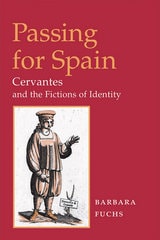
Passing for Spain
CERVANTES AND THE FICTIONS OF IDENTITYBarbara Fuchs
University of Illinois Press, 2003
In five lucid and engaging chapters, Fuchs examines what passes in Cervantes’s fiction: gender and race in Don Quijote and “Las dos doncellas”; religion in “El amante liberal” and La gran sultana; national identity in the Persiles and “La española inglesa.” She argues that Cervantes represents cross-cultural impersonation -- or characters who pass for another gender, nationality, or religion -- as challenges to the state’s attempts to assign identities and categories to proper Spanish subjects.
Fuchs demonstrates the larger implications of this challenge by bringing a wide range of literary and political texts to bear on Cervantes’s representations. Impeccably researched, Passing for Spain examines how the fluidity of individual identity in early modern Spain undermined a national identity based on exclusion and difference.
Peacocks, Chameleons, Centaurs
Gay Suburbia and the Grammar of Social IdentityWayne Brekhus
University of Chicago Press, 2003
In this first-ever ethnography of American gay suburbanites, Wayne H. Brekhus demonstrates that who one is depends at least in part on where and when one is. For many urban gay men, being homosexual is key to their identity because they live, work, and socialize in almost exclusively gay circles. Brekhus calls such men "lifestylers" or peacocks. Chameleons or "commuters," on the other hand, live and work in conventional suburban settings, but lead intense gay social and sexual lives outside the suburbs. Centaurs, meanwhile, or "integrators," mix typical suburban jobs and homes with low-key gay social and sexual activities. In other words, lifestylers see homosexuality as something you are, commuters as something you do, and integrators as part of yourself.
Ultimately, Brekhus shows that lifestyling, commuting, and integrating embody competing identity strategies that occur not only among gay men but across a broad range of social categories. What results, then, is an innovative work that will interest sociologists, psychologists, anthropologists, and students of gay culture.
Peer Power
Preadolescent Culture and IdentityAdler, Peter
Rutgers University Press, 1998
The Adlers explore some of the patterns that develop in this social space, noting both the differences in boys' and girls' gendered cultures and the overlap in many social dynamics, afterschool activities, role behaviour, romantic inclinations and social stratification. For example, children's participation in adult-organized afterschool activities - a now-prominent feature of many American children's social experience - has profound implications for their socialization and development, moving them away from the negotiated, spontaneous character of play into the formal systems of adult norms and values at ever-younger ages. When they retreat from adults, however, they still display distinctive peer group dynamics, forging strong ingroup/outgroup differentiation, loyalty and identification. Peer culture thus contains informal social mechanisms through which children create their social order, determine their place and identity, and develop positive and negative feelings about themselves. Studying children's peer culture is thus valuable as it reveals not only how this subculture parallels the adult world but also how it differs from it.
Performing Brazil
Essays on Culture, Identity, and the Performing ArtsEdited by Severino J. Albuquerque and Kathryn Bishop-Sanchez
University of Wisconsin Press, 2015
The contributors to the volume are Maria José Somerlate Barbosa, Eric A. Galm, Annie McNeill Gibson, Ana Paula Höfling, Benjamin Legg, Bryan McCann, Simone Osthoff, Fernando de Sousa Rocha, Cristina F. Rosa, Alessandra Santos, and Lidia Santos.
Performing the News
Identity, Authority, and the Myth of NeutralityElia Powers
Rutgers University Press, 2024
Performing the News: Identity, Authority, and the Myth of Neutrality explores how journalists from historically marginalized groups have long felt pressure to conform when performing for audiences. Many speak with a flat, “neutral” accent, modify their delivery to hide distinctive vocal attributes, dress conventionally to appeal to the “average” viewer, and maintain a consistent appearance to avoid unwanted attention. Their aim is what author Elia Powers refers to as performance neutrality—presentation that is deemed unobjectionable, reveals little about journalists’ social identity, and supposedly does not detract from their message. Increasingly, journalists are challenging restrictive, purportedly neutral forms of self-presentation. This book argues that performance neutrality is a myth that reinforces the status quo, limits on-air diversity, and hinders efforts to make newsrooms more inclusive. Through in-depth interviews with journalists in broadcasting and podcasting, and those who shape their performance, the author suggests ways to make journalism more inclusive and representative of diverse audiences.
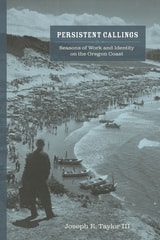
Persistent Callings
Seasons of Work and Identity on the Oregon CoastJoseph E. Taylor
Oregon State University Press, 2019
The Nestucca Valley is a small watershed, tucked away in one corner of a county in far western Oregon. There are no incorporated towns, and cows outnumber humans. It has long been a place without a written history, yet its past offers many surprising twists on received wisdom about rural economies. In crisp prose and succinct chapters, Persistent Callings carries readers from aboriginal times to the present, illustrating the wisdom of seasonal labor, the complex relationships between work and identity, and the resilience of rural economics across more than a century of almost continual change.
Life in this watershed, known to locals as “South County,” has always been demanding. Farming, fishing, and logging were difficult occupations, but work had deeper meanings. Challenges arrived in many forms, including climate shifts, market crashes, regulatory changes, and industry consolidations. Residents’ ability to innovate was their greatest resource, and their persistence helps us to recognize the callings they pursued.
During the late twentieth and early twenty-first centuries, disruptions came more quickly, and they coincided with infusions of capital that dramatically altered the structure of employment, with devastating results for the valley’s hardest working residents. Unemployment and poverty skyrocketed while health and life expectancy dropped to alarming levels. Moreover, the arrival of retirees and rise of environmental amenities actually exacerbated some ecological problems. Little in this history plays out as expected, and much of it will make readers reconsider how they think about the social, economic, and environmental contours of rural life in the American West.
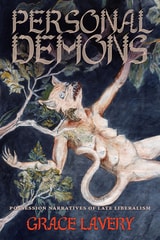
Personal Demons
Possession Narratives of Late LiberalismGrace Lavery
Duke University Press, 2026
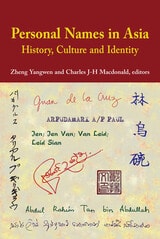
Personal Names in Asia
History, Culture and IdentityEdited by Yangwen Zheng and Chales J-H MacDonald
National University of Singapore Press, 2009
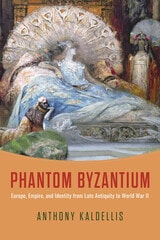
Phantom Byzantium
Europe, Empire, and Identity from Late Antiquity to World War IIAnthony Kaldellis
University of Chicago Press, 2026
Unveiling the ideological foundations of Byzantine studies, Phantom Byzantium is a pioneering survey of western European perceptions of the eastern Roman empire (also known as Byzantium) spanning late antiquity to World War II. Through ten chronological chapters, Anthony Kaldellis makes the case that western Europe gradually formed its identity by adopting prestigious cultural elements from the eastern empire but simultaneously portraying the east as inferior. The West modeled its Roman imperial style on Constantinople while minimizing the latter as Greek rather than Roman; appropriated a host of Christian traditions from the east while casting the east as schismatic, heretical, or treacherous; and, during the Renaissance, used classical Hellenic philology from Greek scholars before marginalizing them as unworthy bearers of that tradition. This orientalizing impulse worked to buttress western exceptionalism and resulted in the fictitious construction of “Byzantium” as Europe’s evil doppelgänger, embodying the worst versions of traditions fundamental to European identity and casting the region as despotic, superstitious, and degenerate.
Explaining the creation, history, and functions of the ideological construct of Byzantium in the western imagination and European self-fashioning, this book has critical implications for contemporary views of European history.
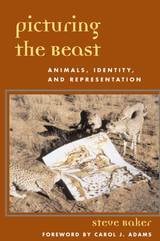
Picturing the Beast
Animals, Identity, and RepresentationSteve Baker
University of Illinois Press, 1993
Baker provides an animated discussion of how animals enter into the iconography of power through wartime depictions of the enemy, political cartoons, and sports symbolism. He examines a phenomenon he calls the "disnification" of animals, meaning a reduction of the animal to the trivial and stupid, and shows how books featuring talking animals underscore human superiority. He also discusses how his findings might inform the strategies of animal rights advocates seeking to call public attention to animal suffering and abuse. Until animals are extricated from the baggage of imposed images, Baker maintains, neither they nor their predicaments can be clearly seen.
For this edition, Baker provides a new introduction, specifically addressing an American audience, that touches on such topics as the Cow Parade, animal imagery in the presidential race, and animatronic animals in recent films.
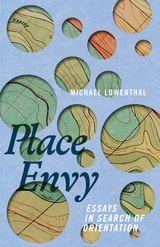
Place Envy
Essays in Search of OrientationMichael Lowenthal
The Ohio State University Press, 2026
Growing up in places where his family had no past, and met mostly by silence from his Holocaust-refugee grandparents, Michael Lowenthal longed to be from somewhere. Then he realized he was gay and felt displaced from his own displaced family. Place Envy—his first book of essays after five acclaimed books of fiction—chronicles his quest for orientation in the world: as an agnostic Jew, as a queer traveler and lover, and as a writer who can tell or twist the truth. Yearning for a queer lineage, he obsesses about an uncle who perished at Bergen-Belsen but then finds, in his grandmother’s German hometown, a more surprising legacy. He lives with a Pennsylvania Amish family; accompanies blind gay men on a Mexican cruise; plays jazz with Sun Ra, the Afrofuturist who claimed to hail from Saturn; and pursues a clarifying love affair in Brazil. Collectively, these essays recount Lowenthal’s many journeys of dislocation and relocation: to foreign countries and subcultures and to the riskiest shores of family and self.
Place, Language, and Identity in Afro-Costa Rican Literature
Dorothy E. Mosby
University of Missouri Press, 2003
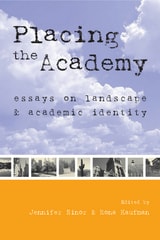
Placing the Academy
Essays on Landscape, Work, and Identityedited by Jennifer Sinor and Rona Kaufman
Utah State University Press, 2007
Twenty-one writers answer the call for literature that addresses who we are by understanding where we are--where, for each of them, being in some way part of academia. In personal essays, they imaginatively delineate and engage the diverse, occasionally unexpected play of place in shaping them, writers and teachers in varied environments, with unique experiences and distinctive world views, and reconfiguring for them conjunctions of identity and setting, here, there, everywhere, and in between.
Contents
I Introduction Writing Place, Jennifer Sinor
II Here
Six Kinds of Rain: Searching for a Place in the Academy, Kathleen Dean Moore and Erin E. Moore
The Work the Landscape Calls Us To, Michael Sowder
Valley Language, Diana Garcia
What I Learned from the Campus Plumber, Charles Bergman
M-I-Crooked Letter-Crooked Letter, Katherine Fischer
On Frogs, Poems, and Teaching at a Rural Community College, Sean W. Henne
III There
Levittown Breeds Anarchists Film at 11:00, Kathryn T. Flannery
Living in a Transformed Desert, Mitsuye Yamada
A More Fortunate Destiny, Jayne Brim Box
Imagined Vietnams, Charles Waugh
IV Everywhere
Teaching on Stolen Ground, Deborah A. Miranda
The Blind Teaching the Blind: The Academic as Naturalist, or Not, Robert Michael Pyle
Where Are You From? Lee Torda
V In Between
Going Away to Think, Scott Slovic
Fronteriza Consciousness: The Site and Language of the Academy and of Life, Norma Elia Cantu
Bones of Summer, Mary Clearman Blew
Singing, Speaking, and Seeing a World, Janice M. Gould
Making Places Work: Felt Sense, Identity, and Teaching, Jeffrey M. Buchanan
VI Coda
Running in Place: The Personal at Work, in Motion, on Campus, and in the Neighborhood, Rona Kaufman

Planet Cosplay
Costume Play, Identity and Global FandomEdited by Paul Mountfort, Anne Peirson-Smith and Adam Geczy
Intellect Books, 2019
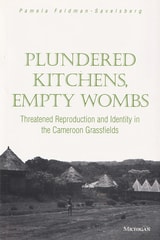
Plundered Kitchens, Empty Wombs
Threatened Reproduction and Identity in the Cameroon GrassfieldsPamela Feldman-Savelsberg
University of Michigan Press, 1999
In the Cameroon grassfields, an area of high fertility, women hold a paradoxical fear of infertility. By combining symbolic, political-economic, and historical analyses, Pamela Feldman-Savelsberg traces the way reproductive threat is invoked in struggles over gender and ethnic identities. Women's fears of reproductive disorders, she finds, are an important mode of expression for their worries about much larger issues, such as rural poverty, brought about or exacerbated by political and economic changes in this century.
A lively case study of an infertile queen who flees the palace sets the stage for discussions of the ethnographic and historical setting, the symbolism of fertility and infertility, and the development and interaction of cosmopolitan and ethno-gynecologies. The book concludes with an analysis of the links between women's role in human reproduction and the divine king's role in social reproduction, both occurring in the rapidly changing context of a multiethnic African nation.
Plundered Kitchens, Empty Wombs underscores the relevance of medical anthropology to other anthropological specializations, as well as to epidemiologists, population specialists, and development planners. It should reach a broad audience in medical anthropology, public health, and women's studies.
Pamela Feldman-Savelsberg is Assistant Professor of Anthropology, Carleton College.

Plundered Kitchens, Empty Wombs
Threatened Reproduction and Identity in the Cameroon GrassfieldsPamela Feldman-Savelsberg
University of Michigan Press, 0

Pluralising Pasts
Heritage, Identity and Place in Multicultural SocietiesBrian Graham, G. J. Ashworth, and J. E. Tunbridge
Pluto Press, 2007
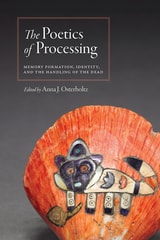
Poetics of Processing
Memory Formation, Identity, and the Handling of the DeadAnna J. Osterholtz
University Press of Colorado, 2020
The contributors interpret postmortem treatment of the physical body through a poetics lens, examining body processing as a mechanism for the re-creation of cosmological events and processing’s role in the creation of social memory. They analyze methods of processing and the ways in which the living use the physical body to stratify society and gain power, as evidenced in rituals of body preparation and burial around the world, objects buried with the dead and the hierarchies of tomb occupancy, the dissection of cadavers by medical students, the appropriation of living spaces once occupied by the dead, and the varying treatments of the remains of social outsiders, prisoners of war, and executed persons.
The Poetics of Processing combines social theory and bioarchaeology to examine how the living manipulate the bodies of the dead for social purposes. These case studies—ranging from prehistoric to historic and modern and from around the globe—explore this complex material relationship that does not cease with physical death. This volume will be of interest to mortuary archaeologists, bioarchaeologists, and cultural anthropologists.
Contributors:
Dil Singh Basanti, Roselyn Campbell, Carlina de la Cova, Eric Haanstad, Scott Haddow, Christina Hodge, Christopher Knusel, Kristin Kuckelman, Clark Spencer Larsen, Debra Martin, Kenneth Nystrom, Adrianne Offenbecker, Megan Perry, Marin Pilloud, Beth K. Scaffidi, Mehmet Somel, Kyle D. Waller
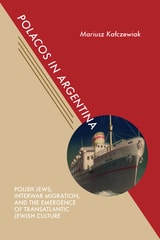
Polacos in Argentina
Polish Jews, Interwar Migration, and the Emergence of Transatlantic Jewish CultureMariusz Kalczewiak
University of Alabama Press, 2020
An examination of the social and cultural repercussions of Jewish emigration from Poland to Argentina in the 1920s and 1930s
Between the 1890s and 1930s, Argentina, following the United States and Palestine, became the main destination for Eastern European Ashkenazi Jews seeking safety, civil rights, and better economic prospects. In the period between 1918 and 1939, sixty thousand Polish Jews established new homes in Argentina. They formed a strong ethnic community that quickly embraced Argentine culture while still maintaining their unique Jewish-Polish character. This mass migration caused the transformation of cultural, social, and political milieus in both Poland and Argentina, forever shaping the cultural landscape of both lands.
In Polacos in Argentina: Polish Jews, Interwar Migration, and the Emergence of Transatlantic Jewish Culture, Mariusz Kałczewiak has constructed a multifaceted and in-depth narrative that sheds light on marginalized aspects of Jewish migration and enriches the dialogue between Latin American Jewish studies and Polish Jewish Studies. Based on archival research, Yiddish travelogues on Argentina, and the Yiddish and Spanish-language press, this study recreates a mosaic of entanglements that Jewish migration wove between Poland and Argentina.
Most studies on mass migration fail to acknowledge the role of the country of origin, but this innovative work approaches Jewish migration to Argentina as a continuous process that took place on both sides of the Atlantic. Taken as a whole, Polacos in Argentina enlightens the heterogeneous and complex issue of immigrant commitments, belongings, and expectations. Jewish emigration from Poland to Argentina serves as a case study of how ethnicity evolves among migrants and their children, and the dynamics that emerge between putting down roots in a new country and maintaining commitments to the country of origin.
Pole/Jew
History, Literature, Identity, FutureJohn J. Bukowczyk and Halina Filipowicz
Ohio University Press, 0
Pole/Jew brings together a group of scholars—about half of them Jewish, about half of them ethnic Poles—from the United States, Poland, the United Kingdom, and Canada and enlists their diverse methodological and generational perspectives to push debates over Polish-Jewish relations beyond entrenched and reductive positions. At the core of the volume are the following questions:
–What impact has the Holocaust had on Polish history and Polish literature?
–How has the Holocaust affected Polish-Jewish—and Polish—identity?
–What future is there for relations between Poland’s small Jewish minority and the country’s overwhelming ethnic Polish majority? Between Poland and Israel? Between Jews of the diaspora and ethnic Poles abroad?
–Which research areas have yet to be addressed or revisited and reexamined?
–Are there ways to move beyond the reductive notion of 1989 (i.e., the fall of the communist regime in Poland) as wall and fulcrum?
By addressing these compelling questions, this volume offers fresh perspectives and encourages a nuanced understanding of Polish-Jewish relations.
Contributors:
M. B. B. Biskupski
Robert Blobaum
John J. Bukowczyk
Patrice M. Dabrowski
Halina Filipowicz
Agnieszka Jezyk
Bozena Karwowska
Kamil Kijek
Kate Korycki
Elzbieta Kossewska
Grazyna J. Kozaczka
Stanislaw Krajewski
Adam Lipszyc
Wiktor Marzec
Alina Molisak
Stanislaw Obirek
Benjamin Paloff
Antony Polonsky
Brian Porter-Szucs
Piotr Puchalski
Roma Sendyka
Dariusz Stola
Katarzyna Zechenter
Joshua D. Zimmerman
Geneviève Zubrzycki
Slawomir Zurek
Polish Jewish Culture Beyond the Capital
Centering the PeripheryHalina Goldberg
Rutgers University Press, 2023
PIASA's 2024 Anna M. Cienciala Award for Best-Edited Multi-Authored Scholarly Volume
Polish Jewish Culture beyond the Capital: Centering the Periphery is a path-breaking exploration of the diversity and vitality of urban Jewish identity and culture in Polish lands from the second half of the nineteenth century to the outbreak of the Second World War (1899–1939). In this multidisciplinary essay collection, a cohort of international scholars provides an integrated history of the arts and humanities in Poland by illuminating the complex roles Jews in urban centers other than Warsaw played in the creation of Polish and Polish Jewish culture.
Each essay presents readers with the extraordinary production and consumption of culture by Polish Jews in literature, film, cabaret, theater, the visual arts, architecture, and music. They show how this process was defined by a reciprocal cultural exchange that flourished between cities at the periphery—from Lwów and Wilno to Kraków and Łódź—and international centers like Warsaw, thereby illuminating the place of Polish Jews within urban European cultures.
Companion website (https://polishjewishmusic.iu.edu)
Political Mourning
Identity and Responsibility in the Wake of TragedyHeather Pool
Temple University Press, 2021
What leads us to respond politically to the deaths of some citizens and not others? This is one of the critical questions Heather Pool asks in Political Mourning. Born out of her personal experiences with the trauma of 9/11, Pool’s astute book looks at how death becomes political, and how it can mobilize everyday citizens to argue for political change.
Pool examines four tragedies in American history—the Triangle Shirtwaist Factory Fire, the lynching of Emmett Till, the September 11 attacks, and the Black Lives Matter movement—that offered opportunities to tilt toward justice and democratic inclusion. Some of these opportunities were taken, some were not. However, these watershed moments show, historically, how political identity and political responsibility intersect and how racial identity shapes who is mourned. Political Mourning helps explain why Americans recognize the names of Trayvon Martin and Sandra Bland; activists took those cases public while many similar victims have been ignored by the news media.
Concluding with an afterword on the coronavirus, Pool emphasizes the importance of collective responsibility for justice and why we ought to respond to tragedy in ways that are more politically inclusive.
Popular Music Ethnographies
Practice, Place and IdentityEdited by Sarah Raine, Shane Blackman, Robert McPherson, and Iain A. Taylor
Intellect Books, 2025
This edited collection offers evocative ways into an international selection of popular music, from the Ecuadorian indie scene to Chinese rock. In exploring the experiences of musicians, fans, industry professionals, and academics, the rich complexity of popular music is brought to life through ethnography as an immersive approach to both undertaking and communicating research.
Experimenting with ethnography through the joys and tribulations of musical production, fandom, and scholarship, the contributors critically consider what it means to be a popular music ethnographer and what it means to take an ethnographic approach to studying popular music.
In addition to the critical essays, shorter vignettes are provided by musicians, venue owners, music writers, live music photographers, and fans. Altogether, the book explores the practices, places, and identities behind the music.
Postnational Self
Belonging And IdentityUlf Hedetoft
University of Minnesota Press, 2002
A timely look at how our globalized era has reconfigured experiences of belonging.
What happens to a sense of belonging when national and regional governments, religious organizations, community groups, political parties, and corporations become unstable and incoherent, as they have in these nationalist and postnationalist times? From a richly interdisciplinary perspective, the authors examine notions of citizenship and cultural hybridization, migration and other forms of mobility, displacements and ethnic cleansing, and the nature of national belonging in a world turning ever more fluid, aided by transnational flows of capital, information, people, and ideas.
Contributors: Seyla Benhabib, Yale; John A. Hall, McGill U; Ulf Hannerz, Stockholm U; Jeffrey Herf, U of Maryland; Michael Herzfeld, Harvard; Richard Jenkins, U of Sheffield, UK; Mark Juergensmeyer, U of California, Santa Barbara; Riva Kastoryano, Center for International Studies and Research (CERI), Paris; Michèle Lamont, Princeton; Benjamin Lee, Rice U; Orvar Löfgren, U of Lund, Sweden; Philip Schlesinger, U of Stirling, Scotland; Yasemin Nuhõglu Soysal, U of Essex, UK; Ray Taras, Tulane U; James Tully, U of Victoria, British Columbia.
Power and Identity in Archaeological Theory and Practice
Case Studies from Ancient MesoamericaEleanor Harrison-Buck
University of Utah Press, 2012
The contributions to this volume represent a diverse array of Mesoamerican archaeological studies that are all theo-retically rooted to larger, global debates concerning issues of power and identity—two logically paired concepts. While social identity has been the focus of more critical analysis in recent years, the concept of power has received far less attention. Most studies focus on large-scale, institutional forms of power and the ruling body. Here, the focus is on relations of power, addressing broader segments of society outside the dominant group, that often are ignored in traditional reconstructions of past societies.
Harrison-Buck has compiled works that address a common criticism of social theory in the field of anthropological archaeology—the lack of strong case studies and corroborating facts supporting the abstract and often complex social theoretical concepts presented by scholars. Each contributor offers innovative method and theory and provides alternative and varied approaches to understanding power and identity in the archaeological record. They draw from a wide range of related disciplines and theoretical frameworks, including feminism, queer theory, cognitive studies, and postcolonial theory. The provocative case studies and exciting theoretical applications presented here will stimulate lively debate among scholars working both in and outside of Mesoamerica.
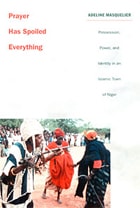
Prayer Has Spoiled Everything
Possession, Power, and Identity in an Islamic Town of NigerAdeline Masquelier
Duke University Press, 2001
To explore the role of bori possession in local definitions of history, power, and identity, Masquelier spent a total of two years in Niger, focusing on the diverse ways in which spirit mediums share, transform, and contest a rapidly changing reality, threatened by Muslim hegemony and financial hardship. She explains how the spread of Islam has provoked irreversible change in the area and how prayer—a conspicuous element of daily life that has become virtually synonymous with Islamic practice in this region of west Africa—has thus become equated with the loss of tradition. By focusing on some of the creative and complex ways that bori at once competes with and borrows from Islam, Masquelier reveals how possession nonetheless remains deeply embedded in Mawri culture, representing more than simple resistance to Islam, patriarchy, or the state. Despite a widening gap between former ways of life and the contradictions of the present, it maintains its place as a feature of daily life in which villagers participate with varying degrees of enthusiasm and approval.
Specialists in African studies, in the anthropology of religion, and in the historical transformations of colonial and postcolonial societies will welcome this study.
Prayers and the Construction of Israelite Identity
Susanne Gillmayr-Bucher
SBL Press, 2019
Substantial insights into various identity discourses reflected in the biblical prayers
This collection of essays from an international group of scholars focuses on how biblical prayers of the Persian and early Hellenistic periods shaped identity, evoked a sense of belonging to specific groups, and added emotional significance to this affiliation. Contributors draw examples from different biblical texts, including Genesis, Samuel, Kings, Chronicles, Ezra and Nehemiah, Psalms, Jonah, and Daniel.
Features
- Thorough study of prayers that play a key role for a biblical book’s (re)construction of the people’s history and identity
- An examination of ways biblical figures are remodeled by their prayers by introducing other, sometimes even contradictory, discourses on identity
- An exploration of different ways in which psalms from postexilic times shaped, reflected, and modified identity discourses
Primitivism and Identity in Latin America
Essays on Art, Literature, and CultureErik Camayd-Freixas
University of Arizona Press, 2000
Although primitivism has received renewed attention in recent years, studies linking it with Latin America have been rare. This volume examines primitivism and its implications for contemporary debates on Latin American culture, literature, and arts, showing how Latin American subjects employ a Western construct to "return the gaze" of the outside world and redefine themselves in relation to modernity.
Examining such subjects as Julio Cortázar and Frida Kahlo and such topics as folk art and cinema, the volume brings together for the first time the views of scholars who are currently engaging the task of cultural studies from the standpoint of primitivism. These varied contributions include analyses of Latin American art in relation to social issues, popular culture, and official cultural policy; essays in cultural criticism touching on ethnic identity, racial politics, women's issues, and conflictive modernity; and analytical studies of primitivism's impact on narrative theory and practice, film, theater, and poetry.
This collection contributes offers a new perspective on a variety of significant debates in Latin American cultural studies and shows that the term primitive does not apply to these cultures as much as to our understanding of them.
CONTENTSParadise Subverted: The Invention of the Mexican Character / Roger Bartra
Between Sade and the Savage: Octavio Paz’s Aztecs / Amaryll Chanady
Under the Shadow of God: Roots of Primitivism in Early Colonial Mexico / Delia Annunziata Cosentino
Of Alebrijes and Ocumichos: Some Myths about Folk Art and Mexican Identity / Eli Bartra
Primitive Borders: Cultural Identity and Ethnic Cleansing in the Dominican Republic / Fernando Valerio-Holguín
Dialectics of Archaism and Modernity: Technique and Primitivism in Angel Rama’s Transculturación narrativa en América Latina / José Eduardo González
Narrative Primitivism: Theory and Practice in Latin America / Erik Camayd-Freixas
Narrating the Other: Julio Cortázar’s "Axolotl" as Ethnographic Allegory / R. Lane Kauffmann
Jungle Fever: Primitivism in Environmentalism; Rómulo Gallegos’s Canaima and the Romance of the Jungle / Jorge Marcone
Primitivism and Cultural Production: Future’s Memory; Native Peoples’ Voices in Latin American Society / Ivete Lara Camargos Walty
Primitive Bodies in Latin American Cinema: Nicolás Echevarría’s Cabeza de Vaca / Luis Fernando Restrepo
Subliminal Body: Shamanism, Ancient Theater, and Ethnodrama / Gabriel Weisz
Primitivist Construction of Identity in the Work of Frida Kahlo / Wendy B. Faris
Mi andina y dulce Rita: Women, Indigenism, and the Avant-Garde in César Vallejo / Tace Megan Hedrick
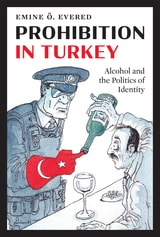
Prohibition in Turkey
Alcohol and the Politics of IdentityEmine Ö. Evered
University of Texas Press, 2024
A social history of alcohol, identity, secularism, and modernization from the late Ottoman and early Turkish republican eras to the present day.
Prohibition in Turkey investigates the history of alcohol, its consumption, and its proscription as a means to better understand events and agendas of the late Ottoman and early Turkish republican eras. Through a comprehensive examination of archival, literary, popular culture, media, and other sources, it unveils a traditionally overlooked—and even excluded—aspect of human history in a region that many do not associate with intoxicants, inebriation, addiction, and vigorous wet-dry debates.
Historian Emine Ö. Evered’s account uniquely chronicles how the Turko-Islamic Ottoman Empire developed strategies for managing its heterogeneous communities and their varied rights to produce, market, and consume alcohol, or to simply abstain. The first author to reveal this experience’s connections with American Prohibition, she demonstrates how—amid modernization, sectarianism, and imperial decline—drinking practices reflected, shifted, and even prompted many of the changes that were underway and that hastened the empire’s collapse. Ultimately, Evered’s book reveals how Turkey’s alcohol question never went away but repeatedly returns in the present, in matters of popular memory, public space, and political contestation.
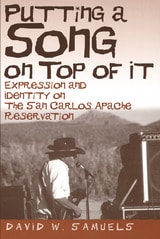
Putting a Song on Top of It
Expression and Identity on the San Carlos Apache ReservationDavid W. Samuels
University of Arizona Press, 2004
For many people on the San Carlos reservation, both the traditional calls of the Mountain Spirits and the hard edge of a country, rock, or reggae song can evoke the feeling of being Apache. Using insights gained from both linguistic and musical practices in the community—as well as from his own experience playing in an Apache country band—David W. Samuels explores the complex expressive lives of these people to offer new ways of thinking about cultural identity.
Samuels analyzes how people on the reservation make productive use of popular culture forms to create and transform contemporary expressions of Apache cultural identity. As Samuels learned, some popular songs—such as those by Bob Marley—are reminiscent of history and bring about an alignment of past and present for the Apache listener. Thinking about Geronimo, for instance, might mean one thing, but “putting a song on top of it” results in a richer meaning. Samuels also proposes that the concept of the pun, as both a cultural practice and a means of analysis, helps us understand the ways in which San Carlos Apaches are able to make cultural symbols point in multiple directions at once. Through these punning, layered expressions, people on the reservation express identities that resonate with the complicated social and political history of the Apache community.
This richly detailed study challenges essentialist notions of Native American tribal and ethnic identity by revealing the turbulent complexity of everyday life on the reservation. Samuels’s work is a multifaceted exploration of the complexities of sound, of language, and of the process of constructing and articulating identity in the twenty-first century.