412 books match the query 'Japan' and 25 start with p
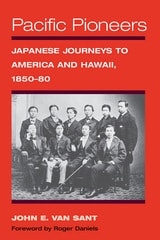
cover of Pacific Pioneers: Japanese Journeys to America and Hawaii, 1850-80

Pacific Pioneers

Japanese Journeys to America and Hawaii, 1850-80

John E. Van Sant

University of Illinois Press, 2019

Shipwrecked sailors, samurai seeking a material and sometimes spiritual education, and laborers seeking to better their economic situation: these early Japanese travelers to the West occupy a little-known corner of Asian American studies. Pacific Pioneers profiles the first Japanese who resided in the United States or the Kingdom of Hawaii for a substantial period of time and the Westerners who influenced their experiences.
 
Although Japanese immigrants did not start arriving in substantial numbers in the West until after 1880, in the previous thirty years a handful of key encounters helped shape relations between Japan and the United States. John E. Van Sant explores the motivations and accomplishments of these resourceful, sometimes visionary individuals who made important inroads into a culture quite different from their own and paved the way for the Issei and Nisei.
 
Pacific Pioneers  presents detailed biographical sketches of Japanese such as Joseph Heco, Niijima Jo, and the converts to the Brotherhood of the New Life and introduces the American benefactors, such as William Griffis, David Murray, and Thomas Lake Harris, who built relationships with their foreign visitors. Van Sant also examines the uneasy relations between Japanese laborers and sugar cane plantation magnates in Hawaii during this period and the shortlived Wakamatsu colony of Japanese tea and silk producers in California.
 
A valuable addition to the literature, Pacific Pioneers  brings to life a cast of colorful, long-forgotten characters while forging a critical link between Asian and Asian American studies.

 
[more]
cover of Paleoethnobotany of the Kameda Peninsula Jomon

Paleoethnobotany of the Kameda Peninsula Jomon

Gary W. Crawford

University of Michigan Press, 1983

In this volume, author Gary W. Crawford presents archaeological data he gathered on plant utilization by Jomon populations in southwestern Hokkaido. Using this data, he examines the adaptations of the Initial through Middle Jomon (a period from 8000 BP to 4000 BP). He also considers the success of the Jomon adaptation in northeastern Japan in general.
[more]
cover of Patriots and Redeemers in Japan: Motives in the Meiji Restoration

Patriots and Redeemers in Japan

Motives in the Meiji Restoration

George M. Wilson

University of Chicago Press, 1991

In this concise but ambitious historiographical essay, Wilson argues for an approach to the Meiji Restoration that emphasizes multiple lines of motive and action.

"By bringing some very interesting critical theory to his reading, Wilson has produced a book that will shift the terms of discussion on this event."—Harry D. Harootunian

[more]
cover of Peasant Uprisings in Japan: A Critical Anthology of Peasant Histories

Peasant Uprisings in Japan

A Critical Anthology of Peasant Histories

Edited by Anne Walthall

University of Chicago Press, 1991
Combining translations of five peasant narratives with critical commentary on their provenance and implications for historical study, this book illuminates the life of the peasantry in Tokugawa Japan.
[more]
cover of Pedagogy of Democracy: Feminism and the Cold War in the U.S. Occupation of Japan

Pedagogy of Democracy

Feminism and the Cold War in the U.S. Occupation of Japan

Mire Koikari

Temple University Press, 2009

Pedagogy of Democracy re-interprets the U.S. occupation of Japan from 1945 to 1952 as a problematic instance of Cold War feminist mobilization rather than a successful democratization of Japanese women as previously argued. By combining three fields of research—occupation, Cold War, and postcolonial feminist studies—and examining occupation records and other archival sources, Koikari argues that postwar gender reform was one of the Cold War containment strategies that undermined rather than promoted women’s political and economic rights.

[more]
cover of Pink Globalization: Hello Kitty's Trek across the Pacific

Pink Globalization

Hello Kitty's Trek across the Pacific

Christine R. Yano

Duke University Press, 2013

In Pink Globalization, Christine R. Yano examines the creation and rise of Hello Kitty as a part of Japanese Cute-Cool culture. Yano argues that the international popularity of Hello Kitty is one aspect of what she calls pink globalization—the spread of goods and images labeled cute (kawaii) from Japan to other parts of the industrial world. The concept of pink globalization connects the expansion of Japanese companies to overseas markets, the enhanced distribution of Japanese products, and the rise of Japan's national cool as suggested by the spread of manga and anime. Yano analyzes the changing complex of relations and identities surrounding the global reach of Hello Kitty's cute culture, discussing the responses of both ardent fans and virulent detractors. Through interviews, Yano shows how consumers use this iconic cat to negotiate gender, nostalgia, and national identity. She demonstrates that pink globalization allows the foreign to become familiar as it brings together the intimacy of cute and the distance of cool. Hello Kitty and her entourage of marketers and consumers wink, giddily suggesting innocence, sexuality, irony, sophistication, and even sheer happiness. Yano reveals the edgy power in this wink and the ways it can overturn, or at least challenge, power structures.
[more]
cover of Playing in the Shadows: Fictions of Race and Blackness in Postwar Japanese Literature

Playing in the Shadows

Fictions of Race and Blackness in Postwar Japanese Literature

William Bridges

University of Michigan Press, 2020
Playing in the Shadows considers the literature engendered by postwar Japanese authors’ robust cultural exchanges with African Americans and African American literature. The Allied Occupation brought an influx of African American soldiers and culture to Japan, which catalyzed the writing of black characters into postwar Japanese literature. This same influx fostered the creation of organizations such as the Kokujin kenkyū no kai (The Japanese Association for Negro Studies) and literary endeavors such as the Kokujin bungaku zenshū (The Complete Anthology of Black Literature). This rich milieu sparked Japanese authors’—Nakagami Kenji and Ōe Kenzaburō are two notable examples—interest in reading, interpreting, critiquing, and, ultimately, incorporating the tropes and techniques of African American literature and jazz performance into their own literary works. Such incorporation leads to literary works that are “black” not by virtue of their representations of black characters, but due to their investment in the possibility of technically and intertextually black Japanese literature. Will Bridges argues that these “fictions of race” provide visions of the way that postwar Japanese authors reimagine the ascription of race to bodies—be they bodies of literature, the body politic, or the human body itself.
[more]
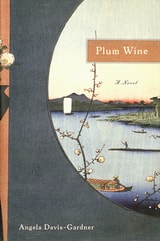
cover of Plum Wine: A Novel

Plum Wine

A Novel

Angela Davis-Gardner

University of Wisconsin Press, 2006

    Barbara Jefferson, a young American teaching in Tokyo in the 1960s, is set on a life-changing quest when her Japanese surrogate mother, Michi, dies, leaving her a tansu of homemade plum wines wrapped in rice paper. Within the papers Barbara discovers writings in Japanese calligraphy that comprise a startling personal narrative. With the help of her translator, Seiji Okada, Barbara begins to unravel the mysteries of Michi's life, a story that begins in the early twentieth century and continues through World War II and its aftermath.
     As Barbara and Seiji translate the plum wine papers they form an intimate bond, with Michi a ghostly third in what becomes an increasingly uneasy triangle. Barbara is deeply affected by the revelation that Michi and Seiji are hibakusha, survivors of the atomic bombing in Hiroshima, and even harder for her to understand are the devastating psychological effects wrought by war. Plum Wine examines human relationships, cultural differences, and the irreparable consequences of war in a story that is both original and timeless.

2007 A Notable Fiction Book of 2007, selected by the Kiriyama Prize Committee
 
Winner, Fiction Award, Southern Independent Bookstore Alliance
 
Notable Fiction, Kiriyama Pacific Rim Book Prize
[more]
cover of Poems of the Five Mountains: An Introduction to the Literature of the Zen Monasteries

Poems of the Five Mountains

An Introduction to the Literature of the Zen Monasteries

Marian Ury

University of Michigan Press, 1992
This second, revised edition of a pioneering volume, long out of print, presents translations of Japanese Zen poems on sorrow, old age, homesickness, the seasons, the ravages of time, solitude, the scenic beauty of the landscape of Japan, and monastic life. Composed by Japanese Zen monks who lived from the last quarter of the thirteenth century to the middle of the fifteenth century, these poems represent a portion of the best of the writing called in Japanese gozan bungaku, “literature of the five mountains.”
“Five mountains” or “five monasteries” refers to the system by which the Zen monasteries were hierarchically ordered and governed. For the monks in the monasteries, poetry functioned as a means not only of expressing religious convictions and personal feelings but also of communicating with others in a civilized and courteous fashion. Effacing barriers of time and space, the practice of Chinese poetry also made it possible for Japanese authors to feel at one with their Chinese counterparts and the great poets of antiquity. This was a time when Zen as an institution was being established and contact with the Chinese mainland becoming increasingly frequent—ten of the sixteen poets represented here visited China.
Marian Ury has provided a short but substantial introduction to the Chinese poetry of Japanese gozan monasteries, and her translations of the poetry are masterful. Poems of the Five Mountains is an important work for anyone interested in Japanese literature, Chinese literature, East Asian Religion, and Zen Buddhism.
[more]
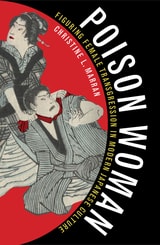
cover of Poison Woman: Figuring Female Transgression in Modern Japanese Culture

Poison Woman

Figuring Female Transgression in Modern Japanese Culture

Christine L. Marran

University of Minnesota Press, 2007

Based on the lives and crimes of no less than twenty real women, dokufu (poison women) narratives emerged as a powerful presence in Japan during the 1870s. During this tumultuous time, as the nation moved from feudalism to oligarchic government, such accounts articulated the politics and position of underclass women, sexual morality, and female suffrage. Over the next century, the figure of the oversexed female criminal, usually guilty of robbery or murder, became ubiquitous in modern Japanese culture.

In Poison Woman, Christine L. Marran investigates this powerful icon, its shifting meanings, and its influence on defining women’s sexuality and place in Japan. She begins by considering Meiji gesaku literature, in which female criminality was often medically defined and marginalized as abnormal. She describes the small newspapers (koshinbun) that originally reported on poison women, establishing journalistic and legal conventions for future fiction about them. She examines zange, or confessional narratives, of female and male ex-convicts from the turn of the century, then reveals how medical and psychoanalytical literature of the 1920s and 1930s offered contradictory explanations of the female criminal as an everywoman or a historical victim of social circumstances and the press. She concludes by exploring postwar pulp fiction (kasutori), film and underground theater of the 1970s, and the feminist writer Tomioka Taeko’s take on the transgressive woman.

Persistent stories about poison women illustrate how a few violent acts by women were transformed into myriad ideological, social, and moral tales that deployed notions of female sexual desire and womanhood. Bringing together literary criticism, the history of science, media theory, and gender and sexuality studies, Poison Woman delves into genre and gender in ways that implicate both in projects of nation-building.

Christine L. Marran is associate professor of Japanese literature and cultural studies at the University of Minnesota.

[more]
cover of Policy & Politics Japan

Policy & Politics Japan

T. Pempel

Temple University Press, 1982
"This is a masterful, well-written examination of Japanese politics." --Choice In a comparative framework, Pempel analyzes six major areas of domestic policy-making in Japan--administrative reform, economic policy, labor relations, social welfare, environmental policy, and higher education. Each case is accompanied by selected readings translated from official government documents and the writings of critics of official policy. The book offers an unusually strong point of view, one that is sure to invite debate. Pemple attempts to unravel the intertwined issues of the autonomy of the Japanese bureaucracy and the strength of the conservative coalition. He describes the weaknesses of opposition politics and labor but goes on to suggest how protest movements can be effective and how change can occur in the face of a powerful conservative consensus. The "economic miracle" of Japan, like the other policy areas, is realistically assessed in the context of events in other industrialized countries.
[more]
cover of Political Leadership in Contemporary Japan

Political Leadership in Contemporary Japan

Terry Edward MacDougall, Editor

University of Michigan Press, 1982

Those who do not read Japanese seldom have access to analytic studies of the fascinating and surprisingly diverse world of contemporary Japanese political leadership. This volume constitutes a step toward bringing to the English reader some sense of the norms, beliefs, styles, and modes of exercising power of Japanese political leaders and the organizational and political contexts which are changing leadership role expectations. The second volume in this series concentrates more explicitly on leadership recruitment, although the subject is also addressed here.
All of the essays in this volume highlight specific politicians, while attempting to develop analytic categories to understand the broader significance of these types of leaders. Included are the following: a Liberal Democratic Party prime minister and faction leader (Fukuda Takeo) who rose "almost effortlessly" to the pinnacle of power on the basis of an elitist educational and bureaucratic career background and another (Tanaka Kakuei) who took advantage of the chaotic wartime and immediate postwar period to overcome the limitations of his commoner background by developing an entrepreneurial style that makes him even today "the most powerful in Japan"; a younger conservative leader (Kono Yohei) who, with certain others of his generation, found life within the restrictive but predictable career paths of ruling Liberal Democrats less attractive than the risky option of forming his own New Liberal Club; an unconventional Socialist chairman (Asukata Ichio) who bucks the pull toward coalition making among the opposition parties in favor of his belief that this major but perpetual opposition party must first reconstruct itself and structure a new popular consensus that can legitimize a coalitional alternative to the Liberal Democrats; parliamentary leaders (like lower-house speaker Maeo Shigesaburo, directors of the House Management Committee, and heads of the Diet policy committees of the various parties) who are projected into increasingly influential roles by changing electoral trends and popular expectations; an innovative and dynamic mayor (Suzuki Heizaburo) who, taking advantage of the considerable authority afforded by Japan's "presidential" system of local chief executives, pursues his own priorities, mobilizing the requisite support despite the lack of national guidance and the oppositions of former backers; and the "power behind the throne" (Matsunaga Yasuzaemon and Komori Takeshi) whose visions move prime ministers and governors as well as their own followers in powerful public and private bureaucracies. [intro]
[more]
cover of Politics and the News Media in Japan

Politics and the News Media in Japan

Ofer Feldman

University of Michigan Press, 1993

Written by a longtime resident of Japan, Politics and the News Media in Japan describes and analyzes political communication in Japan with a particular focus on the relationship between the news media and politicians.In this pioneering work, Ofer Feldman shows how the close connection between reporters and members of the Japanese National Diet influences the coverage of politics in the media and how the news media and reporters function as information sources for Diet members. The author discusses the importance of the national dailies in Japanese political life; reporters' work patterns and their formal and informal interaction with political news sources; the objectives reporters and politicians have vis-à-vis one another; and how Japanese cultural factors affect the role reporters play in politics.This volume fills a serious gap in the literature on the Japanese media and its role in the political system by focusing on the structure and process of news-gathering by Japanese reporters. It is the first work based on a survey of rank-and-file members of the Japanese National Diet; newsmen and editors of national and local newspapers, news agencies, and broadcast media; political party officials; and secretaries to Diet members. It will appeal especially to those interested in comparative politics, comparative mass communication, and Japanese studies.
[more]
cover of Pop Against Empire: Art as Masked Critique in Japan, Okinawa, and the US Diaspora

Pop Against Empire

Art as Masked Critique in Japan, Okinawa, and the US Diaspora

Hiroko Ikegami

University of Chicago Press, 2027

How Pop artists confronted the legacies of modern Empire of Japan and post-1945 American imperialism from the 1960s to the present.

Looking at a pivotal period spanning the 1960s to the present, Hiroko Ikegami explores how artists in Japan, Okinawa, and the United States have adopted Pop strategies to critique legacies of imperialism. 

Ikegami focuses on locales—Tokyo, Okinawa, Minidoka, and New York—that were deeply impacted by the complex relationship between the Japanese and American empires and considers artists across different situations and generations. The book begins with Tokyo Pop artists and graphic designers, including Shinohara Ushio and Tanaami Keiichi, who critically parodied American Pop during the long 1960s. It then turns to Okinawa, where Tom Max probed Okinawans’ convoluted reality regarding the American Occupation and the Vietnam War. Artists in the second half of the volume confronted legacies of the Asia-Pacific War as a historical condition of the present. Roger Shimomura, the third-generation Japanese American who had been incarcerated in the Minidoka camp as a child, dealt with the subject by appropriating motifs of ukiyo-e woodblock prints. Takashi Murakami, now a global art star, created otaku-inspired art and capitalized on his country’s experience of the atomic bombs in promoting his “Superflat” enterprise. The book concludes with a new generation of artists protesting repercussions of empire in the twenty-first century. This is the first study to treat artists of post-1945 Japan, Okinawa, and the US diaspora in a single volume as mutually independent yet interrelated, using Pop’s criticality as a connecting thread.
[more]
cover of Postmodern Advertising in Japan: Seduction, Visual Culture, and the Tokyo Art Directors Club

Postmodern Advertising in Japan

Seduction, Visual Culture, and the Tokyo Art Directors Club

Ory Bartal

Dartmouth College Press, 2015

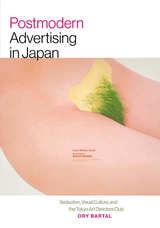
In a study driven by stunning images of Japanese advertisements and the artworks they quote from, Ory Bartal offers a first-of-its-kind interpretation of the “postmodern” genre of advertising in Japan, which both shaped and reflected the new consumer-driven culture that arose during the bubble era of the 1980s and 1990s. Through a fascinating tale of art directors and their works and influences, Bartal shows how this postmodern visual language, like postmodernism in other streams, is distinguished by its mélange of styles, blurring of boundaries between art and design, and reliance on visual and textual quotations from sources past and present, domestic and foreign. Although this advertising culture partakes of global trends, Bartal draws attention to the varied local artistic sensibilities, structures of thought, and underlying practices, challenging the often-simplistic characterization of “Japaneseness” as being rooted in a Zen tradition of aesthetic indirectness and ambiguity. Combining multilingual scholarship with a wealth of information gleaned through years of personal interviews with the principals involved, this is a truly original contribution to the discussion of Japanese art and advertising as well as an insightful reading of more general issues in the study of visual culture and media.
[more]
cover of Postmodernism and Japan

Postmodernism and Japan

Masao Miyoshi and H. D. Harootunian, eds.

Duke University Press, 1989
Postmodernism and Japan is a coherent yet diverse study of the dynamics of postmodernism, as described by Lyotard, Baudrillard, Deleuze, and Guatarri, from the often startling perspective of a society bent on transforming itself into the image of Western “enlightenment” wealth and power. This work provides a unique view of a society in transition and confronting, like its models in the West, the problems induced by the introduction of new forms of knowledge, modes of production, and social relationships.
[more]
cover of Precarious Japan

Precarious Japan

Anne Allison

Duke University Press, 2013
In an era of irregular labor, nagging recession, nuclear contamination, and a shrinking population, Japan is facing precarious times. How the Japanese experience insecurity in their daily and social lives is the subject of Precarious Japan. Tacking between the structural conditions of socioeconomic life and the ways people are making do, or not, Anne Allison chronicles the loss of home affecting many Japanese, not only in the literal sense but also in the figurative sense of not belonging. Until the collapse of Japan's economic bubble in 1991, lifelong employment and a secure income were within reach of most Japanese men, enabling them to maintain their families in a comfortable middle-class lifestyle. Now, as fewer and fewer people are able to find full-time work, hope turns to hopelessness and security gives way to a pervasive unease. Yet some Japanese are getting by, partly by reconceiving notions of home, family, and togetherness.
[more]
cover of Preschool in Three Cultures Revisited: China, Japan, and the United States

Preschool in Three Cultures Revisited

China, Japan, and the United States

Joseph Tobin, Yeh Hsueh, and Mayumi Karasawa

University of Chicago Press, 2009

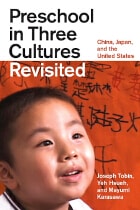
Published twenty years ago, the original Preschool in Three Cultures was a landmark in the study of education: a profoundly enlightening exploration of the different ways preschoolers are taught in China, Japan, and the United States. Here, lead author Joseph Tobin—along with new collaborators Yeh Hsueh and Mayumi Karasawa—revisits his original research to discover how two decades of globalization and sweeping social transformation have affected the way these three cultures educate and care for their youngest pupils. Putting their subjects’ responses into historical perspective, Tobin, Hsueh, and Karasawa analyze the pressures put on schools to evolve and to stay the same, discuss how the teachers adapt to these demands, and examine the patterns and processes of continuity and change in each country.

Featuring nearly one hundred stills from the videotapes, Preschool in Three Cultures Revisited artfully and insightfully illustrates the surprising, illuminating, and at times entertaining experiences of four-year-olds—and their teachers—on both sides of the Pacific.

[more]
cover of Pride, Not Prejudice: National Identity as a Pacifying Force in East Asia

Pride, Not Prejudice

National Identity as a Pacifying Force in East Asia

Eunbin Chung

University of Michigan Press, 2022

As shown by China’s relationship to Japan, and Japan’s relationship to South Korea, even growing regional economic interdependencies are not enough to overcome bitter memories grounded in earlier wars, invasions, and periods of colonial domination. Although efforts to ease historical animosity have been made, few have proven to be successful in Northeast Asia. In previous research scholars anticipated an improvement in relations through thick economic interdependence or increased societal contact. In economic terms, however, Japan and China already trade heavily: Japan has emerged as China’s largest trading partner and China as second largest to Japan. Societal contact is already intense, as millions of Chinese, Koreans, and Japanese visit one another’s countries annually as students, tourists, and on business trips. But these developments have not alleviated international distrust and negative perception, or resolved disagreement on what constitutes “adequate reparation” regarding the countries’ painful history.

Noticing clashes of strong nationalisms around the world in areas like Northeast Asia, numerous studies have suggested that more peaceful relations are likely only if countries submerge or paper over existing national identities by promoting universalism. Pride, Not Prejudice argues, to the contrary, that affirmation of national identities may be a more effective way to build international cooperation. If each national population reflects on the values of their national identity, trust and positive perception can increase between countries. This idea is consistent with the theoretical foundation that those who have a clear, secure, and content sense of self, in turn, can be more open, evenhanded, and less defensive toward others. In addition, this reduced defensiveness also enhances guilt admission by past “inflictors” of conflict and colonialism. Eunbin Chung borrows the social psychological theory of self-affirmation and applies it to an international context to argue that affirmation of a national identity, or reflecting on what it means to be part of one’s country, can increase trust, guilt recognition, and positive perception between countries.
[more]
cover of Prince Saionji: Japan

Prince Saionji

Japan

Jonathan Clements

Haus Publishing, 2010
Prince Saionji Kinmochi (1849-1940). The Japanese delegation at the Paris Peace Conference did not have the Japanese prime or foreign ministers with them as they had only just been elected and had plenty to do back home. The delegation was instead led by Prince Saionji, the dashing 'kingmaker' of early 20th-century Japanese politics whose life spanned the arrival of Commodore Perry and his 'black ships', the Japanese civil war, the Meiji Restoration, the Sino-Japanese War, the Russo-Japanese War, the First World War, the Paris Peace Conference and the Treaty of Versailles, and the rise of Japanese militarism. Unlike many of the conservatives of his day, Saionji was a man with experience of international diplomacy and admiration for European culture. Brought up in the days of the last Shogun, he became an active supporter of Japan's new ruling regime, after the Shogun was overthrown in a civil war, and a leading figure in the post-Restoration reform movement. In 1869 he founded the institution that would become the Ritsumeikan University - literally, 'The place to establish one's destiny'. He was sent to France for nine years to investigate Western technology and philosophy, and served for a decade as a Japanese ambassador in Europe. Returning to Japan, he served twice as Minister of Education and later became prime minister before resigning to become a revered elder statesman. Japan entered the First World War on the Allied side, seizing German possessions in China and the Pacific. In the closing days of the war, Japanese military forces participated in the Siberian Intervention - an American-led invasion of eastern Russia against Communist insurgents. At the Conference Saionji's presence was initially regarded by the Japanese as a sign that Japan had become a fully-fledged member of the international community and accepted on an equal footing with the Western Powers. His delegation introduced a controversial proposal to legally enshrine racial equality as one of the tenets of the League of Nations. The Japanese were also keen to grab colonies of their own, and went head-to-head with the Chinese delegation over the fate of the former German possession of Shandong. When Shandong was 'returned' not to China but to its Japanese occupiers, riots broke out in China. Despite Saionji's statesmanship and diplomacy, the Treaty of Versailles was regarded by many Japanese as a slap in the face. Saionji's influence weakened in his last years, while his party was dissolved and amalgamated with others.
[more]
cover of Productivity Growth in Japan and the United States

Productivity Growth in Japan and the United States

Edited by Charles R. Hulten

University of Chicago Press, 1991

Emerging from the ruins of the Second World War, the Japanese economy has grown at double-digit rate throughout much of the 1950s and 1960s, and, when the oil crisis of the 1970s slowed growth throughout the industrialized world, Japanese growth throughout the industrialized world, Japanese growth rates remained relatively strong. There have been many attempts by scholars from a wide range of disciplines to explain this remarkable history, but for economists interested in the quantitative analysis of economic growth and the principal question addressed is how Japan was able to grow so rapidly.

The contributors focus their efforts on the accurate measurement and comparison of Japanese and U.S. economic growth. Assuming that any sustained increase in real GNP must be due either to an increase in the quantity of capital and labor used in production or to the more efficient use of these inputs, the authors analyze the individual contributions of various factors and their importance in the process of output growth.

These essays extend the methodology of growth analysis and offer many insights into the factors leading to the superior performance of the Japanese economy. They demonstrate that growth is a complex process and no single factor can explain the Japanese 'miracle.'
[more]
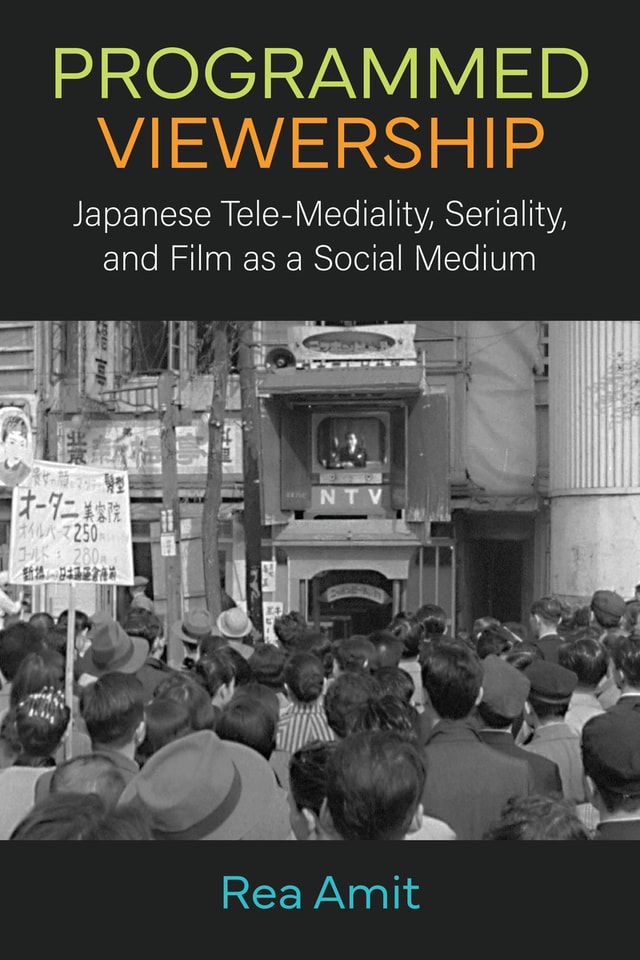
cover of Programmed Viewership: Japanese Tele-Mediality, Seriality, and Film as a Social Medium

Programmed Viewership

Japanese Tele-Mediality, Seriality, and Film as a Social Medium

Rea Amit

University of Michigan Press, 2027

Programmed Viewership examines the concept of “program” in Japanese cinema as an organizing framework that links marketing and promotion, exhibition and distribution, and viewing practices in public and domestic spaces. Rea Amit defines “program” as the ideological infrastructure or platform that perpetuates habitual and ritualistic patterns in film production and reception. Amit takes a holistic approach to understanding more than a century of Japanese cinema through the analysis of material film ephemera, cinema theatre, film content, and viewership. This framework positions programming, rather than provenance, as the decisive factor that confers a film’s cultural and institutional identity. While earlier scholarship has gestured toward loosening the tie between cinematic identity and its nation of origin, Programmed Viewership extends this insight by emphasizing that production constitutes only one dimension of a broader programmatic system.
[more]
cover of Protohistoric Yamato: Archaeology of the First Japanese State

Protohistoric Yamato

Archaeology of the First Japanese State

Gina Lee Barnes

University of Michigan Press, 1988
Nara is located in the center of what is known today as the Kinai region of Japan. The ancient name for the region was the Go-Kinai ("five-within the royal domain"), referring to the five provinces of which it was composed: Settsu, Kawachi, Izumi, Yamato and Yamashiro. The name Yamato, presented above variously as a provincial unit (corresponding to the present-day Nara Prefecture), or geographical unit (the Nara Basin only), is also sometimes expanded and applied on a regional scale to mean the Kinai region. This is particularly true in scholarship dealing with the fifth and sixth centuries when Yamato was in ascendance.
Therefore, the Nara Basin and its archeology are the keys to unlocking the mysteries of the emergence of Japanese civilization and the early state in Japan. These mysteries are entailed in the earliest recorded history of Japan--references to Japanese island "countries" and "queens" in the Chinese dynastic histories of the third to fifth centuries A.D., and references to "kings" and "emperors" in two late fifth- to early sixth-century sword inscriptions and in the extant chronicles of Japan compiled in the early eighth century.
[more]
cover of Public Properties: Museums in Imperial Japan

Public Properties

Museums in Imperial Japan

Noriko Aso

Duke University Press, 2013

In the late nineteenth century, Japan's new Meiji government established museums to showcase a national aesthetic heritage. Inspired by Western museums and expositions, these institutions were introduced by government officials hoping to spur industrialization and self-disciplined public behavior, and to cultivate an "imperial public" loyal to the emperor. Japan's network of museums expanded along with its colonies. By the mid-1930s, the Japanese museum system had established or absorbed institutions in Taiwan, Korea, Sakhalin, and Manchuria. Not surprising, colonial subjects' views of Japanese imperialism differed from those promulgated by the Japanese state. Meanwhile, in Japan, philanthropic and commercial museums were expanding, revising, and even questioning the state-sanctioned aesthetic canon. Public Properties describes how museums in Japan and its empire contributed to the reimagining of state and society during the imperial era, despite vigorous disagreements about what was to be displayed, how, and by whom it was to be seen.
[more]
cover of Push the Button: Interactive Television and Collaborative Journalism in Japan

Push the Button

Interactive Television and Collaborative Journalism in Japan

Elizabeth Rodwell

Duke University Press, 2024

In Push the Button, Elizabeth Rodwell follows a battle over what interactivity will mean for Japanese television, as major media conglomerates took on independent media professionals developing interactive forms from new media. Rodwell argues that at the dawn of a potentially transformative moment in television history, content conservatism has triumphed over technological innovation. Despite the ambition and idealism of Japanese TV professionals and independent journalists, corporate media worked to squelch interactive broadcast projects such as smartphone-playable television and live-streamed and open press conferences before they caught on. Instead, interactive programming in the hands of major TV networks retained the structure and qualities of most other television and maintained conventional barriers between audiences and the actual space of broadcast. Despite their lack of success, the innovators behind these experiments nonetheless sought to expand the possibilities for mass media, national identity, and open journalism.
[more]