356 books match the query 'Jewish Studies' and 13 start with p
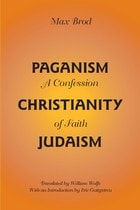
cover of Paganism - Christianity - Judaism: A Confession of Faith

Paganism - Christianity - Judaism

A Confession of Faith

Max Brod, translated by William Wolfe, introduction by Eric Gottgetreu

University of Alabama Press, 1970

Now remembered primarily as Franz Kafta's friend and literary executor, Max Brod was an accomplishered thinker and writer in his own right. In this volume, he considers the nature and differences between Judaism and Christianity, addressing some of the most perplexing questions at the heart of human existence.

“One of the most famous and widely discussed books of the 1920’s, Max Brod’s Paganism—Christianity—Judaism, has at last found its way into English translation to confront a new generation of readers. Max Brod is best remembered today as the literary editor and friend of Franz Kafka. In his day, however, he was the more famous of the two by far. A major novelist, playwright, poet, essayist, and composer, he was also, as this book demonstrates, a serious thinker on the perennial questions that are at the heart of human existence. . . .Some of his judgments are open to question. Still, with all its limitations, this is a forthright and passionate proclamation of the uniqueness of Judaism. Paganism—Christianity—Judaism was an intellectual and spiritual event when it was first published and it remains a valuable document even now.” —Rabbi Jack Riemer, Hadassah
 

[more]
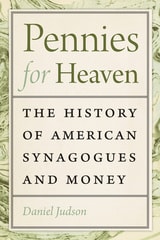
cover of Pennies for Heaven: The History of American Synagogues and Money

Pennies for Heaven

The History of American Synagogues and Money

Daniel Judson

Brandeis University Press, 2018

In the annals of American Jewish history, synagogue financial records have been largely overlooked. But as Daniel Judson shows in his examination of synagogue ledgers from 1728 to the present, these records provide an array of new insights into the development of American synagogues and the values of the Jews who worshipped in them. Looking at the history of American synagogues through an economic lens, Judson examines how synagogues raised funds, financed buildings, and paid clergy. By “following the money,” he reveals the priorities of the Jewish community at a given time. Throughout the book, Judson traces the history of capital campaigns and expenditures for buildings. He also explores synagogue competition and debates over previously sold seats, what to do about wealthy widows, the breaking down of gender norms, the hazan “bubble” (which saw dozens of overpaid cantors come to the United States from Europe), the successful move to outlaw “mushroom synagogues,” and the nascent synagogue-sharing economy of the twenty-first century. Judson shows as well the ongoing relationship of synagogue and church financing as well as the ways in which the American embrace of the free market in all things meant that the basic rules of supply and demand ultimately prevailed in the religious as well as the commercial realm.
[more]
cover of Performing Captivity, Performing Escape: Cabarets and Plays from the Terezín/Theresienstadt Ghetto

Performing Captivity, Performing Escape

Cabarets and Plays from the Terezín/Theresienstadt Ghetto

Edited by Lisa Peschel

Seagull Books, 2014

A meticulously researched book that collects twelve playscripts written by European Jews imprisoned in the Terezín ghetto during the Holocaust.
 
The concentration camp and Jewish ghetto at Terezín, or Theresienstadt, in what is now the Czech Republic, was a site of enormous suffering, fear, and death. But amid this horrific period, there was also a thriving and desperately vibrant cultural life. While the children’s drawings and musical pieces created in the ghetto have become justly famous, the prisoners’ theatrical works, though a lesser-known aspect of their artistic endeavors, deserves serious attention as well.
 
Performing Captivity, Performing Escape collects twelve theatrical texts—cabaret songs and sketches, historical and verse dramas, puppet plays, and a Purim play—written by Czech and Austrian Jews. Together these works reveal the wide range of ways in which the prisoners engaged with and escaped from life in the ghetto through performance. The anthology opens with an insightful prologue by novelist Ivan Klíma, who was interned in the ghetto as a child and contains a detailed introduction by editor Lisa Peschel about the pre-war theatrical influences and wartime conditions that inspired the theater of the ghetto. The array of theatrical forms collected in this anthology speaks of the prisoners’ persistence of hope in a harrowing time and will be a moving read for students and scholars of the Holocaust.
 
[more]
cover of Philosophical Witnessing: The Holocaust as Presence

Philosophical Witnessing

The Holocaust as Presence

Berel Lang

Brandeis University Press, 2012
In this volume, eminent scholar Berel Lang brings the perspective of philosophical analysis to bear on issues related to the Holocaust. Setting out from a conception of philosophical “witnessing” that expands and illuminates the standard view of the witness, he confronts the question of what philosophy can add to the views of the Holocaust provided in other disciplines. Drawing on the philosophical areas of political theory, ethics, aesthetics, and the philosophy of history, he draws attention especially to the post-Holocaust emphasis on the concepts of genocide and “group rights.” Lang’s study, which emphasizes the moral choices that now face post-Holocaust thought, inspires the reader to think of the Holocaust in new ways, showing how its continued presence in contemporary consciousness affects areas of thought and practice not directly associated with that event.
[more]
cover of Philosophy en noir

Philosophy en noir

Miroslav Petrícek

Karolinum Press, 2020
Thought necessarily reflects the times. Following the tragedy of the Holocaust, this fact became ever more clear. And it may be the reason postwar philosophical texts are so difficult to understand, since they confront incomprehensibly traumatic experiences. In this first English-language translation of any of his books, Miroslav Petříček—one of the most influential and erudite Czech philosophers, and a student of Jan Patočka—argues that to exist in the second half of the twentieth century and beyond, Western philosophy has had to rewrite its tradition and its discourse, radically transforming itself. Should philosophy be capable of bearing witness to the time, Petříček contends, this metamorphosis in philosophy is necessary. Offering an original Central European perspective on postwar philosophical discourse that reflects upon the historical underpinnings of pop culture phenomena and complex philosophical schools—including Adorno, Agamben, Benjamin, Derrida, Husserl, Kracauer, and many others—Philosophy en noir is a record of this transformation.
[more]
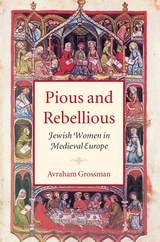
cover of Pious and Rebellious: Jewish Women in Medieval Europe

Pious and Rebellious

Jewish Women in Medieval Europe

Avraham Grossman

Brandeis University Press, 2004
This volume, an amazing act of historical recovery and reconstruction, offers a comprehensive examination of Jewish women in Europe during the High Middle Ages (1000–1300). Avraham Grossman covers multiple aspects of women’s lives in medieval Jewish society, including the image of woman, the structure of the family unit, age at marriage, position in family and society, her place in economic and religious life, her education, her role in family ceremonies, violence against women, and the position of the divorcée and the widow in society. Grossman shows that the High Middle Ages saw a distinct improvement in the status of Jewish women in Europe relative to their status during the Talmudic period and in Muslim countries. If, during the twelfth century, rabbis applauded women as "pious and pure" because of their major role in the martyrdom of the Crusades of 1096, then by the end of the thirteenth century, rabbis complained that women were becoming bold and rebellious. Two main factors fostered this change: first, the transformation of Jewish society from agrarian to "bourgeois," with women performing an increasingly important function in the family economy; and second, the openness toward women in Christian Europe, where women were not subjected to strict limitations based upon conceptions of modesty, as was the case in Muslim countries. The heart of Grossman’s book concerns the improvement of Jewish women’s lot, and the efforts of secular and religious authorities to impede their new-found status. Bringing together a variety of sources including halakhic literature, biblical and talmudic exegesis, ethical literature and philosophy, love songs, folklore and popular literature, gravestones, and drawings, Grossman’s book reconstructs the hitherto unrecorded lives of Jewish women during the Middle Ages.
[more]
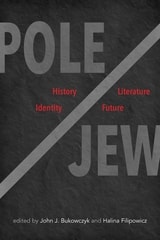
cover of Pole/Jew: History, Literature, Identity, Future

Pole/Jew

History, Literature, Identity, Future

John J. Bukowczyk and Halina Filipowicz

Ohio University Press, 0

Pole/Jew brings together a group of scholars—about half of them Jewish, about half of them ethnic Poles—from the United States, Poland, the United Kingdom, and Canada and enlists their diverse methodological and generational perspectives to push debates over Polish-Jewish relations beyond entrenched and reductive positions. At the core of the volume are the following questions:

–What impact has the Holocaust had on Polish history and Polish literature?

–How has the Holocaust affected Polish-Jewish—and Polish—identity?

–What future is there for relations between Poland’s small Jewish minority and the country’s overwhelming ethnic Polish majority? Between Poland and Israel? Between Jews of the diaspora and ethnic Poles abroad?

–Which research areas have yet to be addressed or revisited and reexamined?

–Are there ways to move beyond the reductive notion of 1989 (i.e., the fall of the communist regime in Poland) as wall and fulcrum?

By addressing these compelling questions, this volume offers fresh perspectives and encourages a nuanced understanding of Polish-Jewish relations.

Contributors:

M. B. B. Biskupski
Robert Blobaum
John J. Bukowczyk
Patrice M. Dabrowski
Halina Filipowicz
Agnieszka Jezyk
Bozena Karwowska
Kamil Kijek
Kate Korycki
Elzbieta Kossewska
Grazyna J. Kozaczka
Stanislaw Krajewski
Adam Lipszyc
Wiktor Marzec
Alina Molisak
Stanislaw Obirek
Benjamin Paloff
Antony Polonsky
Brian Porter-Szucs
Piotr Puchalski
Roma Sendyka
Dariusz Stola
Katarzyna Zechenter
Joshua D. Zimmerman
Geneviève Zubrzycki
Slawomir Zurek
[more]
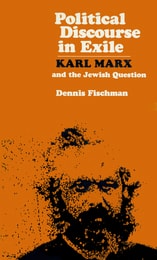
cover of Political Discourse in Exile: Karl Marx and the Jewish Question

Political Discourse in Exile

Karl Marx and the Jewish Question

Dennis Fischman

University of Massachusetts Press, 1991
Over the years, Karl Marx's tangled relation with Judaism has provoked heated debate among followers and critics alike. Can the Jewish tradition better help us understand Marx's political theory? Which themes in Marx's writings become clearer when read in a Jewish context? This book argues that Marx's work, from his doctoral dissertation to Capital, resounds with characteristic concerns of Jewish thought, identifying three key elements that Marx's theory shares with Judaism - its ontology, its use of texts, and its conception of liberation as a return from exile.
[more]
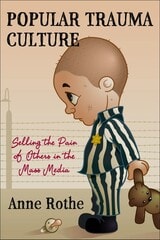
cover of Popular Trauma Culture: Selling the Pain of Others in the Mass Media

Popular Trauma Culture

Selling the Pain of Others in the Mass Media

Rothe, Anne

Rutgers University Press, 2011

In Popular Trauma Culture, Anne Rothe argues that American Holocaust discourse has a particular plot structure—characterized by a melodramatic conflict between good and evil and embodied in the core characters of victim/survivor and perpetrator—and that it provides the paradigm for representing personal experiences of pain and suffering in the mass media. The book begins with an analysis of Holocaust clichés, including its political appropriation, the notion of vicarious victimhood, the so-called victim talk rhetoric, and the infusion of the composite survivor figure with Social Darwinism. Readers then explore the embodiment of popular trauma culture in two core mass media genres: daytime TV talk shows and misery memoirs.

Rothe conveys how victimhood and suffering are cast as trauma kitsch on talk shows like Oprah and as trauma camp on modern-day freak shows like Springer. The discussion also encompasses the first scholarly analysis of misery memoirs, the popular literary genre that has been widely critiqued in journalism as pornographic depictions of extreme violence. Currently considered the largest growth sector in book publishing worldwide, many of these works are also fabricated. And since forgeries reflect the cultural entities that are most revered, the book concludes with an examination of fake misery memoirs.
[more]
cover of Power, Protest, and the Public Schools: Jewish and African American Struggles in New York City

Power, Protest, and the Public Schools

Jewish and African American Struggles in New York City

Melissa F. Weiner

Rutgers University Press, 2012
Accounts of Jewish immigrants usually describe the role of education in helping youngsters earn a higher social position than their parents. Melissa F. Weiner argues that New York City schools did not serve as pathways to mobility for Jewish or African American students. Instead, at different points in the city's history, politicians and administrators erected similar racial barriers to social advancement by marginalizing and denying resources that other students enjoyed. Power, Protest, and the Public Schools explores how activists, particularly parents and children, responded to inequality; the short-term effects of their involvement; and the long-term benefits that would spearhead future activism. Weiner concludes by considering how today's Hispanic and Arab children face similar inequalities within public schools.
[more]
cover of Projecting the Nation: History and Ideology on the Israeli Screen

Projecting the Nation

History and Ideology on the Israeli Screen

Eran Kaplan

Rutgers University Press, 2020
Projecting the Nation: History and Ideology on the Israeli Screen is a wide-ranging history of over seven decades of Israeli cinema.  The only book in English to offer this type of historical scope was Ella Shohat’s Israeli Cinema: East West and the Politics of Representation from 1989.  Since 1989, however, Israeli cinema and Israeli society have undergone some crucial transformations and, moreover, Shohat’s book offered a single framework through which to judge Israeli cinema: a critique of orientalism. Projecting the Nation contends that Israeli cinema offers much richer historical and ideological perspectives that expose the complexity of the Israeli project.  By analyzing Israeli films which address such issues as the Arab-Israeli conflict, the Ashkenazi-Mizrahi divide, the kibbutz and urban life, the rise of religion in Israeli public life and more, the book explores the way cinema has represented and also shaped our understanding of the history of modern Israel as it evolved from a collectivist society to a society where individualism and adherence to local identities is the dominant ideology. 
 
[more]
cover of Promised Lands

Promised Lands

Edited by Derek Rubin

Brandeis University Press, 2010
This vibrant anthology showcases new, unpublished short stories by a rapidly growing crop of highly talented young Jewish American fiction writers. Cohering around the core Jewish theme of the Promised Land, all the stories were written especially for this volume. With the kind of depth and imagination that only fiction allows, they offer striking variations on the multivalent theme of the Promised Land and how it continues to shape the collective consciousness of contemporary American Jews. This anthology provides a rich reading experience and a unique window onto Jewish American life and culture at the beginning of the twenty-first century. A scholarly introduction by Derek Rubin provides literary context, discusses the organization of the volume, and illuminates expected and unexpected connections among the stories. Promised Lands features 23 stories by Elisa Albert, Melvin Jules Bukiet, Janice Eidus, Rebecca Newberger Goldstein, Lauren Grodstein, Aaron Hamburger, Dara Horn, Rachel Kadish, Binnie Kirshenbaum, Joan Leegant, Yael Goldstein Love, Rivka Lovett, Tova Mirvis, Lev Raphael, Nessa Rapoport, Jonathan Rosen, Thane Rosenbaum, Joey Rubin, Edward Schwarzschild, Steve Stern, Lara Vapnyar, Adam Wilson, and Jonathan Wilson.
[more]
cover of Propaganda and Persecution

Propaganda and Persecution

Renée Poznanski

University of Wisconsin Press, 2024

Renée Poznanski’s magisterial history of the French Resistance during World War II offers a comprehensive exploration of the most significant issue in that period’s social imaginary: the “Jewish question.” With extraordinary nuance, she analyzes the discourse around Jews and Judaism that pervaded the Resistance’s propaganda and debates, while closely examining the fate of Jews under Vichy and after. 

Poznanski argues that Jews in France suffered a double persecution: one led by the Vichy government, the other imposed by the Nazis. Marginalization and exclusion soon led to internment and deportation to terrifying places. Meanwhile, a propaganda war developed between the Resistance and the official voice of Vichy. Poznanski draws on a breathtaking array of sources, especially clandestine publications and French-language BBC transmissions, to show how the Resistance both fought and accommodated the deeply entrenched antisemitism within French society. Her close readings of propaganda texts against public opinions probe ambiguities and silences in Resistance writing about the persecution of the Jews and, in parallel, the numerous and detailed denunciations that could be read in the Jewish clandestine press. This extensive synthesis extends to the post-Liberation period, during which the ongoing persecution of Jews in Europe and North Africa would be portrayed as secondary to the suffering of the nation.

The winner of the 2009 Henri Hertz Prize by the Chancellerie des Universités de Paris, Sorbonne, Propaganda and Persecution makes major contributions to the study of the Resistance and of antisemitism. Lenn J. Schramm’s English translation brings Poznanski’s dynamic prose to life.
[more]