Results by title
56 books match the query 'Judicial Branch' and 3 start with p
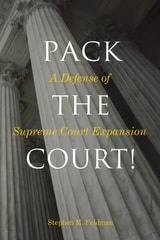
Pack the Court!
A Defense of Supreme Court ExpansionStephen M. Feldman
Temple University Press, 2021
The United States Supreme Court has numbered nine justices for the past 150 years. But that number is not fixed. With the Democrats controlling the House and Senate during the Biden presidency, they could add justices to the Supreme Court. But would court packing destroy the Court as an apolitical judicial institution? This is the crucial question Stephen Feldman addresses in his provocative book, Pack the Court! He uses a historical, analytical, and political argument to justify court-packing in general and Democratic court-packing more specifically.
Republicans and Democrats alike profess to worry that court-packing will destroy the legitimacy of the Supreme Court as a judicial institution by injecting politics into a purely legal adjudicative process. But as Feldman’s insightful book shows, law and politics are forever connected in judicial interpretation and decision making. Pack the Court! insists that court packing is not the threat to the Supreme Court’s institutional legitimacy that many fear. Given this, Feldman argues that Democrats should pack the Court while they have the opportunity. Doing so might even strengthen the American people’s faith in the Court.
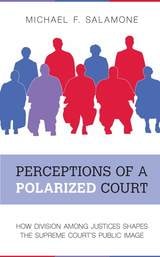
Perceptions of a Polarized Court
How Division among Justices Shapes the Supreme Court's Public ImageMichael F. Salamone
Temple University Press, 2018
Like our divided nation, the Supreme Court is polarized. But does a split among Supreme Court justices—particularly when it occurs along ideological lines—hurt public perception and the Court’s ability to muster popular support for its rulings? Michael Salamone’s Perceptions of a Polarized Court offers the first comprehensive, empirical analysis of how divisiveness affects the legitimacy of the Court’s decisions.
Salamone looks specifically at the Roberts Court years—which are characterized by unprecedented ideological and partisan polarization among the justices—to evaluate the public consequences of divided Supreme Court rulings. He also analyzes both the media’s treatment of Supreme Court decisions and public opinion toward the Court’s rulings to show how public acceptance is (or is not) affected.
Salmone contends that judicial polarization has had an impact on the manner in which journalists report on the Supreme Court. However, contrary to expectation, Court dissent may help secure public support by tapping into core democratic values.
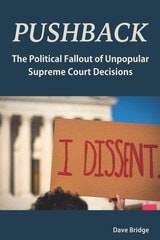
Pushback
The Political Fallout of Unpopular Supreme Court DecisionsDave Bridge
University of Missouri Press, 2024
Certain to appeal to anyone interested in American political science and history, Pushback closes with a detailed examination of the unequivocally countermajoritarian Supreme Court ruling of our lifetimes, Dobbs v. Jackson Women’s Health Organization, which overturned Roe. For the first time in 50 years, conditions are ripe for a party to win votes by campaigning against the will of the Court. Upcoming elections will tell if the Republicans overplayed their hand, or if Democrats will play theirs as skillfully as did the GOP after Roe.