Results by title
72 books match the query 'Korea (South)' and 2 start with p
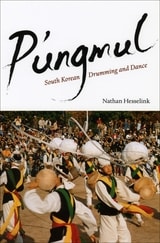
P'ungmul
South Korean Drumming and DanceNathan Hesselink
University of Chicago Press, 2006
Composed of a core set of two drums and two gongs, p’ungmul is a South Korean tradition of rural folk percussion. Steeped in music, dance, theater, and pageantry, but centrally focused on rhythm, such ensembles have been an integral part of village life in South Korea for centuries, serving as a musical accompaniment in the often overlapping and shifting contexts of labor, ritual, and entertainment.
The first book to introduce Korean drumming and dance to the English-speaking world, Nathan Hesselink’s P’ungmul offers detailed descriptions of its instrumentation, dance formations, costuming, actors, teaching lineages, and the complexities of training. Hesselink also evaluates how this tradition has taken on new roles and meanings in the twentieth and early-twenty-first centuries, investigating the interrelated yet contested spheres of history, memory, government policy, grassroots politics, opportunities for musical transmission, and performance practices and aesthetics.
P’ungmul offers those interested in ethnomusicology, world music, anthropology, sociology, and Asian studies a special glimpse into the inner workings of a historically rich, artistically complex, and aesthetically and aurally beautiful Korean musical and dance tradition.
[more]
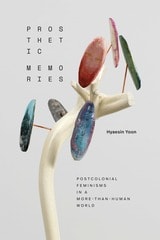
Prosthetic Memories
Postcolonial Feminisms in a More-Than-Human WorldHyaesin Yoon
Duke University Press, 2025
In Prosthetic Memories, Hyaesin Yoon examines the entanglements of humans, animals, and technologies across South Korea and the United States at the turn of the twenty-first century. Interrogating a variety of body-technology interfaces, Yoon outlines an emergent mode of prosthetic memory in which human memory is extended into both machines and animals. Prosthetic memory overflows and provides an alternative to familiar human perception, Western scientific reason, and other senses of knowledge in ways that can foster networks of solidarity, care, and empathy between human and nonhuman subjects. Among other sites and subjects, Yoon examines tongue surgery to correct English pronunciation in Korea, Asian American poetry that engages the human-machine divide, transnational dog cloning, and stem cell research, each of which activates potent postcolonial feminist mnemonics and alliances. In so doing, Yoon narrates the countermemories of racialized, gendered, diasporic, queer, and marginalized human and nonhuman others that work against the violent and isolating biopolitical and neoliberal forces in contemporary society.
[more]