Results by title
128 books match the query 'Language and languages' and 8 start with p
Peer Response in Second Language Writing Classrooms
Jun Liu and Jette G. Hansen
University of Michigan Press, 2002
Peer Response in Second Language Writing Classrooms, Second Edition
Jun Liu and Jette G. Hansen Edwards
University of Michigan Press, 2018
Now that classes are as likely to be online as held in physical classrooms and now that a new generation of digital natives can routinely read and respond to what others write via laptops, tablets, and phones, peer response as pedagogical practice is not just more easily implemented, but it is more likely to feel natural to L2 learners.
The Second Edition is a highly accessible guide to how the world is using peer response and serves as a motivator and facilitator for those who want to try it for the first time or want to increase the effectiveness of the activities—whether via CMC or not. The volume includes 11 forms useful in training students to provide good peer feedback, including a final checklist to ensure teachers have taken all the necessary steps to achieve a successful peer feedback activity.
Perspectives on Fluency
Heidi Riggenbach
University of Michigan Press, 2000
Section 1, What Is Fluency? presents papers that all describe fluency, but in different ways.
The articles in Section 2, Essential Components of Fluency, consider features or components that contribute to impressions of fluency.
Section 3, Cognitive Processes Underlying Fluency, is devoted to an exploration of the psycholinguistic factors underlying fluency.
Three studies are presented in Section 4, Empirical Studies on Nonnative Fluency, and they exemplify the range of approaches to characterizing learners as fluent or nonfluent in their target language.
One objective of Perspectives on Fluency is to provide a starting point for language researchers interested in exploring the concept of fluency, a foundation that, until the arrival of this volume, did not exist. The book can be useful to those approaching fluency from a language assessment perspective, and those interested in the relationship of fluency to oral proficiency.
Philosophy of Language
Vilém Flusser
University of Minnesota Press, 2016
In 1963 Vilém Flusser presented a series of lectures at the Brazilian Institute of Philosophy (IBF) in São Paulo concerning the philosophy of language. The resulting ten essays would eventually be published in 1965 in the annual magazine of the Brazilian Institute of Technology and Aeronautics (ITA), and published here for the first time in book form.
Flusser prepared each lecture as a response to the dialogs that followed the preceding lecture, thereby expanding and explicating his philosophy of language in an intense dialogical process. Despite the fact that the other side of the dialogue was not recorded, it becomes clear to the reader that the resulting discussions and polemics generated by the lectures progressively and profoundly changed Flusser’s intended trajectory for the course. This kind of philosophy in fieri was in part the result of a group effort between all of those present, and subsequently synthesized by Flusser in every essay. As a result of this experience, Flusser adopted this dialogic method as an integral part of his future work.
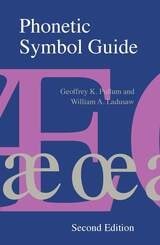
Phonetic Symbol Guide
Geoffrey K. Pullum and William A. Ladusaw
University of Chicago Press, 1996
This fully revised second edition incorporates the major revisions to the International Phonetic Alphabet made in 1989 and 1993. Also covered are the American tradition of transcription stemming from the anthropological school of Franz Boas; the Bloch/Smith/Trager style of transcription; the symbols used by dialectologists of the English language; usages of specialists such as Slavicists, Indologists, Sinologists, and Africanists; and the transcription proposals found in all major textbooks of phonetics.
With sixty-one new entries, an expanded glossary of phonetic terms, added symbol charts, and a full index, this book will be an indispensable reference guide for students and professionals in linguistics, phonetics, anthropology, philology, modern language study, and speech science.

Poetic Interaction
Language, Freedom, ReasonJohn McCumber
University of Chicago Press, 1989
Politics, Language, and Thought
The Somali ExperienceDavid D. Laitin
University of Chicago Press, 1977
Twelve years after independence, a military government was able to settle the acrimonious controversy by announcing that Somali would be the official language and Latin the basic script. It was hoped that this choice would foster political equality and strengthen the national culture. Politics, Language, and Thought is an exploration of how language and politics interrelate in the Somali Republic. Using both historical and experimental evidence, David D. Laitin demonstrates that the choice of an official language may significantly affect the course of a country's political development.
Part I of Laitin's study is an attempt to explain why the parliamentary government was incapable of reaching agreement on a national script and to assess the social and political consequences of the years of nondecision. Laitin shows how the imposition of nonindigenous languages produced inequalities which eroded the country's natural social basis of democracy.
Part 2 attempts to relate language to political thought and political culture. Analyzing interviews and role-playing sessions among Somali bilingual students, Laitin demonstrates that the impact of certain political concepts is quite different when expressed in different languages. He concludes that the implications of choosing a language are far more complex than previously thought, because to change the language of a people is to change the ways they think and act politically.
Pronouncing and Persevering
Gender and the Discourses of Disputing in an African Islamic CourtSusan F. Hirsch
University of Chicago Press, 1998
Pronouncing and Persevering focuses closely on the language used in disputes, particularly how men and women narrate their claims and how their speech shapes and is shaped by gender hierarchy in postcolonial Swahili society. Based on field research and court testimony, Hirsch's book debunks the conventional view that women are powerless under Islamic law and challenges the dichotomies through which Islam and gender relations are currently understood.