Results by title
151 books match the query 'Liberalism' and 9 start with p
Passions and Constraint
On the Theory of Liberal DemocracyStephen Holmes
University of Chicago Press, 1995
According to Holmes, three elements of classical liberal theory are commonly used to attack contemporary liberalism as antagonistic to genuine democracy and the welfare state: constitutional constraints on majority rule, the identification of individual freedom with an absence of government involvement, and a strong emphasis on the principle of self-interest. Through insightful essays on Hobbes's analysis of the English Civil War in Behemoth, Bodin's writings on the benefits of limited government, and Mill's views on science and politics, Holmes shows that these basic principles provide, to the contrary, a necessary foundation for the development of democratic, regulatory, and redistributionist politics in the modern era.
Holmes argues that the aspirations of liberal democracy—including individual liberty, the equal dignity of citizens, and a tolerance for diversity—are best understood in relation to two central themes of classical liberal theory: the psychological motivations of individuals and the necessary constraint on individual passions provided by institutions. Paradoxically, Holmes argues that such institutional restraints serve to enable, rather than limit, effective democracy.
In explorations of subjects ranging from self-interest to majoritarianism to "gag rules," Holmes shows that limited government can be more powerful than unlimited government—indeed, that liberalism is one of the most effective philosophies of state building ever contrived. By restricting the arbitrary powers of government officials, Holmes states, a liberal constitution can increase the state's capacity to focus on specific problems and mobilize collective resources for common purposes.
Passions and Constraint is an assessment of what that tradition has meant and what it can mean today.
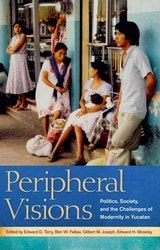
Peripheral Visions
Politics, Society, and the Challenges of Modernity in YucatanEdward D. Terry
University of Alabama Press, 2010
The essays in this collection illuminate both the processes of change and the negative reactions that they frequently elicited
Yucatan has been called “a world apart”—cut off from the rest of Mexico by geography and culture. Yet, despite its peripheral location, the region experienced substantial change in the decades after independence. As elsewhere in Mexico, apostles of modernization introduced policies intended to remold Yucatan in the image of the advanced nations of the day. Indeed, modernizing change began in the late colonial era and continued throughout the 19th century as traditional patterns of land tenure were altered and efforts were made to divest the Catholic Church of its wealth and political and intellectual influence. Some changes, however, produced fierce resistance from both elites and humbler Yucatecans and modernizers were frequently forced to retreat or at least reach accommodation with their foes.
Covering topics from the early 19th century to the late 20th century, the essays in this collection illuminate both the processes of change and the negative reactions that they frequently elicited. The diversity of disciplines covered by this volume—history, anthropology, sociology, economics—illuminates at least three overriding challenges for study of the peninsula today. One is politics after the decline of the Institutional Revolutionary Party: What are the important institutions, practices, and discourses of politics in a post-postrevolutionary era? A second trend is the scholarly demystification of the Maya: Anthropologists have shown the difficulties of applying monolithic terms like Maya in a society where ethnic relations are often situational and ethnic boundaries are fluid. And a third consideration: researchers are only now beginning to grapple with the region’s transition to a post-henequen economy based on tourism, migration, and the assembly plants known as maquiladoras. Challenges from agribusiness and industry will no doubt continue to affect the peninsula’s fragile Karst topography and unique environments.
Contributors: Eric N. Baklanoff, Helen Delpar, Paul K. Eiss, Ben W. Fallaw, Gilbert M. Joseph, Marie Lapointe, Othón Baños Ramírez, Hernán Menéndez Rodríguez, Lynda S. Morrison, Terry Rugeley, Stephanie J. Smith
Personal Demons
Possession Narratives of Late LiberalismGrace Lavery
Duke University Press, 2026
Persons of the Market
Conservatism, Corporate Personhood, and Economic TheologyKevin Musgrave
Michigan State University Press, 2022
light on their seemingly odd marriage in contemporary American politics. Author Kevin Musgrave highlights the ways that theories of corporate and human personhood have long been and remain bound together by examining four case studies: the U.S. Supreme Court’s 1886 Santa Clara decision, the role of early twentieth-century advertisers in endowing corporations with souls, Justice Lewis Powell Jr.’s eponymous memo of 1971, and the arc of the conservative movement from Ronald Reagan to Donald Trump. Tracing this rhetorical history of the extension and attribution of personhood to the corporate form illustrates how the corporation has for many increasingly become a normative model or ideal to which human persons should aspire. In closing, the book offers preliminary ideas about how we might fashion a more democratic and humane understanding of what it means to be a person.
Polish Liberal Thought Before 1918
Maciej Janowski
Central European University Press, 2004
Politics and the Order of Love
An Augustinian Ethic of Democratic CitizenshipEric Gregory
University of Chicago Press, 2008
Gregory examines a broad range of Augustine’s texts and their reception in different disciplines and identifies two classical themes which have analogues in secular political theory: love—and related notions of care, solidarity, and sympathy—and sin—as well as related notions of cruelty, evil, and narrow self-interest. From an Augustinian point of view, Gregory argues, love and sin constrain each other in ways that yield a distinctive vision of the limits and possibilities of politics.
In providing a constructive argument for Christian participation in liberal democratic societies, Gregory advances efforts to revive a political theology in which love’s relation to justice is prominent. Politics and the Order of Love will provoke new conversations for those interested in Christian ethics, moral psychology, and the role of religion in a liberal society.
Postcolonial Studies and Beyond
Ania Loomba, Suvir Kaul, Matti Bunzl, Antoinette Burton, and Jed Esty, eds.
Duke University Press, 2005
The contributors represent many of the fields altered by postcolonial studies over the past two decades, including literary studies, history, anthropology, Asian and African studies, and political science. They model diverse applications of postcolonial theory to Latin America, East Asia, the Middle East, and the United States. Postcolonial Studies and Beyond propels the field forward. It showcases scholars coming from intellectual precincts usually considered outside the purview of the postcolonial finding new ways to deploy classic techniques of postcolonial analysis, and scholars strongly associated with postcolonial studies offering substantial critiques designed to challenge the field’s most fundamental assumptions.
Contributors. Tani E. Barlow, Ali Behdad, Daniel Boyarin, Timothy Brennan, Matti Bunzl, Antoinette Burton, Laura Chrisman, Jean Comaroff, Frederick Cooper, Vilashini Cooppan, Jed Esty, James Ferguson, Peter Hulme, Suvir Kaul, Neil Lazarus, Ania Loomba, Florencia E. Mallon, Nivedita Menon, Rob Nixon, Elizabeth A. Povinelli, David Scott, Ella Shohat, Kelwyn Sole, Robert Stam, Rebecca L. Stein

Pragmatic Liberalism
Charles W. Anderson
University of Chicago Press, 1990
Pragmatist Politics
Making the Case for Liberal DemocracyJohn McGowan
University of Minnesota Press, 2012
In our current age of cynicism, John McGowan suggests that the time is right to take a fresh look at pragmatism, the philosophy of American democracy. As McGowan shows, pragmatism can be an inspiring alternative to the despair that seems to dominate contemporary American politics. Pragmatist Politics is passionate and convincing, both heartfelt and clear-eyed. It offers an expansive vision of what the United States could be and should be.
From John Dewey and William James, McGowan derives a history of democracy as a way of life, characterized by a distinctive ethos and based on an understanding of politics as potentially effective collective agency. That democratic ideal is wedded to a liberalism that focuses on extending the benefits of democracy and of material prosperity to all. Beyond the intellectual case for liberal democracy, McGowan turns to how James, especially, was attuned to the ways that emotional appeals often trump persuasion through arguments, and he examines the work of Kenneth Burke, among others, to investigate the link between liberal democracy and a comic view of human life. Comedy, McGowan notes, allows consideration of themes of love, forgiveness, and generosity that figure far too infrequently in philosophical accounts of politics.
In McGowan’s work, the combination of pragmatism and comedy takes us on a wide-ranging exploration of what American politics—and by extension American life—could actually be like if it truly reflected American values.