Results by title
97 books match the query 'Literature, Modern' and 6 start with p
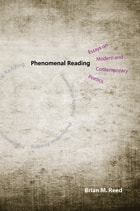
Phenomenal Reading
Essays on Modern and Contemporary PoeticsBrian M. Reed
University of Alabama Press, 2012
Normal0falsefalsefalseMicrosoftInternetExplorer4
The essays in Phenomenal Reading entice readers to cross accepted barriers, and highlight the work of poets who challenge language-as-usual in academia and the culture at large.
Phenomenal Reading is comprised of essays that are central to how best to read poetry. This book examines individually and collectively poets widely recognized as formal and linguistic innovators. Why do their words appear in unconventional orders? What end do these arrangements serve? Why are they striking? Brian Reed focuses on poetic form as a persistent puzzle, using historical fact and the views of other key critics to clarify how particular literary works are constructed and how those constructions lead to specific effects.
Understanding that explication and contextualization do not always sufficiently harness the power of poetry, Reed pursues phenomenological methods that take into account each reader’s unique perception of the world. This collection of twelve essays values narrative as a tool for conveying the intricacy, contingency, and richness of poetic experience.
[more]
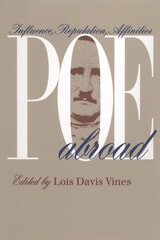
Poe Abroad
Influence Reputation AffinitiesLois Davis Vines
University of Iowa Press, 1999
Perhaps no one would be more shocked at the steady rise of his literary reputation—on a truly global scale—Than Edgar Allan Poe himself. Poe's literary reputation has climbed steadily since his death in 1849.
In Poe Abroad, Lois Vines has brought together a collection of essays that document the American writer's influence on the diverse literatures—and writers—of the world. Over twenty scholars demonstrate how and why Poe has significantly influenced many of the major literary figures of the last 150 years.
Part One includes studies of Poe's popularity among general readers, his influence on literary movements, and his reputation as a poet, fiction writer, and literary critic. Part Two presents analyses of the role Poe played in the literary development of specific writers representing many different cultures.
Poe Abroad commemorates the 150th anniversary of Poe's death and celebrates his worldwide impact, beginning with the first literal translation of Poe into a foreign language, “The Gold-Bug”into French in 1845. Charles Baudelaire translated another Poe tale in 1848 and four years later wrote an essay that would make Poe a well-known author in Europe even before he achieved recognition in America.
Poe died knowing only that some of his stories had been translated into French. He probably never would have imagined that his work would be admired and imitated as far away as Japan, China, and India or would have a lasting influence on writers such as Baudelaire, August Strindberg, Franz Kafka, Jorge Luis Borges, Julio Cortázar, and Tanizaki Junichiro.
As we approach the sesquicentennial of his death, Poe Abroad brings together a timely one-volume assessment of Poe's influence throughout the world.
[more]
Points of Departure
Samuel Weber between Spectrality and ReadingEdited by Peter Fenves, Kevin McLaughlin, and Marc Redfield
Northwestern University Press, 2016
Since the late 1960s, when he introduced Theodor Adorno’s work on literature and cultural critique to an English-speaking public, Samuel Weber has stimulated the discovery of new and unexpected links within a broad spectrum of humanistic disciplines, including critical theory and psychoanalysis, media studies and literary analysis, continental philosophy and theater studies. The international group of scholars who contribute to Points of Departure demonstrate the persistent fecundity of Weber’s work. Centered around his essay on the Ghost of Hamlet, as reflected in the writings of Walter Benjamin and Carl Schmitt, the volume is broadly divided into explorations of the nature of spectrality, on the one hand, and the dynamics of reading, on the other. Each of the twelve essays thus takes its point of departure from “Weber’s singular path between languages, cultures, and traditions”—to quote Jacques Derrida, whose fictive “interview with a passing journalist” is published here for the first time.
[more]
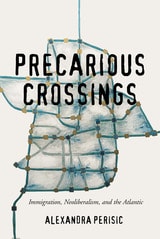
Precarious Crossings
Immigration, Neoliberalism, and the AtlanticAlexandra Perisic
The Ohio State University Press, 2019
With global debt, labor, and environmental crises on the rise, the precarious position of people in the Global South has become a significant force moving people across countries, continents, and around the world. Through a comparative study of contemporary trans-Atlantic immigrant narratives in French, Spanish, and English, Alexandra Perisic offers an account of a multilingual Atlantic under neoliberalism. More specifically, Precarious Crossings: Immigration, Neoliberalism, and the Atlantic examines how contemporary authors from the Caribbean, Sub-Saharan Africa, and Latin America—including Roberto Bolaño, Giannina Braschi, Maryse Condé, Fatou Diome, Marie Ndiaye, and Caryl Phillips, among others—have reconceptualized the Atlantic from a triangular space into a multipolar one, introducing new destinations for contemporary immigrants and establishing new Atlantic connections.
Perisic argues that in traveling beyond the postcolonial route that connects former colonizer and former colonized, these authors also shift their focus from cultural difference and national belonging to precarity—a condition characterized by a lack of economic and social stability and protection—as a shared characteristic under global neoliberalization. She demonstrates how contemporary Atlantic narratives reveal the contradictions inherent in neoliberalism as an ideology—thereby showing how they further participate in Atlantic literary and cultural dialogues and push against literary conventions of various genre as they explore the complexities of a globalized Atlantic.
Perisic argues that in traveling beyond the postcolonial route that connects former colonizer and former colonized, these authors also shift their focus from cultural difference and national belonging to precarity—a condition characterized by a lack of economic and social stability and protection—as a shared characteristic under global neoliberalization. She demonstrates how contemporary Atlantic narratives reveal the contradictions inherent in neoliberalism as an ideology—thereby showing how they further participate in Atlantic literary and cultural dialogues and push against literary conventions of various genre as they explore the complexities of a globalized Atlantic.
[more]
Profiles and Plotlines
Data Surveillance in Twenty-first Century LiteratureKatherine D. Johnston
University of Iowa Press, 2023
Algorithmic data profiling is not merely an important topic in contemporary fiction, it is an increasingly dominant form of storytelling and characterization in our society. These stories are being told inside boardrooms, banks, presidential briefings, police stations, advertising agencies, and technology companies. And so, to the extent that data has taken up storytelling, literature must take up data. After all, profiling coincides with character development; surveillance reflects point of view; and data points track as plot points in tales of the political economy.
In Profiles and Plotlines, Katherine Johnston engages this energetic reformation of contemporary literature to account for a society and economy of frenetic counting. Fiction and poetry are capable of addressing precisely that for which algorithms cannot or do not account: the effects of profile culture; the ideologies and supposed truth-power of data; the gendered and racialized dynamics of watching and being watched; and the politics of who counts and what gets counted. Johnston analyzes prescient work by contemporary authors such as Jennifer Egan, Claudia Rankine, Mohsin Hamid, and William Gibson to probe how the claims of data surveillance serve to make lives seem legible, intelligible, and sometimes even expendable.
In Profiles and Plotlines, Katherine Johnston engages this energetic reformation of contemporary literature to account for a society and economy of frenetic counting. Fiction and poetry are capable of addressing precisely that for which algorithms cannot or do not account: the effects of profile culture; the ideologies and supposed truth-power of data; the gendered and racialized dynamics of watching and being watched; and the politics of who counts and what gets counted. Johnston analyzes prescient work by contemporary authors such as Jennifer Egan, Claudia Rankine, Mohsin Hamid, and William Gibson to probe how the claims of data surveillance serve to make lives seem legible, intelligible, and sometimes even expendable.
[more]
Pushkin on Literature
Tatiana Wolff
Northwestern University Press, 1998
Pushkin on Literature approaches Pushkin's literary accomplishment from a unique perspective: it focuses on Pushkin the critic, and on his passionate enthusiasm, volatile judgments, joy, frustration, and fascination with the literary world that surrounded him. This is the only English-language edition of the complete set of Pushkin's critical writing, both on his own work and on the wide range of European literature--Byron, Shakespeare, Voltaire, Milton--which he read and studied, and which so profoundly influenced his own writing.
[more]