85 books match the query 'Literature and history' and 4 start with p
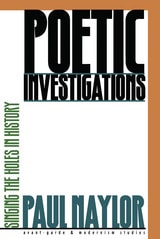
cover of Poetic Investigations: Singing the Holes in History

Poetic Investigations

Singing the Holes in History

Paul Naylor

Northwestern University Press, 1999
Poetic Investigations studies five contemporary writers whose radical engagements with poetic form and political content shed new light on issues of race, class, and gender. In a detailed reading of three American poets—Susan Howe, Nathaniel Mackey, and Lyn Hejinian—and two African-Caribbean poets, Kamau Brathwaite and M. Nourbese Philip, Paul Naylor argues that these writers have produced new forms of poetry that address the "holes," or erasures, in history that more traditional poetry neglects.
[more]
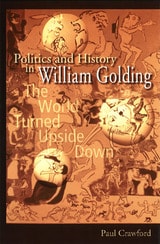
cover of Politics and History in William Golding: The World Turned Upside Down

Politics and History in William Golding

The World Turned Upside Down

Paul Crawford

University of Missouri Press, 2002
Politics and History in William Golding provides a much needed politicized and historicized reading of William Golding’s novels as a counter to previous, universalizing criticism. Paul Crawford argues that an understanding of fantastic and carnivalesque modes in Golding’s work is vital if we are to appreciate fully his interrogation of twentieth-century life.
            Golding’s early satirical novels question English constructions of national identity in opposition to Nazism and the “totalitarian personality.” For Crawford, Golding can and must be studied in the wider European tradition of “literature of atrocity.” His early novels, especially Lord of the Flies, are preoccupied with atrocity, whereas the later work betrays a greater concern for the status of language and literature.
In Golding’s later fiction, such as Darkness Visible, the fantastic and carnivalesque are used in an increasingly nonsatirical manner to complement first modernist and then postmodernist self-consciousness and indeterminacy. Even his critique of class and religious authority, which carries through all of his fiction, gives way to more lighthearted productions—a symptom of which is his crude, absurd attack against the English literary industry in The Paper Men. This reduction of satire marks a decline in Golding’s political commitment and the production of more complex and arguably less satisfying novels.
            The fantastic and carnivalesque are foundational to both the satirical and nonsatirical approaches that mark Golding’s early and late fiction. No previous study has analyzed this structure that is so central to his work. Politics and History in William Golding examines this writer’s work more fully than it has been studied within the convoluted context of the last half of the twentieth century. Crawford directly links Golding’s various deployments of the fantastic and carnivalesque to historical, political, and social change.
[more]
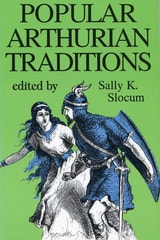
cover of Popular Arthurian Traditions

Popular Arthurian Traditions

Sally K. Slocum

University of Wisconsin Press, 1992
From medieval history and romance through various twentieth-century renderings, this collection of essays considers themes, characters, and events of the legend and the meanings they impart. Sir Thomas Malory, Chrétien de Troyes, Mark Twain, Thomas Berger, Marion Zimmer Bradley, C. J. Cherryh, and other prose writers are discussed as are comic books and other genres. Film interpretations, photographic illustrations, and musical expressions receive analytical attention, as do poetic, religious, and mythic uses of the Arthurian world.
[more]
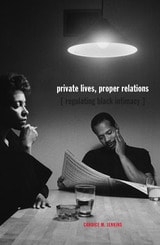
cover of Private Lives, Proper Relations: Regulating Black Intimacy

Private Lives, Proper Relations

Regulating Black Intimacy

Candice M. Jenkins

University of Minnesota Press, 2007

Private Lives, Proper Relations begins with the question of why contemporary African American literature—particularly that produced by black women—is continually concerned with issues of respectability and propriety. Candice M. Jenkins argues that this preoccupation has its origins in recurrent ideologies about African American sexuality, and that it expresses a fundamental aspect of the racial self—an often unarticulated link between the intimate and the political in black culture.

In a counterpoint to her paradigmatic reading of Nella Larsen’s Passing, Jenkins’s analysis of black women’s narratives—including Ann Petry’s The Street, Toni Morrison’s Sula and Paradise, Alice Walker’s The Color Purple, and Gayl Jones’s Eva’s Man—offers a theory of black subjectivity. Here Jenkins describes middle-class attempts to rescue the black community from accusations of sexual and domestic deviance by embracing bourgeois respectability, and asserts that behind those efforts there is the “doubled vulnerability” of the black intimate subject. Rather than reflecting a DuBoisian tension between race and nation, to Jenkins this vulnerability signifies for the African American an opposition between two poles of potential exposure: racial scrutiny and the proximity of human intimacy. 

Scholars of African American culture acknowledge that intimacy and sexuality are taboo subjects among African Americans precisely because black intimate character has been pathologized. Private Lives, Proper Relations is a powerful contribution to the crucial effort to end the distortion still surrounding black intimacy in the United States.

Candice M. Jenkins is associate professor of English at Hunter College, City University o

[more]