Results by title
57 books match the query 'Literature and science' and 2 start with p
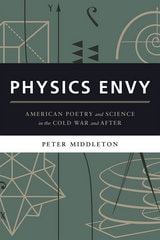
Physics Envy
American Poetry and Science in the Cold War and AfterPeter Middleton
University of Chicago Press, 2015
At the close of the Second World War, modernist poets found themselves in an increasingly scientific world, where natural and social sciences claimed exclusive rights to knowledge of both matter and mind. Following the overthrow of the Newtonian worldview and the recent, shocking displays of the power of the atom, physics led the way, with other disciplines often turning to the methods and discoveries of physics for inspiration.
In Physics Envy, Peter Middleton examines the influence of science, particularly physics, on American poetry since World War II. He focuses on such diverse poets as Charles Olson, Muriel Rukeyser, Amiri Baraka, and Rae Armantrout, among others, revealing how the methods and language of contemporary natural and social sciences—and even the discourse of the leading popular science magazine Scientific American—shaped their work. The relationship, at times, extended in the other direction as well: leading physicists such as Robert Oppenheimer, Werner Heisenberg, and Erwin Schrödinger were interested in whether poetry might help them explain the strangeness of the new, quantum world. Physics Envy is a history of science and poetry that shows how ultimately each serves to illuminate the other in its quest for the true nature of things.
In Physics Envy, Peter Middleton examines the influence of science, particularly physics, on American poetry since World War II. He focuses on such diverse poets as Charles Olson, Muriel Rukeyser, Amiri Baraka, and Rae Armantrout, among others, revealing how the methods and language of contemporary natural and social sciences—and even the discourse of the leading popular science magazine Scientific American—shaped their work. The relationship, at times, extended in the other direction as well: leading physicists such as Robert Oppenheimer, Werner Heisenberg, and Erwin Schrödinger were interested in whether poetry might help them explain the strangeness of the new, quantum world. Physics Envy is a history of science and poetry that shows how ultimately each serves to illuminate the other in its quest for the true nature of things.
[more]
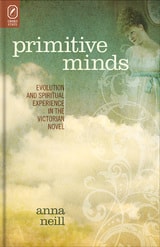
Primitive Minds
Evolution and Spiritual Experience in the Victorian NovelAnna Neill
The Ohio State University Press, 2013
For twenty-first-century veterans of the evolution culture wars, Primitive Minds: Evolution and Spiritual Experience in the Victorian Novel, by Anna Neill, makes unlikely bedfellows of two Victorian “discoveries”: evolutionary theory and spiritualism. Victorian science did much to uncover the physical substratum of mystical or dreamy experience, tracing spiritual states to a lower, reflex, or more evolutionarily primitive stage of consciousness. Yet science’s pursuit of knowledge beyond sense-based evidence uncannily evoked powers associated with this primitive mind: the capacity to link events across space and time, to anticipate the future, to uncover elements of the forgotten past, and to see into the minds of others.
Neill does not ask how the Victorians explained away spiritual experience through physiological psychology, but instead explores how physical explanation interacted with dreamy content in Victorian accounts of the mind’s most exotic productions. This synthesis, she argues, was particularly acute in realist fiction, where, despite novelists’ willingness to trace the nervous origins of individual behavior and its social consequences, activity in hidden regions of the mind enabled levels of perception inaccessible to ordinary waking thought. The authors in her study include Charlotte Brontë, Charles Dickens, George Eliot, Arthur Conan Doyle, and Thomas Hardy.
[more]