Results by title
99 books match the query 'Local' and 7 start with p
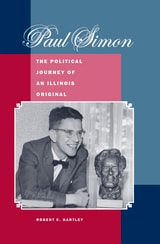
Paul Simon
The Political Journey of an Illinois OriginalRobert E. Hartley
Southern Illinois University Press, 2009
With Paul Simon: The Political Journey of an Illinois Original, author Robert E. Hartley presents the first thorough, objective volume on the journalistic and political career of one of Illinois’s most respected public figures. Hartley’s detailed account offers a fully rounded portrait of a man whose ideals and tenacity not only spurred reform on both state and national levels during his celebrated forty-year career but also established the lasting legacy of a political legend.
Simon first became a public figure at the age of nineteen, when he assumed the post of editor and publisher of a weekly newspaper in Troy, Illinois. From there, he used his paper to launch a fierce crusade against the crime and corruption plaguing Madison County. This battle sparked his entry into politics, helping to land him a seat in the state legislature in 1954. While serving, he campaigned tirelessly according to his principles, earning him the mass voter approval that would usher him into the seat of lieutenant governor in 1968—the first person elected to that position who did not share party affiliation with the governor.
As lieutenant governor, Simon initiated many changes to the position, remaking it to better serve the citizens of the state of Illinois. The cornerstone of his reform plan was an ombudsman program designed to allow the people of the state to voice problems they had with government and state agencies. The program, extremely popular with the public and the press, solved problems and helped to make Simon a household name throughout Illinois. Although he faced challenges along the way, including racial upheaval in Cairo and the student and police riots on the Carbondale campus of Southern Illinois University, Simon’s outspoken honesty and strong support of his constituents earned him the utmost esteem and popularity.
While his 1972 bid for governor of Illinois ultimately failed, this did not deter Simon from his dedication to social progress. In 1974 he began his remarkable twenty-two-year career in the U.S. House of Representatives and Senate, where he earned the admiration of the country for his political integrity. Despite the praise and support Simon had earned during his time in Washington, he was unable to win the Democratic presidential nomination in 1988 and returned to the Senate, winning a second term in 1990. Simon committed time and energy to the myriad issues of interest to him, especially in the field of education, with one of his biggest successes coming with the passage of the National Literacy Act, which he sponsored. He continued to foster his ties to journalism throughout his lengthy political career, authoring numerous books, articles, and columns, all of which he used to relentlessly promote open government and social programs.
This vivid account of the public life of Paul Simon reveals a man whose personal honor and dedication were unshakeable throughout nearly half a century in the political arena. Robert E. Hartley provides a candid perspective on Simon’s accomplishments and victories, as well as his mistakes and losses, revealing new insights into the life of this dynamic and widely respected public figure.
Planning the City upon a Hill
Boston since 1630Lawrence W. Kennedy
University of Massachusetts Press, 1992
Police
Streetcorner PoliticiansWilliam K. Muir Jr.
University of Chicago Press, 1979
"Other social scientists have observed policemen on patrol, or have interviewed them systematically. Professor Muir has brought the two together, and, because of the philosophical depth he brings to his commentaries, he has lifted the sociology of the police on to a new level. He has both observed the men and talked with them at length about their personal lives, their conceptions of society and of the place of criminals within it. His ambition is to define the good policeman and to explain his development, but his achievement is to illuminate the philosophical and occupational maturation of patrol officers in 'Laconia' (a pseudonym) . . . . His discussions of [the policemen's] moral development are threaded through with analytically suggestive formulations that bespeak a wisdom very rarely encountered in reports of sociological research."—Michael Banton, Times Literary Supplement
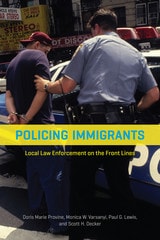
Policing Immigrants
Local Law Enforcement on the Front LinesDoris Marie Provine, Monica W. Varsanyi, Paul G. Lewis, and Scott H. Decker
University of Chicago Press, 2016
Policing Immigrants traces the transition of immigration enforcement from a traditionally federal power exercised primarily near the US borders to a patchwork system of local policing that extends throughout the country’s interior. Since federal authorities set local law enforcement to the task of bringing suspected illegal immigrants to the federal government’s attention, local responses have varied. While some localities have resisted the work, others have aggressively sought out unauthorized immigrants, often seeking to further their own objectives by putting their own stamp on immigration policing. Tellingly, how a community responds can best be predicted not by conditions like crime rates or the state of the local economy but rather by the level of conservatism among local voters. What has resulted, the authors argue, is a system that is neither just nor effective—one that threatens the core crime-fighting mission of policing by promoting racial profiling, creating fear in immigrant communities, and undermining the critical community-based function of local policing.
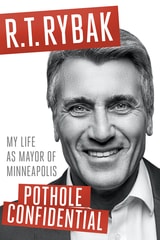
Pothole Confidential
My Life as Mayor of MinneapolisR.T. Rybak
University of Minnesota Press, 2016
A pajama party at the Minneapolis–St. Paul International Airport inadvertently helped launch R.T. Rybak’s political career (imagine a rumba line one hundred protesters long chanting, “We deserve to sleep, hey!”), but his earliest lessons in leadership occurred during his childhood. Growing up in a middle-class neighborhood, attending private school with students who had much more than he did, spending evenings at his family’s store in an area where people lived with much less, he witnessed firsthand the opportunity and injustice of the city he called home.
In a memoir that is at once a political coming-of-age story and a behind-the-scenes look at the running of a great city, the three-term mayor takes readers into the highs and lows and the daily drama of a life inextricably linked with Minneapolis over the past fifty years. With refreshing candor and insight, Rybak describes his path through journalism, marketing, and community activism that led to his unlikely (to him, at least) primary election—on September 11, 2001. His personal account of the challenges and crises confronting the city over twelve years, including the tragic collapse of the I-35W bridge, the rising scourge of youth violence, and the bruising fight over a ban on gay marriage (with Rybak himself conducting the first such ceremony at City Hall on August 1, 2013), is also an illuminating, often funny depiction of learning the workings of the job, frequently on the fly, while trying to keep up with his most important constituency, his family.
As bracing as the “fresh air” campaign that swept him into office, Rybak’s memoir is that rare document from a politician: one more concerned with the people he served and the issues of his time than with burnishing his own credentials. As such, it reflects what leadership truly looks like.
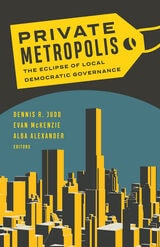
Private Metropolis
The Eclipse of Local Democratic GovernanceDennis R. Judd
University of Minnesota Press, 2021
Examines the complex ecology of quasi-public and privatized institutions that mobilize and administer many of the political, administrative, and fiscal resources of today’s metropolitan regions
In recent decades metropolitan regions in the United States have witnessed the rise of multitudes of “shadow governments” that often supersede or replace functions traditionally associated with municipalities and other local governments inherited from the urban past. Shadow governments take many forms, ranging from billion-dollar special authorities that span entire urban regions, to public–private partnerships and special districts created to accomplish particular tasks, to privatized gated communities, to neighborhood organizations empowered to receive private and public funds. They finance and administer public services ranging from the prosaic (garbage collection and water utilities) to the transformative (economic development and infrastructure). Private Metropolis demonstrates that this complex ecosystem of local governance has compromised and even eclipsed democratic processes by moving important policy decisions out of public sight.
The quasi-public institutions of urban governance generally escape the budgetary and statutory restraints imposed on traditional local governments and protect policy decisions from the limitations and vagaries of electoral politics. Moving major policy decisions into a privatized and corporatized realm facilitates efficiency and speed, but at the cost of democratic oversight. Increasingly, the urban electorate is left debating symbolic issues only tangentially connected to the actual distribution of the resources that affect people’s lives.
The essays in Private Metropolis grapple with the difficult and timely questions that arise from this new ecology of governance: What are the consequences of the proliferation of special authorities, privatized governments, and public–private arrangements? Is the trade-off between democratic accountability and efficiency worth it? Has the public sector, with its messiness and inefficiencies—but also its checks and balances—ceded too much power to these new institutions? By examining such questions, this book provokes a long-overdue debate about the future of urban governance.
Contributors: Douglas Cantor, California State U, Long Beach; Ellen Dannin, Pennsylvania State U; Jameson W. Doig, Princeton U; Mary Donoghue; Peter Eisinger, New School; Steven P. Erie, U of California, San Diego; Rebecca Hendrick, U of Illinois at Chicago; Sara Hinkley, U of California, Berkeley; Amanda Kass, U of Illinois at Chicago; Scott A. MacKenzie, U of California, Davis; David C. Perry, U of Illinois at Chicago; James M. Smith, U of Indiana South Bend; Shu Wang, Michigan State U; Rachel Weber, U of Illinois at Chicago.
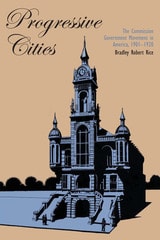
Progressive Cities
The Commission Government Movement in America, 1901–1920By Bradley Robert Rice
University of Texas Press, 1977
Although the commission government movement is often treated by historians as an element of the reform surge of the Progressive Era, this is the first full-scale study of the origins, spread, and decline of the commission idea.
Commission government originated in Galveston, Texas, where business leaders conceived the plan as a temporary measure to speed recovery from the great hurricane of 1900. Other cities in Texas and across the nation soon followed; by 1920, about 500 municipalities had adopted the plan in which elected representatives serve as heads of city departments and, collectively, as a policy-making body.
Beginning with Galveston and Houston and Des Moines, Iowa, Bradley Robert Rice presents detailed case studies of the earliest commission cities and shows how the plan was developed and modified to suit each community’s needs. He goes on to chronicle the adoption of the commission plan by other cities across the country that strove for “businesslike efficiency” as a reaction against corruption and machine politics in urban government. Most commission charters included a wide-ranging package of municipal reforms, such as the short ballot, at-large representation, nonpartisanship, civil service, and direct legislation. Yet Rice shows that the commission plan generally offered little in the way of social reform to accompany its reorganization of municipal government.
Applying a model of innovation diffusion, the author analyzes how and why the new form of city government spread across Progressive Era America. He also thoroughly explores the relationship between the commission plan and other Progressive Era reforms and reports on the reasons for its decline from both a social and a practical perspective.
Progressive Cities is described by Professor Bruce M. Stave, editor of the Journal of Urban History, as “a sound piece of work which should make a useful and worthwhile contribution to the existing scholarship on urban reform and should appeal to an audience which cuts across disciplines: history, political science, urban studies and urban planning.”