66 books match the query 'Masculinity in literature' and 3 start with p
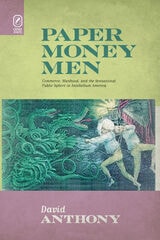
cover of Paper Money Men: Commerce, Manhood, and the Sensational Public Sphere in Antebellum America

Paper Money Men

Commerce, Manhood, and the Sensational Public Sphere in Antebellum America

David Anthony

The Ohio State University Press, 2009
Paper Money Men: Commerce, Manhood, and the Sensational Public Sphere in Antebellum America by David Anthony outlines the emergence of a “sensational public sphere” in antebellum America. It argues that this new representational space reflected and helped shape the intricate relationship between commerce and masculine sensibility in a period of dramatic economic upheaval. Looking at a variety of sensational media—from penny press newspapers and pulpy dime novels to the work of well-known writers such as Irving, Hawthorne, and Melville—this book counters the common critical notion that the period’s sensationalism addressed a primarily working-class audience. Instead, Paper Money Men shows how a wide variety of sensational media was in fact aimed principally at an emergent class of young professional men. “Paper money men” were caught in the transition from an older and more stable mercantilist economy to a panic-prone economic system centered on credit and speculation. And, Anthony argues, they found themselves reflected in the sensational public sphere, a fantasy space in which new models of professional manhood were repeatedly staged and negotiated. Compensatory in nature, these alternative models of manhood rejected fiscal security and property as markers of a stable selfhood, looking instead toward intangible factors such as emotion and race in an effort to forge a secure sense of manhood in an age of intense uncertainty.
[more]
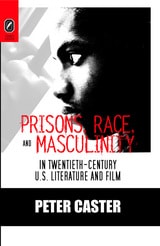
cover of Prisons, Race, and Masculinity in Twentieth-Century U.S. Literature and Film

Prisons, Race, and Masculinity in Twentieth-Century U.S. Literature and Film

Peter Caster

The Ohio State University Press, 2008

In Prisons, Race, and Masculinity, Peter Caster demonstrates the centrality of imprisonment in American culture, illustrating how incarceration, an institution inseparable from race, has shaped and continues to shape U.S. history and literature in the starkest expression of what W. E. B. DuBois famously termed “the problem of the color line.”

A prison official in 1888 declared that it was the freeing of slaves that actually created prisons: “we had to establish means for their control. Hence came the penitentiary.” Such rampant racism co ntributed to the criminalization of black masculinity in the cultural imagination, shaping not only the identity of prisoners (collectively and individually) but also America’s national character. Caster analyzes the representations of imprisonment in books, films, and performances, alternating between history and fiction to describe how racism influenced imprisonment during the decline of lynching in the 1930s, the political radicalism in the late 1960s, and the unprecedented prison expansion through the 1980s and 1990s. Offering new interpretations of familiar works by William Faulkner, Eldridge Cleaver, and Norman Mailer, Caster also engages recent films such as American History X, The Hurricane, and The Farm: Life Inside Angola Prison alongside prison history chronicled in the transcripts of the American Correctional Association. This book offers a compelling account of how imprisonment has functioned as racial containment, a matter critical to U.S. history and literary study.
[more]
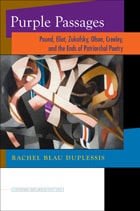
cover of Purple Passages: Pound, Eliot, Zukofsky, Olson, Creeley, and the Ends of Patriarchal Poetry

Purple Passages

Pound, Eliot, Zukofsky, Olson, Creeley, and the Ends of Patriarchal Poetry

Rachel Blau DuPlessis

University of Iowa Press, 2012

What is patriarchal poetry? How can it be both attractive and tempting and yet be so hegemonic that it is invisible? How does it combine various mixes of masculinity, femininity, effeminacy, and eroticism? At once passionate and dispassionate, Rachel Blau DuPlessis meticulously outlines key moments of choice and debate about masculinity among writers as disparate as Ezra Pound, T. S. Eliot, Louis Zukofsky, Charles Olson, Robert Creeley, and Allen Ginsberg, choices that construct consequential models for institutions of poetic practice.
As DuPlessis writes, “There are no genderless subjects in any relationship structuring literary culture: not in production, dissemination, or reception; not in objects, discourses, or practices; not in reading experiences or in interpretations.” And, as she reveals in careful and enthralling detail, for the poets at the center of this book, questions of masculinity loomed large and were continuously articulated in their self-creation as writers, in literary bonding, and in its deployment.
These gender-laden choices, debates, and contradictions all have a striking influence today. In this empathic yet critical historical polemic, DuPlessis reveals the outcomes of these many investments in the radical reconstruction of masculinity, in their strains, incompleteness, tensions—and failures. At the heart of modernist maleness and poetic practices are contradictions and urgencies, gender ideas both progressive and defensive.In a striking book on male behavior in poetic dyads, the third book in a feminist critical trilogy, DuPlessis tracks the poetic debates and arguments about gender that continuously affirm patriarchal poetry.
[more]