Results by title
58 books match the query 'Mass media and culture' and 5 start with p
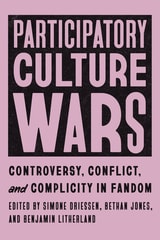
Participatory Culture Wars
Controversy, Conflict, and Complicity in FandomSimone Driessen
University of Iowa Press, 2025
Fans, fandoms, and fan practices are no longer the realm of media and popular culture; they have been adopted and co-opted across the contemporary political terrain. This volume offers specific examples and suggests approaches that can help make sense of the constantly shifting interaction between fandom and politics.
Contributors:
Alfred Archer, Renee Barnes, Simone Driessen, Xing Fan, Monica Flegel, Zoe Hurley, Bethan Jones, Sklaerenn Le Gallo, Judith Leggatt, Georgina Mills, Peng Qiao, James Rendell, Mel Stanfill, Michelle Stewart, Rebecca Williams, Christina Wurst
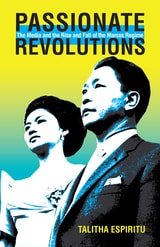
Passionate Revolutions
The Media and the Rise and Fall of the Marcos RegimeTalitha Espiritu
Ohio University Press, 2017
In the last three decades, the dictatorship of Ferdinand Marcos has commanded the close scrutiny of scholars. These studies have focused on the political repression, human rights abuses, debt-driven growth model, and crony capitalism that defined Marcos’ so-called Democratic Revolution in the Philippines. But the relationship between the media and the regime’s public culture remains underexplored.
In Passionate Revolutions, Talitha Espiritu evaluates the role of political emotions in the rise and fall of the Marcos government. Focusing on the sentimental narratives and melodramatic cultural politics of the press and the cinema from 1965 to 1986, she examines how aesthetics and messaging based on heightened feeling helped secure the dictator’s control while also galvanizing the popular struggles that culminated in “people power” and government overthrow in 1986.
In analyzing news articles, feature films, cultural policy documents, and propaganda films as national allegories imbued with revolutionary power, Espiritu expands the critical discussion of dictatorships in general and Marcos’s in particular by placing Filipino popular media and the regime’s public culture in dialogue. Espiritu’s interdisciplinary approach in this illuminating case study of how melodrama and sentimentality shape political action breaks new ground in media studies, affect studies, and Southeast Asian studies.

Playful Protest
The Political Work of Joy in Latinx MediaKristie Soares
University of Illinois Press, 2023
Joy is a politicized form of pleasure that goes beyond gratification to challenge norms of gender, sexuality, race, and class. Kristie Soares focuses on the diasporic media of Puerto Rico and Cuba to examine how music, public activist demonstrations, social media, sitcoms, and other areas of culture resist the dominant stories told about Latinx joy. As she shows, Latinx creators compose versions of joy central to social and political struggle and at odds with colonialist and imperialist narratives that equate joy with political docility and a lack of intelligence. Soares builds her analysis around chapters that delve into gozando in salsa music, precise joy among the New Young Lords Party, choteo in the comedy ¿Qué Pasa U.S.A.?, azúcar in the life and death of Celia Cruz, dale as Pitbull’s signature affect, and Alexandria Ocasio-Cortez’s use of silliness to take seriously political violence.
Daring and original, Playful Protest examines how Latinx creators resist the idea that joy only exists outside politics and activist struggle.
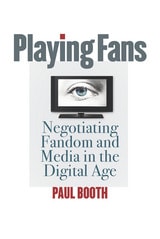
Playing Fans
Negotiating Fandom and Media in the Digital AgePaul Booth
University of Iowa Press, 2015
In Playing Fans, Paul Booth argues that the more attention entertainment businesses pay to fans, the more mainstream fans have become popularized. But such mainstreaming ignores important creative fan work and tries to channel fandom into activities lucrative for the companies. Offering a new approach to the longstanding debate about the balance between manipulation and subversion in popular culture, the author argues that we can understand the current moment best through the concepts of pastiche and parody. This sophisticated alternative to conceiving of fans as either dupes of the media industry or rebels against it takes the discussion of “transformative” and “affirmative” fandom in a productive new direction.
With nuanced analyses of the Doctor Who Experience in Cardiff, the representations of fans in TV shows like Community and films like Fanboys, SuperWhoLock fans’ use of gifs, and the similarities in discussions of slash fandom and pornographic parody films, this book reveals how fans borrow media techniques and media industries mimic fan activities. Just as the entertainment industry needs fans to succeed, so too do fans need—and desire—the media, and they represent their love through gif fics, crowdfunding, and digital cosplay. Everyone who wants to understand how consumers are making themselves at home in the brave new world being built by the contemporary media should read this book.
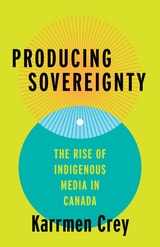
Producing Sovereignty
The Rise of Indigenous Media in CanadaKarrmen Crey
University of Minnesota Press, 2024
Exploring how Indigenous media has flourished across Canada from the 1990s to the present
In the early 1990s, Indigenous media experienced a boom across Canada, resulting in a vast landscape of film, TV, and digital media. Coinciding with a resurgence of Indigenous political activism, Indigenous media highlighted issues around sovereignty and Indigenous rights to broader audiences in Canada. In Producing Sovereignty, Karrmen Crey considers the conditions—social movements, state policy, and evolutions in technology—that enabled this proliferation.
Exploring the wide field of media culture institutions, Crey pays particular attention to those that Indigenous media makers engaged during this cultural moment, including state film agencies, arts organizations, provincial broadcasters, and more. Producing Sovereignty ranges from the formation of the Aboriginal Film and Video Art Alliance in the early 1990s and its partnership with the Banff Centre for the Arts to the Canadian Broadcasting Corporation’s 2016 production of Highway of Tears—an immersive 360-degree short film directed by Anishinaabe filmmaker Lisa Jackson—highlighting works by Indigenous creators along the way and situating Indigenous media within contexts that pay close attention to the role of media-producing institutions.
Importantly, Crey focuses on institutions with limited scholarly attention, shifting beyond the work of the National Film Board of Canada to explore lesser-known institutions such as educational broadcasters and independent production companies that create programming for the Aboriginal Peoples Television Network. Through its refusal to treat Indigenous media simply as a set of cultural aesthetics, Producing Sovereignty offers a revealing media history of this cultural moment.