Results by title
204 books match the query 'Massachusetts' and 4 start with p

Pain and Shock in America
Politics, Advocacy, and the Controversial Treatment of People with DisabilitiesJan Nisbet
Brandeis University Press, 2021
The first book to be written on the Judge Rotenberg Center and their use of painful interventions to control the behavior of children and adults with disabilities.
For more than forty years, professionals in the field of disability studies have engaged in debates over the use of aversive interventions (such as electric shock) like the ones used at the Judge Rotenberg Center. Advocates and lawyers have filed complaints and lawsuits to both use them and ban them, scientists have written hundreds of articles for and against them, and people with disabilities have lost their lives and, some would say, lived their lives because of them. There are families who believe deeply in the need to use aversives to control their children’s behavior. There are others who believe the techniques used are torture. All of these families have children who have been excluded from numerous educational and treatment programs because of their behaviors. For most of the families, placement at the Judge Rotenberg Center is the last resort.
This book is a historical case study of the Judge Rotenberg Center, named after the judge who ruled in favor of keeping its doors open to use aversive interventions. It chronicles and analyzes the events and people involved for over forty years that contributed to the inability of the state of Massachusetts to stop the use of electric shock, and other severe forms of punishment on children and adults with disabilities. It is a long story, sad and tragic, complex, filled with intrigue and questions about society and its ability to protect and support its most vulnerable citizens.
[more]
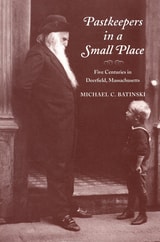
Pastkeepers in A Small Place
Five Centuries in Deerfield, MassachusettsMichael C. Batinski
University of Massachusetts Press, 2004
People know who they are by fixing themselves in place and time. They keep the past in numerous ways—not simply by writing histories but also by telling stories, creating pictures, collecting memorabilia, preserving old homes, and tracing genealogies. As Michael C. Batinski shows in this imaginative study, the pastkeepers of Deerfield, Massachusetts, have long illustrated this human yearning to connect with past and place. For five centuries people in this small New England town have passed stories from one generation to the next, preserved homes, and established one of the nation's first historical societies and local history museums.
Like many small places in the American landscape, Batinski points out, Deerfield does not fit into the history we learn in textbooks. With the exception of the famous French and Indian raid on the town in 1704, nothing of national significance has happened there. Yet that has not diminished the interest of local inhabitants in establishing and maintaining a vital connection to the past.
Different groups, from Native Pocumtuck to Puritan settlers to the grandchildren of Polish immigrants, have told the Deerfield story in varied and sometimes conflicting ways, each drawing on the past to shape its own sense of collective identity. Together their efforts at pastkeeping reveal how people organize and explain the motion of time, why they feel it important to pass on family stories, and why they keep family heirlooms. In doing so, Batinski argues, they illustrate why the preservation of the past remains a civic concern to us all.
[more]
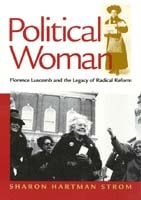
Political Woman
FlorenceSharon Strom
Temple University Press, 2001
Florence Hope Luscomb's life spanned nearly all of the twentieth century. Born into a remarkable family of abolitionists and progressive thinkers, the young Florence accompanied her feminist mother to lectures and political rallies, soon choosing a course of political engagement and social activism from which she never retreated.
Politcal Women counters the traditional narratives that place men at the center of political thinking and history. Showing how three generations of Luscomb's family had set the stage for her activism, this biography presents her story against the backdrop of Boston's politics and larger struggles for social justice. Luscomb participated in every significant social reform movement of her time -- from securing women's right to vote and supporting trade unionism to advocating an end to the war in Vietnam. Luscomb also ran for public office; she was narrowly defeated when she ran for Boston's city council in 1922. Although unsuccessful as a third-party candidate for Congress (in 1936 and 1950) and for Governor of Massachusetts (in 1952), she was one of the few women of her time to seek office. Independent, athletic, and spirited, she apparently never thought that traditional gender prescriptions applied to her. A practicing architect before the First World War, an exuberant hiker all her life, and a member in collective-living arrangements, Luscomb enjoyed a life of rich experiences and sustaining relationships.
In Florence Luscomb's biography, Sharon Hartman Strom suggests that although women were excluded from the activities and sites associated with conventional politics until recently, they did political work that gave purpose to their lives and affected political thinking in their communities, states, and ultimately the nation.
[more]
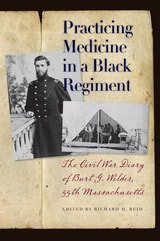
Practicing Medicine in a Black Regiment
The Civil War Diary of Burt G. Wilder, 55th MassachusettsRichard M. Reid
University of Massachusetts Press, 2010
In early 1863, in the aftermath of Abraham Lincoln's Emancipation Proclamation, Massachusetts began recruiting black soldiers to serve in the Civil War. Although the first regiment formed, the 54th Massachusetts, would become the best-known black regiment in the war, the second regiment raised, the 55th Massachusetts Volunteer Infantry, performed equally valuable service in the Union Army.
Burt Green Wilder, a Boston-born, Harvard-educated doctor-in-training, was among the first white officers commissioned to staff the 55th Massachusetts. Like other officers serving in the state's African American units, Wilder was selected for his military experience, his "firm Anti-Slavery principles," and his faith in the value of black troops. From the time he joined the 55th in May 1863 until the regiment was discharged in September 1865, Wilder recorded his experiences and observations. He described the day-to-day activities of a Civil War surgeon, the indignities suffered by black enlisted men at the hands of a War Department that denied them the same treatment offered to white troops, and the role of the regiment in the campaign around Charleston and in Florida.
Service in the southern states also allowed Wilder to indulge a passion for natural science and comparative anatomy, including the collection of unusual species, one of which—the spider known as Nephila wilderi—still bears his name. After the war he completed his medical studies at Harvard and joined the faculty of Cornell University, where he became a distinguished professor of zoology as well as an outspoken advocate of racial equality.
In his introduction to the volume, Richard M. Reid analyzes Burt Wilder's diary and places it within the context of the war, the experience of African American troops, and Wilder's life and career.
[more]