Results by title
209 books match the query 'Mathematics' and 8 start with p

Pairing STEAM with Stories
46 Hands-On Activities for ChildrenElizabeth M. McChesney
American Library Association, 2020
[more]
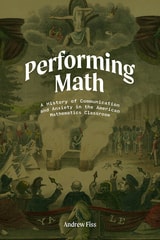
Performing Math
A History of Communication and Anxiety in the American Mathematics ClassroomAndrew Fiss
Rutgers University Press, 2021
Performing Math tells the history of expectations for math communication—and the conversations about math hatred and math anxiety that occurred in response. Focusing on nineteenth-century American colleges, this book analyzes foundational tools and techniques of math communication: the textbooks that supported reading aloud, the burnings that mimicked pedagogical speech, the blackboards that accompanied oral presentations, the plays that proclaimed performers’ identities as math students, and the written tests that redefined “student performance.” Math communication and math anxiety went hand in hand as new rules for oral communication at the blackboard inspired student revolt and as frameworks for testing student performance inspired performance anxiety. With unusual primary sources from over a dozen educational archives, Performing Math argues for a new, performance-oriented history of American math education, one that can explain contemporary math attitudes and provide a way forward to reframing the problem of math anxiety.
[more]

Philosophical Remarks
Ludwig Wittgenstein
University of Chicago Press, 1980
When in May 1930, the Council of Trinity College, Cambridge, had to decide whether to renew Wittgenstein's research grant, it turned to Bertrand Russell for an assessment of the work Wittgenstein had been doing over the past year. His verdict: "The theories contained in this new work . . . are novel, very original and indubitably important. Whether they are true, I do not know. As a logician who likes simplicity, I should like to think that they are not, but from what I have read of them I am quite sure that he ought to have an opportunity to work them out, since, when completed, they may easily prove to constitute a whole new philosophy."
"[Philosophical Remarks] contains the seeds of Wittgenstein's later philosophy of mind and of mathematics. Principally, he here discusses the role of indispensable in language, criticizing Russell's The Analysis of Mind. He modifies the Tractatus's picture theory of meaning by stressing that the connection between the proposition and reality is not found in the picture itself. He analyzes generality in and out of mathematics, and the notions of proof and experiment. He formulates a pain/private-language argument and discusses both behaviorism and the verifiability principle. The work is difficult but important, and it belongs in every philosophy collection."—Robert Hoffman, Philosophy
"Any serious student of Wittgenstein's work will want to study his Philosophical Remarks as a transitional book between his two great masterpieces. The Remarks is thus indispensible for anyone who seeks a complete understanding of Wittgenstein's philosophy."—Leonard Linsky, American Philosophical Association
[more]

Polynomial Methods in Optimal Control and Filtering
Kenneth Hunt
The Institution of Engineering and Technology, 1993
This book aims to demonstrate the power and breadth of polynomial methods in control and filtering. Direct polynomial methods have previously received little attention compared with the alternative Wiener-Hopf transfer-function method and the statespace methods which rely on Riccati equations.
[more]

Prediction and Regulation by Linear Least-Square Methods
Peter Whittle
University of Minnesota Press, 1963
Prediction and Regulation by Linear Least-Square Methods was first published in 1963. This revised second edition was issued in 1983. Minnesota Archive Editions uses digital technology to make long-unavailable books once again accessible, and are published unaltered from the original University of Minnesota Press editions.During the past two decades, statistical theories of prediction and control have assumed an increasing importance in all fields of scientific research. To understand a phenomenon is to be able to predict it and to influence it in predictable ways. First published in 1963 and long out of print, Prediction and Regulation by Linear Least-Square Methods offers important tools for constructing models of dynamic phenomena. This elegantly written book has been a basic reference for researchers in many applied sciences who seek practical information about the representation and manipulation of stationary stochastic processes. Peter Whittle’s text has a devoted group of readers and users, especially among economists. This edition contains the unchanged text of the original and adds new works by the author and a foreword by economist Thomas J. Sargent.
[more]

Probably Overthinking It
How to Use Data to Answer Questions, Avoid Statistical Traps, and Make Better DecisionsAllen B. Downey
University of Chicago Press, 2023
An essential guide to the ways data can improve decision making.
Statistics are everywhere: in news reports, at the doctor’s office, and in every sort of forecast, from the stock market to the weather. Blogger, teacher, and computer scientist Allen B. Downey knows well that people have an innate ability both to understand statistics and to be fooled by them. As he makes clear in this accessible introduction to statistical thinking, the stakes are big. Simple misunderstandings have led to incorrect medical prognoses, underestimated the likelihood of large earthquakes, hindered social justice efforts, and resulted in dubious policy decisions. There are right and wrong ways to look at numbers, and Downey will help you see which are which.
Probably Overthinking It uses real data to delve into real examples with real consequences, drawing on cases from health campaigns, political movements, chess rankings, and more. He lays out common pitfalls—like the base rate fallacy, length-biased sampling, and Simpson’s paradox—and shines a light on what we learn when we interpret data correctly, and what goes wrong when we don’t. Using data visualizations instead of equations, he builds understanding from the basics to help you recognize errors, whether in your own thinking or in media reports. Even if you have never studied statistics—or if you have and forgot everything you learned—this book will offer new insight into the methods and measurements that help us understand the world.
[more]
Proximity and Preference
Problems in the Multidimensional Analysis of Large Data SetsReginald Golledge
University of Minnesota Press, 1982
Proximity and Preference was first published in 1982.How does one design experiments for collecting large volumes of data such as those needed for marketing surveys, studies of travel patterns, and public opinion polls? This is a common problem for social and behavioral scientists. The papers in this collection address the problems of working with large data sets primarily from the perspectives of geography and psychology, two fields that share a common quantitative research methodology.After an introductory paper on substantive and methodological aspects of the interface between geography and psychology, the book is divided into three sections, experimental design and measurement problems, preference functions and choice behavior, and special problems of analyzing large data sets with multidimensional methods. Each paper is directed toward some fundamental problem such as those relating to experimental design, data reliability, and the selection of analytical methods which are appropriate for data sets of various sizes, completeness, and reliability.
[more]

Pushing the Envelope
The American Aircraft IndustryDonald M. Pattillo
University of Michigan Press, 2001
Pushing the Envelope, a survey history of the American aircraft (now aerospace) manufacturing industry, is the most comprehensive history on the subject ever completed. Though it covers the development of the industry from the beginnings of flight to the present, it provides far more than a simple chronology by analyzing key economic, military, technical, and international influences on the industry and showing how the industry has been instrumental in American military and technological leadership from its modest beginnings. Using original sources whenever available, Pushing the Envelope focuses on the business of aircraft. It is neither an aeronautical nor a production history of the industry, although both aspects are addressed. Instead, Donald M. Pattillo features the development and production of aircraft in different periods in the context of aeronautical progress. Pushing the Envelope also establishes that the central fact of the industry's existence, its dependence on military contracts, has been simultaneously its greatest strength and greatest vulnerability. Even during periods of military expansion, Pattillo illustrates, it has always been an unstable and insecure enterprise. Carefully researched, Pushing the Envelope also assesses the environmental impacts on the industry, including those pressures that have often led it into ethical dispute. Unlike any other technological industry, the unique qualities of the aircraft industry are truly paradoxical -- although it provides vital technical and production capability to the nation, demand for its capabilities may be influenced by external developments that it cannot foresee or influence. Pushing the Envelope transcends narrow disciplines, commingling aeronautical science and technology, business management, international business, the history of science and technology, national security studies, and international relations. Written in nontechnical language, it can easily be understood by a diverse audience, including industry and military professionals as well as the general public interested in aviation and technology.
[more]