Results by title
164 books match the query 'Medical care' and 11 start with p
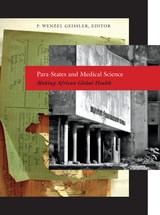
Para-States and Medical Science
Making African Global HealthP. Wenzel Geissler, editor
Duke University Press, 2015
Contributors. Uli Beisel, Didier Fassin, P. Wenzel Geissler, Rene Gerrets, Ann Kelly, Guillaume Lachenal, John Manton, Lotte Meinert, Vinh-Kim Nguyen, Branwyn Poleykett, Susan Reynolds Whyte
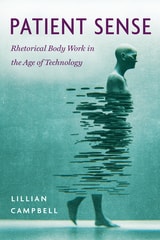
Patient Sense
Rhetorical Body Work in the Age of TechnologyLillian Campbell
The Ohio State University Press, 2025
In Patient Sense, Lillian Campbell introduces a theory of rhetorical body work and applies it to three distinct healthcare contexts: clinical nursing simulations, physical therapy labs, and tele-observation in a virtual intensive care unit. Drawing on sociological frameworks, she defines rhetorical body work as paid physical, emotional, or discursive labor performed at the material or technological interface of worker–client bodies. Such work is devalued within social and institutional systems and often gendered and racialized. Campbell captures the value of providers’ intuitive patient sense in the face of increasingly technology-mediated healthcare and intervenes in conversations about the future of healthcare training. Ultimately, she demonstrates that we will always need responsive healthcare providers whose rhetorical body work and patient sense cannot be replaced by technicians or algorithms.

Pedagogies of Woundedness
Illness, Memoir, and the Ends of the Model MinorityJames Kyung-Jin Lee
Temple University Press, 2022
The pressures Asian Americans feel to be socially and economically exceptional include an unspoken mandate to always be healthy. Nowhere is this more evident than in the expectation for Asian Americans to enter the field of medicine, principally as providers of care rather than those who require care. Pedagogies of Woundedness explores what happens when those considered model minorities critically engage with illness and medicine whether as patients or physicians.
James Kyung-Jin Lee considers how popular culture often positions Asian Americans as medical authorities and what that racial characterization means. Addressing the recent trend of writing about sickness, disability, and death, Lee shows how this investment in Asian American health via the model minority is itself a response to older racial forms that characterize Asian American bodies as diseased. Moreover, he pays attention to what happens when academics get sick and how illness becomes both methodology and an archive for scholars.
Pedagogies of Woundedness also explores the limits of biomedical “care,” the rise of physician chaplaincy, and the impact of COVID. Throughout his book and these case studies, Lee shows the social, ethical, and political consequences of these common (mis)conceptions that often define Asian Americans in regard to health and illness.
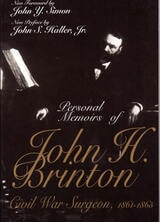
Personal Memoirs of John H. Brinton
Civil War Surgeon, 1861-1865John H. Brinton. Preface by John S. Haller, Jr. Foreword by John Y. Simon
Southern Illinois University Press, 1996
John Hill Brinton (1832–1907) met, observed, and commented on practically the entire hierarchy of the Union army; serving as medical director for Ulysses S. Grant, he came into contact with Philip H. Sheridan, John C. Frémont, Henry W. Halleck, William A. Hammond, D. C. Buell, John A. Rawlins, James Birdseye McPherson, C. F. Smith, John A. McClernand, William S. Rosecrans, and his first cousin George Brinton McClellan. John Y. Simon points out in his foreword that Brinton was one of the first to write about a relatively obscure Grant early in the war:
"Brinton found a quiet and unassuming man smoking a pipe—he could not yet afford cigars— and soon recognized a commander with mysterious strength of intellect and character."
Positioned perfectly to observe the luminaries of the military, Brinton also occupied a unique perspective from which to comment on the wretched state of health and medicine in the Union army and on the questionable quality of medical training he found among surgeons. With both A.B. and A.M. degrees from the University of Pennsylvania and postgraduate training in Paris and Vienna at a time when most medical schools required only a grammar school education, Brinton was exceptional among Civil War doctors. He found, as John S. Haller, Jr., notes in his preface, "the quality of candidates for surgeon’s appointments was meager at best." As president of the Medical Examining Board, Brinton had to lower his standards at the insistence of Secretary of War Edwin Stanton. Haller points out that one "self-educated candidate for an appointment as brigade surgeon explained to the board that he could do ‘almost anything, from scalping an Indian, up and down.’" Brinton assigned this singular candidate to duty in Kansas "where Brinton hoped he would do the least amount of damage." Throughout the war, the dearth of qualified surgeons created problems.
Brinton’s memoirs reveal a remarkable Civil War surgeon, a witness to conditions in Cairo, the Battle of Belmont, and the Siege of Fort Donelson who encountered almost every Union military leader of note.
Brinton wrote his memoirs for the edification of his family, not for public consumption. Yet he was, as Haller notes, a "keen observer of character." And with the exception of Brinton’s acceptance of late nineteenth-century gossip favorable to his cousin General McClellan, Simon finds the memoirs "remarkable for accuracy and frankness." His portrait of Grant is vivid, and his comments on the state of medicine during the war help explain, in Haller’s terms, why the "Civil War was such a medical and human tragedy."
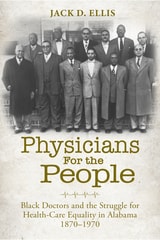
Physicians for the People
Black Doctors and the Struggle for Health-Care Equality in Alabama, 1870–1970Jack D. Ellis with a foreword by Alan I Marcus
University of Alabama Press, 2025
WINNER OF THE JAMES F. SULZBY AWARD
Healing against the odds—Black doctors, bold resistance, and the fight for medical justice in Alabama.
Physicians for the People chronicles the remarkable stories of 241 Black doctors who practiced medicine in Alabama during the Jim Crow era. Historian Jack D. Ellis reveals the ingenuity and resilience of these trailblazing doctors who defied segregation by establishing hospitals and clinics and providing vital healthcare to underserved Black communities.
This meticulously researched work draws on archival sources, oral histories, and an unparalleled database to dismantle the myth of a monolithic medical system in the Jim Crow South. Jack D. Ellis argues that the post–Civil War lives of Black physicians, dentists, pharmacists, nurses, and midwives hold special significance, illuminating both the causes of health care disparities among African Americans and the reasons for their continued underrepresentation in the medical professions.
Offering much of interest to students and scholars of Black history, medical history, and the civil rights movement, Physicians for the People exposes the deliberate exclusion faced by Black doctors within the white medical establishment and their ongoing fight for racial equality in medicine.
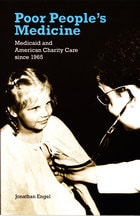
Poor People's Medicine
Medicaid and American Charity Care since 1965Jonathan Engel
Duke University Press, 2006
Starting with a brief overview of the history of charity medical care, Jonathan Engel presents the debates surrounding Medicaid’s creation and the compromises struck to allow federal funding of the nascent programs. He traces the development of Medicaid through the decades, as various states attempted to both enlarge the programs and more finely tailor them to their intended targets. At the same time, he describes how these new programs affected existing institutions and initiatives such as public hospitals, community clinics, and private pro bono clinical efforts. Along the way, Engel recounts the many political battles waged over Medicaid, particularly in relation to larger discussions about comprehensive health care and social welfare reform. Poor People’s Medicine is an invaluable resource for understanding the evolution and present state of programs to deliver health care to America’s poor.
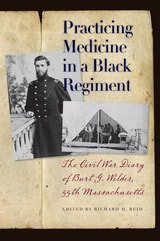
Practicing Medicine in a Black Regiment
The Civil War Diary of Burt G. Wilder, 55th MassachusettsRichard M. Reid
University of Massachusetts Press, 2010
Burt Green Wilder, a Boston-born, Harvard-educated doctor-in-training, was among the first white officers commissioned to staff the 55th Massachusetts. Like other officers serving in the state's African American units, Wilder was selected for his military experience, his "firm Anti-Slavery principles," and his faith in the value of black troops. From the time he joined the 55th in May 1863 until the regiment was discharged in September 1865, Wilder recorded his experiences and observations. He described the day-to-day activities of a Civil War surgeon, the indignities suffered by black enlisted men at the hands of a War Department that denied them the same treatment offered to white troops, and the role of the regiment in the campaign around Charleston and in Florida.
Service in the southern states also allowed Wilder to indulge a passion for natural science and comparative anatomy, including the collection of unusual species, one of which—the spider known as Nephila wilderi—still bears his name. After the war he completed his medical studies at Harvard and joined the faculty of Cornell University, where he became a distinguished professor of zoology as well as an outspoken advocate of racial equality.
In his introduction to the volume, Richard M. Reid analyzes Burt Wilder's diary and places it within the context of the war, the experience of African American troops, and Wilder's life and career.

Principles of Green Bioethics
Sustainability in Health CareCristina Richie
Michigan State University Press, 2019
Private Bodies, Public Texts
Race, Gender, and a Cultural BioethicsKarla FC Holloway
Duke University Press, 2011
Privatizing Health Services in Africa
Turshen, Meredeth
Rutgers University Press, 1998
Privatizing Health Services in Africa analyzes the disappearance of public health in the form of state services in Africa, and the growth of a private market in health care that will serve primarily an urban elite. Meredeth Turshen considers the implications of introducing private insurance in countries with growing unemployment, a shrinking formal job sector, and a lack of social security programs or other safety nets. She debates the pros and cons of shifting the delivery of health services to the nongovernmental sector in the context of new concepts of the role of the state. Many of the schemes to privatize the purchase and sale of pharmaceuticals reverse decades of United Nations work challenging the power of the multinational drug industry. Turshen weighs these policy changes in light of the World Bank’s eclipse of the World Health Organization as the premier UN health policy agency. Until now, no book has disputed the World Bank’s plans to privatize health care in Africa. This is the first book-length analysis of policy changes in light of monetarism and globalization.
Throughout the book, Turshen examines the implications of privatization for gender equity. She also provides a case study of Zimbabwe and comparative material from Malawi, Mozambique, and Zambia. Her study makes a contribution to current debates on the impact of structural adjustment policies on health and the design of health services in the Third World.
Purchasing Population Health
Paying for ResultsDavid A. Kindig
University of Michigan Press, 1997