Results by title
355 books match the query 'Middle Atlantic (DC, DE, MD, NJ, NY, PA)' and 15 start with p
Pennsylvania Stories--Well Told
William Ecenbarger
Temple University Press, 2017
A former journalist for the Philadelphia Inquirer Magazine, and author of the bestseller Kids for Cash, Ecenbarger has collected a dozen of his fascinating articles showcasing the Keystone State in Pennsylvania Stories—Well Told. He provides a history of the pencil, and considers why the first day of Pennsylvania’s deer hunting season—the world’s largest participatory sporting event—is an unofficial state holiday, closing schools and state offices. Ecenbarger also profiles George “Boom Boom” Zambelli, the internationally renowned pyrotechnic king, and goes driving with Pennsylvania native John Updike in rural Berks County, PA.
Other fascinating tales unfold in Pennsylvania Stories, from an inspiring tale of Governor Bob Casey’s double organ transplant, to darker essays on the electric chair and the Ku Klux Klan, to a mile-by-mile appreciation of the Pennsylvania Turnpike.
In these weird and wonderful stories, Ecenbarger highlights just what makes Pennsylvania both eccentric and great. His book is a delightfully intriguing read for natives and curious outsiders alike.
Pennsylvania
A Military HistoryWilliam A. Pencak
Westholme Publishing, 2016
Westholme State Military History Series
Each state in the United States of America has a unique military history. The volumes in this series seek to provide a portrait of the richness of each state’s military experience, primarily defined by its borders, as well as the important contributions the state has made to the nation’s military history. Written by historians for the general reader, the volumes trace the history of conflict from the original native populations to today. The volumes are well illustrated and include specially commissioned maps, extensive bibliographies, lists of national and state historical sites, and a detailed index.

Peruvians in Paterson
Building Businesses and CommunityGianncarlo Muschi
Rutgers University Press, 2027
Peruvians were among the first Latinos to arrive in Paterson and other cities in New Jersey during the post-WW II period. Over successive generations, they established a prosperous ethnic enclave that contributed to Paterson’s socioeconomic renewal. Yet their migration experience has remained relatively unexamined by scholars. This book examines the role of entrepreneurship and informality in the emergence and evolution of the Peruvian community of Paterson. It highlights the historical significance of the establishment of small businesses and social organizations as important cultural elements that validated their physical presence in the area. By uncovering the diverse strategies that Peruvians utilized for building a community, Muschi contends that their culture of informality and resourcefulness paved the way for their economic advancement and the consolidation of the Peruvian community. This book also shows that the informal economic practices introduced by Peruvians altered the social and economic landscape of Paterson and contributed to the revitalization of the local economy. Through the examination of oral histories, archival material from local newspapers, and memoirs declassified by the Peruvian consulate, the author challenges the oversimplified portrayal of Latinos as blue- collar workers with few opportunities for socioeconomic advancement. Peruvians in Paterson demonstrates that Latino migrants achieve wealth and ethnic empowerment in the process of adjustment and community building, suggesting new lines for future research.

Phil Jasner "On the Case"
His Best Writing on the Sixers, the Dream Team, and BeyondAndy Jasner
Temple University Press, 2017
Allen Iverson loved Philadelphia Daily News basketball beat reporter Phil Jasner, calling him “the best” in the world of sports journalism. From 1981 until his death in 2010, Jasner was always “on the case,” going to great lengths to track athletes down for a quote or a story. He was most known for covering the team’s famous players, including World B. Free and Bobby Jones, Julius Erving and Moses Malone, Charles Barkley, and, of course, Iverson. His tremendous output was beloved by players and fans alike, earning him many honors, including inductions into six Halls of Fame.
Phil Jasner “On the Case” collects the best of Jasner’s writing throughout his illustrious career. Jasner wrote about baseball, the Eagles, and the Philadelphia Atoms’ soccer with the same insight and aplomb he showed in his coverage of The Big 5, the 76ers’ championship season in 1983, and the Dream Team. Lovingly assembled—each chapter is introduced by some of the most prominent figures Jasner covered, from Vince Papale, Doug Collins, and Billy Cunningham to Iverson and Barkley—this collection recounts a distinguished sportswriter’s remarkable career.
Philadelphia Mural Arts @ 30
Jane Golden
Temple University Press, 2014
The Mural Arts Program of Philadelphia began in 1984 as a summer youth program with modest support from city government. Under the guidance of Jane Golden, however, it gradually grew into one of the largest and most successful public art organizations in the country, garnering support from local corporations, foundations, and individuals to extend the reach and effectiveness of its innovative programs.
Now three decades later, the Mural Arts Program has created more than 3,800 murals and public art projects that have made lasting imprints in every Philadelphia neighborhood. In the process, Mural Arts has engaged thousands of people of all ages from across the city, helped hundreds of ex-offenders train for new jobs, transformed the face of struggling commercial corridors, and developed funding partners in both public and private sectors.
While the Mural Arts Program has significantly changed the appearance of the city, it has also demonstrated how participatory public art can empower individuals and promote communal healing around difficult issues. Philadelphia Mural Arts @ 30 is a celebration of and guide to the program's success. Unlike Philadelphia Murals and the Stories They Tell and its sequel, More Philadelphia Murals and the Stories They Tell, Philadelphia Murals @ 30 showcases the results of 21 projects completed since 2009 and features essays by policy makers, curators, scholars, and educators that offer valuable lessons for artists, activists, and communities to emulate.
Philadelphia Mural Arts @ 30 traces the program's history and evolution, acknowledging the challenges and rewards of growth and change while maintaining a core commitment to social, personal, and community transformation.
Contributors include: Dr. Arthur C. Evans, Jr., Arlene Goldbard, Thora Jacobson, Rick Lowe, Dr. Samantha L. Matlin, Paulette Moore, Jeremy Nowak, Maureen H. O'Connell, Elisabeth Perez Luna, Robin Rice, Dr. Jacob Kraemer Tebes, Elizabeth Thomas, Cynthia Weiss, Howard Zehr, and the editors.
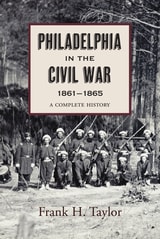
Philadelphia in the Civil War, 1861–1865
Frank H. Taylor
Westholme Publishing, 2014
First published one hundred years ago, Philadelphia in the Civil War presents the complete story of the city during America’s greatest conflict. Richly illustrated with rare images, the book describes every detail of the region’s response to the war, ranging from accounts of each of the military units that served, medicine and medical staffs, and the city’s defense measures to lists of information, such as regiments losing fifty or more men, officers who gained the rank of general, recruiting stations, and famous songs.
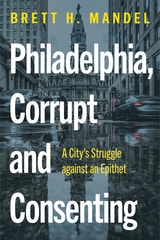
Philadelphia, Corrupt and Consenting
A City’s Struggle against an EpithetBrett H. Mandel
Temple University Press, 2023
He examines the costs of corruption, both financial and nonpecuniary, and considers the opportunity cost that corruption imposes. Mandel explores the nature and development of Philadelphia’s unique culture of corruption, emphasizing how machine politics and self-dealing are entwined with city history, creating a culture that allows corruption to thrive. In addition, he provides practical, achievable policies and actions that can produce positive change in Philadelphia and elsewhere.
Mandel seeks to provide insight into how our collective actions or inattention give consent to the corruption, as well as its roots and effects, and the reasons for its persistence. Philadelphia, Corrupt and Consenting is a critique, but above all, it is a call to action.
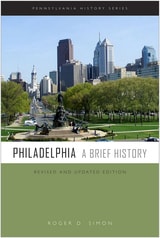
Philadelphia
A Brief HistoryRoger D. Simon
Temple University Press, 2017
Understanding Philadelphia’s history requires that we understand that nothing is inevitable; history is not made by abstract forces, but by the decisions of real individuals as they conduct their lives. With its insightful analysis and engaging prose, Philadelphia provides an accessible and readable overview of the history of the Quaker City from its founding by William Penn to the deindustrialization and gentrification of the early twenty-first century. Roger Simon asserts that the history of Philadelphia is a story of the efforts to sustain economic prosperity while fulfilling community needs, and the continued tension between those priorities.
Philadelphia devotes considerable attention to the evolving physical development of the city and to the social conditions and class structure of the people. Three dozen maps and illustrations enrich this edition, which has been fully updated and revised to reflect new scholarship on Philadelphia’s role in the post-industrial present and the diverse communities that incorporated women and minorities into the economic and social fabric of the city.
Published in association with the Pennsylvania Historical Association
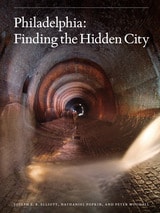
Philadelphia
Finding the Hidden CityJoseph E. B. Elliott
Temple University Press, 2017
Philadelphia possesses an exceptionally large number of places that have almost disappeared—from workshops and factories to sporting clubs and societies, synagogues, churches, theaters, and railroad lines. In Philadelphia: Finding the Hidden City, urban observers Nathaniel Popkin and Peter Woodall uncover the contemporary essence of one of America’s oldest cities. Working with accomplished architectural photographer Joseph Elliott, they explore secret places in familiar locations, such as the Metropolitan Opera House on North Broad Street, the Divine Lorraine Hotel, Reading Railroad, Disston Saw Works in Tacony, and mysterious parts of City Hall.
Much of the real Philadelphia is concealed behind facades. Philadelphia artfully reveals its urban secrets. Rather than a nostalgic elegy to loss and urban decline, Philadelphia exposes the city’s vivid layers and living ruins. The authors connect Philadelphia’s idiosyncratic history, culture, and people to develop an alternative theory of American urbanism, and place the city in American urban history. The journey here is as much visual as it is literary; Joseph Elliott’s sumptuous photographs reveal the city's elemental beauty.
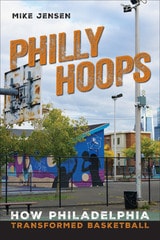
Philly Hoops
How Philadelphia Transformed BasketballMike Jensen
Temple University Press, 2027
Sportswriter Mike Jensen would argue that Philadelphia has earned a unique place in basketball history. In Philly Hoops, he makes an incontrovertible case that the city contributed to the sport on and off the court. Jensen, who spent decades covering the game for The Philadelphia Inquirer, charts the strategies, players, coaches, and even some referees from the pre-Wilt Chamberlain days to the post-Kobe Bryant era to show the region’s impact and influence on the sport worldwide.
Philadelphia didn’t merely play the game. It shaped it through ahead-of-their-time approaches, such as the value of pushing the pace. Jensen chronicles Hall-of-Fame game changers, including Earl Monroe and Paul Arizin, and coaches John Chaney, Jack Ramsay, Jay Wright, and Geno Auriemma. He recounts how the powerhouse teams at Immaculata and Cheyney University, along with Dawn Staley’s landmark playing and coaching achievements, helped make Philadelphia ground zero for women’s basketball. Philly Hoops also celebrates the influence of the Big 5 glory days, Jewish teams like The SPHAS, and icons Kyle Lowry, Tom Gola, and Rasheed Wallace.
Jensen knows how and why Philly loves basketball. His Philly Hoops is all about that love of and for the game.
Philly Sports
Teams, Games, and Athletes from Rocky's TownRyan Swanson
University of Arkansas Press, 2016
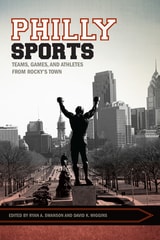
Philadelphia sports—anchored by the Eagles, Flyers, Phillies, and 76ers—have a long, and sometimes tortured, history. Philly fans have booed more than their share and have earned a reputation as some of the most hostile in the country. They’ve been known, so the tales go, to jeer Santa Claus and cheer at the injury of an opposing player.
Strangely though, much of America’s perception of Philadelphia sports has been shaped by a fictional figure: Rocky. The series of Hollywood films named after their title character has told and retold the Cinderella story of an underdog boxer rising up against long odds. One could plausibly make the argument that Rocky is Philadelphia’s most famous athlete.
Beyond the major sports franchises and Rocky, lesser-known athletic competition in Philadelphia offers much to the interested observer. The city’s boxing culture, influence on Negro Leagues baseball, role in establishing interscholastic sport, and leadership in the rise of cricket all deserve and receive close investigation in this new collection. Philly Sports combines primary research and personal experiences—playing in the Palestra, scouting out the tombstones of the city’s best athletes, enjoying the fervor of a Philadelphia night with a local team in pursuit of a championship title. The essence of Philadelphia sport, and to a certain extent the city itself, is distilled here.
Population Trends in New Jersey
James W. Hughes
Rutgers University Press, 2022
The authors also highlight key trends that will continue to transform the state: domestic migration out of the state and immigration into it; increasing diversity; slower overall population growth; contracting fertility; the household revolution and changing living arrangements; generational disruptions; and suburbanization versus re-urbanization. All of these factors help place in context the result of the 2020 decennial U.S. Census.
While the book focuses on New Jersey, the Garden State is a template of demographic, economic, social, and other forces characterizing the United States in the twenty-first century.
Port Newark and the Origins of Container Shipping
Angus Kress Gillespie
Rutgers University Press, 2023
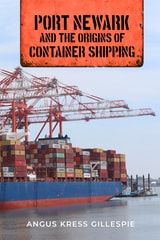
This fascinating study traces the birth of containerization to Port Newark, New Jersey, in 1956 when trucker Malcom McLean thought of a brilliant new way to transport cargo. It tells the story of how Port Newark grew rapidly as McLean’s idea was backed by both New York banks and the US military, who used containerization to ship supplies to troops in Vietnam. Angus Gillespie takes us behind the scenes of today’s active container shipping operations in Port Newark, talking to the pilots who guide the ships into port, the Coast Guard personnel who help manage the massive shipping traffic, the crews who unload the containers, and even the chaplains who counsel and support the mariners. Port Newark shines a spotlight on the unsung men and women who help this complex global shipping operation run smoothly.
Since McLean's innovation, Port Newark has expanded with the addition of the nearby Elizabeth Marine Terminal. This New Jersey complex now makes up the busiest seaport on the East Coast of the United States. Some have even called it “America’s Front Door.” The book tells the story of the rapid growth of worldwide containerization, and how Port Newark has adapted to bigger ships with deeper channels and a raised bridge. In the end, there is speculation of the future of this port with ever-increasing automation, artificial intelligence, and automation.
Potomac Canal
George Washington and the Waterway WestROBERT J. KAPSCH
West Virginia University Press, 2007
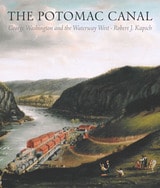
The Potomac Canal: George Washington and the Waterway West is a history of a new nation’s first effort to link the rich western agricultural lands with the coastal port cities of the east. The Potomac Canal Company was founded in 1785, and was active until it was overtaken by the Chesapeake and Ohio Canal Company in 1828. During its operation, the canal system was used to ship flour from mills in the foothills of Appalachia to the tidewater of the Chesapeake, where the flour was shipped to the Caribbean as trade for sugar and other goods. This trade soon became the basis of agricultural wealth in West Virginia’s eastern panhandle and throughout the Appalachian Piedmont. Coal was also shipped via the canal system from the upper reaches of the Potomac River to workshops at Harpers Ferry and beyond. This industrial trade route laid the foundation for what would eventually become the Chesapeake and Ohio Canal and the Baltimore and Ohio Railroad.
Power, Protest, and the Public Schools
Jewish and African American Struggles in New York CityMelissa F. Weiner
Rutgers University Press, 2012