Results by title
121 books match the query 'Motion picture industry' and 7 start with p

Pacific Tremors
Richard Stern
Northwestern University Press, 2001
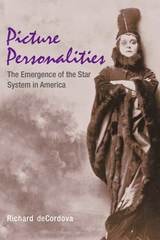
Picture Personalities
The Emergence of the Star System in AmericaRichard deCordova
University of Illinois Press, 1990
Conventional wisdom attributes the rise of the star system to the charisma of individual performers or to the public's desire to idolize an appealing star. In Picture Personalities, Richard deCordova argues that the fledgling movie industry and the press conspired to develop the star system, along with a system of discourse to support it.
How actors became stars and how they began to assume public identities distinct from their fictional roles was closely tied to the journalistic discourse of the period, produced by the trade press, newspapers, general periodicals, fan magazines, publicity stills, posters, and other material. DeCordova shows how the studios worked to fabricate moral images of the stars' marriages and personal lives and how a series of star scandals in the 1920s challenged those images and brought about changes in the conventions of representing stars. A new foreword by Corey K. Creekmur enhances this first paperback edition.
Playing the Percentages
How Film Distribution Made the Hollywood Studio SystemDerek Long
University of Texas Press, 2024
A history of film distribution in the United States from the 1910s to the 1930s, concentrating on booking, circuiting, and packaging marketing practices.
Told not as a “golden age” narrative of films, stars, or individual studios but as an economic history of the industry’s film distribution practices, Playing the Percentages is the story of how Hollywood’s vertically integrated studio system came to be. Studying the history of distribution during the growth of Hollywood, Derek Long makes a case for the domination of the studio system as the result of struggles over distribution practices.
Through a combination of archival research, critical surveys of the film industry trade press, and economic analysis, Long uncovers a complex and ever-shifting system of wrangling between distributors and exhibitors. Challenging the overemphasis within scholarship on “block booking” as a monolithic distribution mode, and attending to distribution practices beyond simple circulation, Long highlights the crucial changes in film distribution brought about by live theater, the rise of features, and the transition to sound. Playing the Percentages is a comprehensive history of film distribution in the United States during the silent era that illustrates the importance of power struggles between distributors and exhibitors over booking, pricing, and playing time.
Producing
Lewis, Jon
Rutgers University Press, 2015
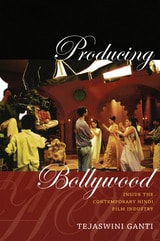
Producing Bollywood
Inside the Contemporary Hindi Film IndustryTejaswini Ganti
Duke University Press, 2012
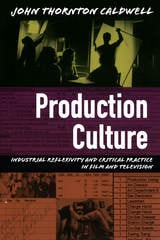
Production Culture
Industrial Reflexivity and Critical Practice in Film and TelevisionJohn Thornton Caldwell
Duke University Press, 2008
Drawing on interviews, observations of sets and workplaces, and analyses of TV shows, industry documents, economic data, and promotional materials, Caldwell shows how film and video workers function in a transformed, post-network industry. He chronicles how workers have responded to changes including media convergence, labor outsourcing, increasingly unstable labor and business relations, new production technologies, corporate conglomeration, and the proliferation of user-generated content. He explores new struggles over “authorship” within collective creative endeavors, the way that branding and syndication have become central business strategies for networks, and the “viral” use of industrial self-reflexivity to motivate consumers through DVD bonus tracks, behind-the-scenes documentaries, and “making-ofs.” A significant, on-the-ground analysis of an industry in flux, Production Culture offers new ways of thinking about media production as a cultural activity.
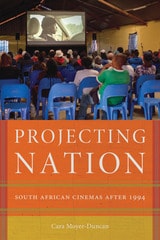
Projecting Nation
South African Cinemas after 1994Cara Moyer-Duncan
Michigan State University Press, 2020