Results by title
92 books match the query 'Multiculturalism' and 2 start with p

Pluralising Pasts
Heritage, Identity and Place in Multicultural SocietiesBrian Graham, G. J. Ashworth, and J. E. Tunbridge
Pluto Press, 2007
The heritage industry is big business. From museums and the preservation of old buildings to broader questions of community and identity, heritage is now a political issue. This book explores what heritage means and how it is used to encourage people to identify with particular places and 'traditions'. The authors show how contemporary societies use heritage in the creation and management of collective identities and, most especially, the different ways in which it is involved with the questions of multicultural societies. The resources that are poured into heritage mean that questions of identity are widely discussed at a policy level: what does it mean to be American or British, or a minority in any society? This book shows how heritage is used politically and commercially to shape the ways people represent themselves, and are represented, in diverse and hybrid societies.
[more]
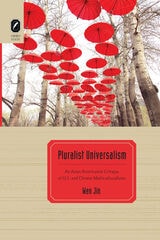
Pluralist Universalism
An Asian Americanist Critique of U.S. and Chinese MulticulturalismsWen Jin
The Ohio State University Press, 2012
Pluralist Universalism: An Asian Americanist Critique of U.S. and Chinese Multiculturalisms by Wen Jin is an extended comparison of U.S. and Chinese multiculturalisms during the post–Cold War era. Her book situates itself at the intersection of Asian American literary critique and the growing field of comparative multiculturalism. Through readings of fictional narratives that address the issue of racial and ethnic difference in both national contexts simultaneously, the author models a “double critique” framework for U.S.–Chinese comparative literary studies.
The book approaches U.S. liberal multiculturalism and China’s ethnic policy as two competing multiculturalisms, one grounded primarily in a history of racial desegregation and the other in the legacies of a socialist revolution. Since the end of the Cold War, the two multiculturalisms have increasingly been brought into contact through translation and other forms of mediation. Pluralist Universalism demonstrates that a number of fictional narratives, including those commonly classified as Chinese, American, and Chinese American, have illuminated incongruities and connections between the ethno-racial politics of the two nations.
The “double critique” framework builds upon critical perspectives developed in Asian American studies and adjacent fields. The book brings to life an innovative vision of Asian American literary critique, even as it offers a unique intervention in ideas of ethnicity and race prevailing in both China and the United States in the post–Cold War era.
[more]