Results by title
52 books match the query 'Mythology' and 4 start with p
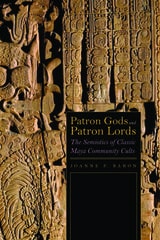
Patron Gods and Patron Lords
The Semiotics of Classic Maya Community CultsJoanne Baron
University Press of Colorado, 2016
Using semiotic theory, Baron draws on three bodies of evidence: ethnographies and manuscripts from Postclassic, Colonial, and modern Maya communities that connect patron saints to pre-Columbian patron gods; hieroglyphic texts from the Classic period that discuss patron deity veneration; and excavations from four patron deity temples at the site of La Corona, Guatemala. She shows how the Classic Maya used patron deity effigies, temples, and acts of devotion to negotiate group membership, social entitlements, and obligations between individuals and communities. She also explores the wider role of these processes in politics, arguing that rituals and discourses related to patron deities ultimately formulated Maya rulership as a locally oriented institution, which limited the ability of powerful kingdoms to create wider religious communities.
Applying a new theoretical approach for the archaeological study of ideology and power dynamics, Patron Gods and Patron Lords reveals an overlooked aspect of the belief system of Maya communities.
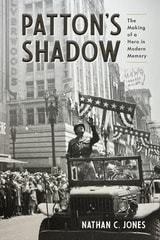
Patton's Shadow
The Making of a Hero in Modern MemoryNathan C. Jones
University of Alabama Press, 2024
An engrossing account of the myth and legend of George S. Patton and what his reputation illuminates about American culture and hero worship
Patton’s Shadow by Nathan C. Jones, a leading authority on George S. Patton, offers a definitive account of the creation of the Patton legend and what it illuminates about American culture and the worship of heroes. Jones traces how the persona of Patton, a brash and brilliant general in the European theater of World War II, transcended the individual man and became a cultural icon and byword for triumphal American might.
Patton was a hero lionized and celebrated in his own time. Patton as well as the US Army cultivated his persona during and after the war. His image was used to promote patriotism, commercial goods, and military recruitment. The 1970 Academy Award–winning film starring George C. Scott cemented his iconic image for millions of Americans, further embellishing Patton’s persona and introducing him to entirely new generations of young Americans.
Patton’s Shadow is an intellectually omnivorous tour de force that draws on ideas about heroes from sources as timeless as ancient mythology and as contemporary as Abraham Maslow, Max Weber, and Carl Jung. Jones artfully locates the honored altar that heroes occupy in the human heart and then answers insightful questions about what America’s embrace of Patton in particular as a military hero illuminates about the United States, about Patton’s generation, and about our own.
Jones’s engrossing work will fascinate readers interested in American history, military history, and the psychology of heroism.
Plants of Life, Plants of Death
Frederick J. Simoons
University of Wisconsin Press, 1998
Pythagoras, the ancient Greek mathematician, did not himself eat fava beans in any form; in fact, he banned his followers from eating them. Cultural geographer Frederick Simoons disputes the contention that Pythagoras established that ban because he recognized the danger of favism, a disease that afflicts genetically-predisposed individuals who consume fava beans. Contradicting more deterministic explanations of history, Simoons argues that ritual considerations led to the Pythagorean ban.
In his fascinating and thorough new study, Simoons examines plants associated with ritual purity, fertility, prosperity, and life, on the one hand, or with ritual impurity, sickness, ill fate, and death, on the other. Plants of Life, Plants of Death offers a wealth of detail from not only history, ethnography, religious studies, classics, and folklore, but also from ethnobotany and medicine. Simoons surveys a vast geographical region extending from Europe through the Near East to India and China. He tells the story of India's giant sacred fig trees, the pipal and the banyan, and their changing role in ritual, religion, and as objects of pilgrimage from antiquity to the present day; the history of mandrake and ginseng, “man roots” whose uses from Europe to China have been shaped by the perception that they are human in form; and the story of garlic and onions as impure foods of bad odor in that same broad region.
Simoons also identifies and discusses physical characteristics of plants that have contributed to their contrasting ritual roles, and he emphasizes the point that the ritual roles of plants are also shaped by basic human concerns—desire for good health and prosperity, hopes for fertility and offspring, fear of violence, evil and death—that were as important in antiquity as they are today.
“It dazzles as a piece of scholarship.”—Daniel W. Gade, University of Vermont
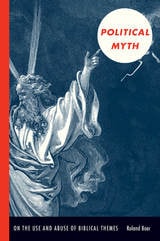
Political Myth
On the Use and Abuse of Biblical ThemesRoland Boer
Duke University Press, 2009
Boer elaborates a theory of political myth in dialogue with Ernst Bloch, Theodor Adorno, Alain Badiou, Jacques Lacan, and Slavoj Žižek. Through close readings of well-known biblical stories he then scrutinizes the nature of political myth in light of feminism, psychoanalysis, and Marxism. Turning to contemporary politics, he examines the statements of prominent American and Australian politicians to show how the stories of Creation, conquest, Paradise, and the Promised Land have been distorted into a fantasy of Israel as a perpetual state in the making and a land in need of protection. Boer explains how this fantasy of Israel shapes U.S. and Australian foreign and domestic policies, and he highlights the links between it and the fantasy of unfettered global capitalism. Contending that political myths have repressed dimensions which if exposed undermine the myths’ authority, Boer urges the Left to expose the weakness in the Right’s mythos. He suggests that the Left make clear what the world would look like were the dream of unconstrained capitalism to be realized.