Results by title
65 books match the query 'Netherlands' and 2 start with p
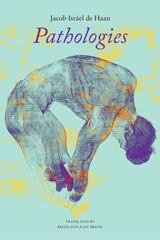
Pathologies
The Downfall of Johan van Vere de WithJacob Isräel de Haan
Seagull Books, 2024
One of the first novels to openly explore gay love and eroticism, Pathologies is a lost classic that is now translated into English for the first time.
At the start of the twentieth century, Jewish anti-Zionist Jacob Israël de Haan led an eventful life as a poet, journalist, teacher, and lawyer in the Netherlands. His autobiographical novella Pipelines caused a storm of controversy in 1904 with its portrayal of a subject that was considered scandalous at the time—a romantic relationship between two young men. He lost his teaching job, and the entire print run was pulped.
In his iconic 1908 novel Pathologies, he once again openly and radically explored the topic of homosexuality. The story centers around adolescent Johan, who lives a secluded life with his father and their elderly housekeeper in a large house. For a while, Johan has been plagued by erotic fantasies about his classmates. When, to make matters worse, he finds himself feeling attracted to his father—first in a dream, and then in real life—he grows desperate. Johan moves out, finding room and board with an older married couple in Haarlem, where he meets René, a young confident artist. Johan falls head-over-heels in love, and the two men enter a sadomasochistic relationship that soon begins to spiral out of control.
Johan is one of world literature’s most tragic, troubled young heroes, at par with Goethe’s Werther and Dostoevsky’s Raskolnikov. His struggle to come to terms with his fantasies and desires—rife with taboos that continue to resonate today—forms the beating heart of this daring novel. Written in De Haan’s precise, lyrical prose, Pathologies has lost none of its force more than a century after it was first published.
[more]
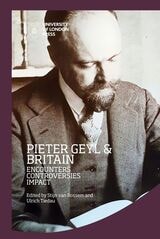
Pieter Geyl and Britain
Encounters, Controversies, ImpactEdited by Stijn van Rossem and Ulrich Tiedau
University of London Press, 2022
An examination of the work and influence of historian Pieter Geyl.
Pieter Geyl (1887—1966) was undoubtedly one of the most internationally renowned Dutch historians of the twentieth century, but also one of the most controversial. Having come to the United Kingdom as a journalist, he started his academic career at the University of London in the aftermath of World War I and played an important role in the early days of the Institute of Historical Research. Known in this time for his reinterpretation of the sixteenth-century Dutch Revolt against the Habsburgs that challenged existing historiographies of both Belgium and the Netherlands but was also linked to his political activism in favor of the Flemish movement in Belgium, Geyl left his stamp on the British perception of Low Countries history before moving back to his country of origin in 1935. Having spent World War II in German hostage camps, he famously coined the adage of history being “a discussion without end” and reengaged in public debates with British historians after the war, partly conducted on the airwaves of the BBC. A prolific writer and an early example of a public intellectual, Geyl remains one of the most influential thinkers on history of his time. The present volume reexamines Geyl’s relationship with Britain (and the Anglophone world at large) and sheds new light on his multifaceted work as a historian, journalist, homme de lettres, and political activist.
Pieter Geyl (1887—1966) was undoubtedly one of the most internationally renowned Dutch historians of the twentieth century, but also one of the most controversial. Having come to the United Kingdom as a journalist, he started his academic career at the University of London in the aftermath of World War I and played an important role in the early days of the Institute of Historical Research. Known in this time for his reinterpretation of the sixteenth-century Dutch Revolt against the Habsburgs that challenged existing historiographies of both Belgium and the Netherlands but was also linked to his political activism in favor of the Flemish movement in Belgium, Geyl left his stamp on the British perception of Low Countries history before moving back to his country of origin in 1935. Having spent World War II in German hostage camps, he famously coined the adage of history being “a discussion without end” and reengaged in public debates with British historians after the war, partly conducted on the airwaves of the BBC. A prolific writer and an early example of a public intellectual, Geyl remains one of the most influential thinkers on history of his time. The present volume reexamines Geyl’s relationship with Britain (and the Anglophone world at large) and sheds new light on his multifaceted work as a historian, journalist, homme de lettres, and political activist.
[more]