Results by title
87 books match the query 'Officials and employees' and 6 start with p
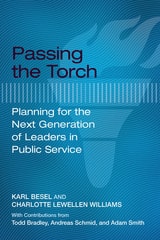
Passing the Torch
Planning for the Next Generation of Leaders in Public ServiceKarl Besel
University of Arkansas Press, 2016
Public-service executives, both elected and appointed within the public and nonprofit sectors, are retiring at record levels, and the number of Americans reaching age sixty-five annually will continue to rise over the next decade and is expected to surpass four million in 2020. Finding qualified, motivated leaders to fill vital public-service positions will challenge the public and nonprofit sectors.
Unfortunately, recent studies show that few proactive steps are being taken by public-service organizations to plan for the next generation. Passing the Torch: Planning for the Next Generation of Public-Service Leaders provides an outline for those who will be facing and managing these looming changes.
In this valuable guide, the factors that influence selection of a career in public service are explored through the authors’ years of experience as leaders in public-service organizations and through interviews with other public-service professionals. Passing the Torch will be essential for leaders of nonprofit organizations, university faculty, researchers in the field of nonprofit management, and students in nonprofit management courses.
Paying Calls in Shangri-La
Scenes from a Woman’s Life in American DiplomacyJudith M. Heimann
Ohio University Press, 2016
Judith M. Heimann entered the diplomatic life in 1958 to join her husband, John, in Jakarta, Indonesia, at his American Embassy post. This, her first time out of the United States, would set her on a path across the continents as she mastered the fine points of diplomatic culture. She did so first as a spouse, then as a diplomat herself, thus becoming part of one of the Foreign Service’s first tandem couples.
Heimann’s lively recollections of her life in Africa, Asia, and Europe show us that when it comes to reconciling our government’s requirements with the other government’s wants, shuttle diplomacy, Skype, and email cannot match on-the-ground interaction. The ability to gauge and finesse gesture, tone of voice, and unspoken assumptions became her stock-in-trade as she navigated, time and again, remarkably delicate situations.
This insightful and witty memoir gives us a behind-the-scenes look at a rarely explored experience: that of one of the very first married female diplomats, who played an unsung but significant role in some of the important international events of the past fifty years. To those who know something of today’s world of diplomacy, Paying Calls in Shangri-La will be an enlightening tour through the way it used to be—and for aspiring Foreign Service officers and students, it will be an inspiration.
Published in association with ADST-DACOR Diplomats and Diplomacy Series
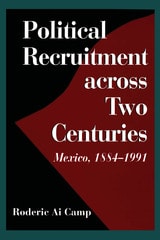
Political Recruitment across Two Centuries
Mexico, 1884-1991By Roderic Ai Camp
University of Texas Press, 1995
During more than twenty years of field research, Roderic Ai Camp built a monumental database of biographical information on more than 3,000 leading national figures in Mexico. In this major contribution to Mexican political history, he draws on that database to present a definitive account of the paths to power Mexican political leaders pursued during the period 1884 to 1992.
Camp’s research clarifies the patterns of political recruitment in Mexico, showing the consequences of choosing one group over another. It calls into question numerous traditional assumptions, including that upward political mobility was a cause of the Mexican Revolution of 1910.
Comparing Mexican practices with those in several East Asian countries also allows Camp to question many of the tenets of political recruitment theory. His book will be of interest to students not only of Mexican politics but also of history, comparative politics, political leadership, and Third World development.
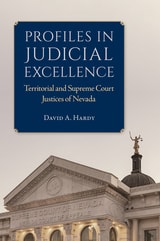
Profiles in Judicial Excellence
Territorial and Supreme Court Justices of NevadaDavid A. Hardy
University of Nevada Press, 2025
Until the publication of Judge David A. Hardy’s Profiles in Judicial Excellence: Territorial and Supreme Court Justices of Nevada, there has been no single source containing biographies of these influential figures from the state’s history from 1861 to 1997. Hardy curates various sources and presents profiles of these judges in sequential order of their service. He also examines the influence of territorial judges in the 1864 vote for statehood. The Nevada judiciary has played an integral, but often unrecognized, role in shaping the unique character of the Silver State.
Public Sector Payrolls
Edited by David A. Wise
University of Chicago Press, 1987
The volume, developed from a 1984 National Bureau of Economic Research conference, focuses on various labor issues in military and other governmental employment. Several contributors discuss compensation in the armed forces and its relationship to that in the private sector, as well as the interaction between the military and the private sector in the employment of youth. This latter is of particular interest because studies of youth employment have generally ignored the important influence of military hiring practices on labor market conditions. In other contributions, the response of wages and employment in the public sector to economic conditions is analyzed, and a detailed study of government pension plans is presented. Also included is a theoretical and empirical analysis of comparable worth in the public sector from the viewpoint of analytical labor economics. The volume concludes with a look at public school teachers' salaries in the context of current debates over improving the quality of American education.
A valuable resource to policymakers, Public Sector Payrolls will be an important addition to research in the field of labor economics.
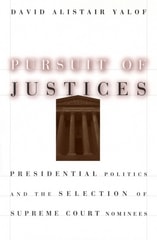
Pursuit of Justices
Presidential Politics and the Selection of Supreme Court NomineesDavid Alistair Yalof
University of Chicago Press, 1999
Yalof draws on the papers of seven modern presidents, from Truman to Reagan, and firsthand interviews with key figures, such as Ramsey Clark, Edwin Meese, and President Gerald Ford. He documents and analyzes the selection criteria these presidents used, the pool of candidates from which they chose, their strategies, and the political pressures affecting their decisions, both successes and failures. Yalof also disputes much conventional wisdom about the selection process, including the widely held view that presidents choose nominees primarily to influence future decisions of the high court. In a substantial epilogue, Yalof offers insightful observations about the selections of Presidents George Bush and Bill Clinton.
By focusing on a neglected area of presidential politics, Yalof offers a fascinating and unprecedented glimpse into the intricate world of executive branch decisionmaking and the Supreme Court appointment process as a whole.
Winner of the 2000 Richard E. Neustadt Award for Best Book on the American Presidency