Results by title
116 books match the query 'Palestine' and 15 start with p
Palestine and Israel
A Challenge to JusticeJohn Quigley
Duke University Press, 1990
Beginning with the early Zionist settlement in Palestine that rose from the effort by Jews to escape long-standing discrimination in Europe, Qigley investigates the origins of the dispute, including the British occupation of Palestine, the British Mandate, and the involvement of the United Nations. He examines the 1948 War, the establishment of Israel, and explores the legal and political status of Jews there. After a detailed analysis of the 1967 War and Israel’s occupation of the West Bank and Gaza Strip, he concludes with recommendations for resolving the conflict, including discussions of the responsibility of other states for the persisting injustice, the role of other states in settling the dispute, and steps to a possible solution.

Palestine and Jewish History
Criticism at the Borders of EthnographyJonathan Boyarin
University of Minnesota Press, 1996
Palestine and Jewish History was first published in 1996. Minnesota Archive Editions uses digital technology to make long-unavailable books once again accessible, and are published unaltered from the original University of Minnesota Press editions.
This provocative and personal series of meditations on the Israeli-Palestinian conflict argues that it represents a struggle not as much about land and history as about space, time, and memory. Juxtaposing entries from Jonathan Boyarin's field diary with critical and theoretical articulations, Palestine and Jewish History shows not only the unfinished nature of anthropological endeavor, but also the author's personal stake in the ethical predicament of being a Jew at this point in history.
Boyarin comes to Israel as a specialist in modern Jewish studies, an individual who has kin, friends, and colleagues there, a scholar with a long history of peace activism. He interweaves fascinating descriptions of ordinary life-parties, walks, classes, visits to homes-with a selection of his related writings on cultural studies and anthropology. Some sections are polemical; others are witty analyses of bumper stickers, slogans, the ambiguities in conversations. Boyarin foregrounds the messiness and lack of closure inherent in this process, presenting "raw materials" (field notes) in some sections of the book that reappear in other sections as various kinds of "finished" products (conference papers, published articles).
In the process, we learn a good deal about the Middle East and its debates and connections to other places. Boyarin addresses two fundamental issues: the difficulty of linking different sorts of memories and memorializations, and the importance of moving beyond objectivity and multiculturalism into a situated, engaged, and nontotalizing framework for fieldwork and ethnography.
Palestine and Jewish History enacts rather than reports on Boyarin's process of error, pain, impatience, uncertainty, discovery, embarrassment, self-criticism, intellectual struggle, and dawning awareness, challenging and engaging us in the process of discovery. Ultimately, it gives the lie, as the Palestinian presence does in Israel, to any concept of a "finishedness" that successfully conceals its unruly and painful multiple processes.
Jonathan Boyarin is the Leonard and Tobee Kaplan Distinguished Professor of Modern Jewish Thought in the Department of Religious Studies at the University of North Carolina at Chapel Hill. He is the author of Storm from Paradise, co-author of Powers of Diaspora, and the co-editor of Remapping Memory and Jews and Other Differences, all available from Minnesota.
Palestine between Politics and Terror, 1945–1947
Motti Golani
Brandeis University Press, 2013
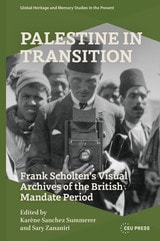
Palestine in Transition
Frank Scholten’s Visual Archive of the British Mandate PeriodKarène Sanchez Summerer
Amsterdam University Press, 2026
Palestine in Transition traces the significance of Frank Scholten’s documentation of the transformations occurring during the British Mandate period. By taking a geographical approach to the collection—like Scholten himself—this book revisits his incomplete project by presenting different regions through contributions by scholars specialized in each field, a century after his visit and the dramatic social, cultural, and political upheavals that the “Holy Land” has undergone since then.
Palestine in a Transnational Context, Volume 21
Timothy Mitchell , Gyan Prakash and Ella Shohat, eds.
Duke University Press, 0
This special issue places the Palestine question in a transnational and comparative frame that strives to better depict its historical complexity. The issue also gives special consideration to the different modes of Palestinian resistance both within and outside the state of Israel and the occupied territories.
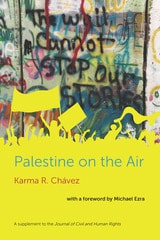
Palestine on the Air
Karma R. Chavez
University of Illinois Press, 2019
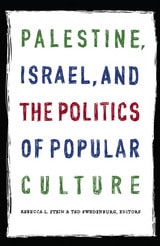
Palestine, Israel, and the Politics of Popular Culture
Rebecca L. Stein and Ted Swedenburg, eds.
Duke University Press, 2005
The volume is interdisciplinary, including the work of anthropologists, historians, sociologists, political scientists, ethnomusicologists, and Americanist and literary studies scholars. Contributors examine popular music of the Palestinian resistance, ethno-racial “passing” in Israeli cinema, Arab-Jewish rock, Euro-Israeli tourism to the Arab Middle East, Internet communities in the Palestinian diaspora, café culture in early-twentieth-century Jerusalem, and more. Together, they suggest new ways of conceptualizing Palestinian and Israeli political culture.
Contributors. Livia Alexander, Carol Bardenstein, Elliott Colla, Amy Horowitz, Laleh Khalili, Mary Layoun, Mark LeVine, Joseph Massad, Melani McAlister, Ilan Pappé, Rebecca L. Stein, Ted Swedenburg, Salim Tamari
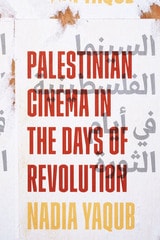
Palestinian Cinema in the Days of Revolution
By Nadia Yaqub
University of Texas Press, 2018
Palestinian cinema arose during the political cinema movements of the late 1960s and early 1970s, yet it was unique as an institutionalized, though modest, film effort within the national liberation campaign of a stateless people. Filmmakers working within the Palestinian Liberation Organization (PLO) and through other channels filmed the revolution as it unfolded, including the Israeli bombings of Palestinian refugee camps, the Jordanian and Lebanese civil wars, and Palestinian life under Israeli occupation, attempting to create a cinematic language consonant with the revolution and its needs. They experimented with form both to make effective use of limited material and to process violent events and loss as a means of sustaining active engagement in the Palestinian political project.
Palestinian Cinema in the Days of Revolution presents an in-depth study of films made between 1968 and 1982, the filmmakers and their practices, the political and cultural contexts in which the films were created and seen, and their afterlives among Palestinian refugees and young filmmakers in the twenty-first century. Nadia Yaqub discusses how early Palestinian cinema operated within emerging public-sector cinema industries in the Arab world, as well as through coproductions and solidarity networks. Her findings aid in understanding the development of alternative cinema in the Arab world. Yaqub also demonstrates that Palestinian filmmaking, as a cinema movement created and sustained under conditions of extraordinary precarity, offers important lessons on the nature and possibilities of political filmmaking more generally.
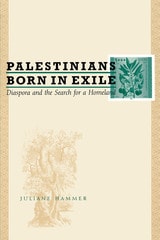
Palestinians Born in Exile
Diaspora and the Search for a HomelandBy Juliane Hammer
University of Texas Press, 2005
In the decade following the 1993 Oslo Peace Accords, some 100,000 diasporic Palestinians returned to the West Bank and Gaza. Among them were children and young adults who were born in exile and whose sense of Palestinian identity was shaped not by lived experience but rather through the transmission and re-creation of memories, images, and history. As a result, "returning" to the homeland that had never actually been their home presented challenges and disappointments for these young Palestinians, who found their lifeways and values sometimes at odds with those of their new neighbors in the West Bank and Gaza.
This original ethnography records the experiences of Palestinians born in exile who have emigrated to the Palestinian homeland. Juliane Hammer interviews young adults between the ages of 16 and 35 to learn how their Palestinian identity has been affected by living in various Arab countries or the United States and then moving to the West Bank and Gaza. Their responses underscore how much the experience of living outside of Palestine has become integral to the Palestinian national character, even as Palestinians maintain an overwhelming sense of belonging to one another as a people.
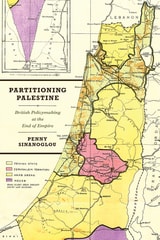
Partitioning Palestine
British Policymaking at the End of EmpirePenny Sinanoglou
University of Chicago Press, 2019

Partitioning Palestine
Legal Fundamentalism in the Palestinian-Israeli ConflictJohn Strawson
Pluto Press, 2010
Law lies at the roots of the Palestinian-Israeli conflict. Jews sought a national home by “Public Law” while Palestinians reject the project as illegal. Britain, the League of Nations and the United Nations all mobilised international law to justify their interventions. After the 1967 war, Israel organised an occupation with excessive legalism that most of the world viewed, in fact, as illegal.
Partitioning Palestine focuses on three key moments in the Palestinian-Israeli conflict: the League of Nations Mandate, the United Nations partition plan and the Oslo agreements. None of these documents are neutral but, rather, encode a variety of meanings. The book traces the way in which these legal narratives have both shaped national identity and sharpened the conflict.
In this pioneering text, John Strawson argues that a committed attachment to the belief in legal justice has hampered the search for a settlement. Law, far from offering conflict resolution, has reinforced the trenches from which Palestinians and Israelis confront one another.
Past Disquiet
Artists, International Solidarity and Museums in ExileEdited by Kristine Khouri and Rasha Salti
Museum of Modern Art in Warsaw, 2018
Popular Protest in Palestine
The History and Uncertain Future of Unarmed ResistanceMarwan Darweish and Andrew Rigby
Pluto Press, 2015
Popular Resistance in Palestine
A History of Hope and EmpowermentMazin B. Qumsiyeh
Pluto Press, 2011
The book contains hundreds of stories of the heroic and highly innovative methods of resistance employed by the Palestinians over more than 100 years. The author also analyses the successes, failures, missed opportunities and challenges facing ordinary Palestinians as they struggle for freedom against incredible odds. This is the only book to critically and comparatively study the uprisings of 1920-21, 1929, 1936-9, 1970s, 1987-1991 and 2000-2006.
The compelling human stories told in this book will inspire people of all faiths and political backgrounds to chart a better and more informed direction for a future of peace with justice.
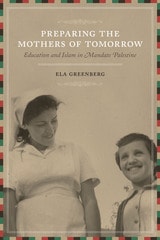
Preparing the Mothers of Tomorrow
Education and Islam in Mandate PalestineBy Ela Greenberg
University of Texas Press, 2009
From the late nineteenth century onward, men and women throughout the Middle East discussed, debated, and negotiated the roles of young girls and women in producing modern nations. In Palestine, girls' education was pivotal to discussions about motherhood. Their education was seen as having the potential to transform the family so that it could meet both modern and nationalist expectations.
Ela Greenberg offers the first study to examine the education of Muslim girls in Palestine from the end of the Ottoman administration through the British colonial rule. Relying upon extensive archival sources, official reports, the Palestinian Arabic press, and interviews, she describes the changes that took place in girls' education during this time. Greenberg describes how local Muslims, often portrayed as indifferent to girls' education, actually responded to the inadequacies of existing government education by sending their daughters to missionary schools despite religious tensions, or by creating their own private nationalist institutions.
Greenberg shows that members of all socioeconomic classes understood the triad of girls' education, modernity, and the nationalist struggle, as educated girls would become the "mothers of tomorrow" who would raise nationalist and modern children. While this was the aim of the various schools in Palestine, not all educated Muslim girls followed this path, as some used their education, even if it was elementary at best, to become teachers, nurses, and activists in women's organizations.