Results by title
96 books match the query 'Penology' and 10 start with p
Poor Discipline
Jonathan Simon
University of Chicago Press, 1993
When parole first emerged as a corrections strategy in the nineteenth century, work was supposed to keep ex-prisoners out of trouble. This strategy foundered in the changing economy after World War II. What followed was a rehabilitative strategy, where the clinical expertise of the parole agent replaced the discipline of the industrial labor market in defining and controlling criminal deviance. Today, Simon argues, as drastic changes in the economy have virtually locked out an entire class, rehabilitation has given way to mere management. The effect is isolation of the offender, either in jail or in an underclass community; the result is an escalating cycle of imprisonment, destabilization, and insecurity.
No significant improvement in the current penal crisis can be expected until we better understand the relationship between punishment and social order, a relationship which this book explores in theoretical, historical, and practical detail.
Prison Abolition for Realists
Anna Terwiel
University of Minnesota Press, 2025
A lucid guide to the radical politics of prison abolitionists
There is growing recognition that mass incarceration is unjust and undemocratic, but prison abolition continues to be dismissed as naïve, idealistic, and out of touch with reality. Anna Terwiel challenges this view, carefully examining the work of abolitionist thinkers and activists since the 1960s to argue that prison abolition is a realist political project. Abolition, Terwiel shows, is oriented toward practical realities and offers concrete proposals for radical democratic change.
Based on insightful readings of renowned abolitionists such as Michel Foucault, Liat Ben-Moshe, and Angela Y. Davis, Prison Abolition for Realists illuminates the realist aspects of their approaches as well as the important differences between them. Distinguishing between paranoid, purist, and agonistic styles of abolitionism, Terwiel argues that an agonistic approach holds the most promise for democratic change to carceral systems. Embodied in the work of Davis, agonistic abolitionism combines radical critique with efforts to build new democratic institutions while accepting that all political achievements will be imperfect. Pursuing examples of what this looks like in practice, Terwiel explores grassroots transformative justice efforts, like those of Communities Against Rape and Abuse. She also proposes a “right to comfort” to support incarcerated people’s demands for air conditioners in extremely hot prisons, showing how state institutions, civil law, and rights claims can be potential resources for abolitionists.
Nuanced and illuminating, Prison Abolition for Realists affirms abolition’s viability during a time of multiple, ongoing crises. While many despair at the state of the world, Terwiel reveals how abolition offers an actionable politics of the possible. Far from being unrealistic, abolition is an indispensable part of a realist politics.
Retail e-book files for this title are screen-reader friendly with images accompanied by short alt text and/or extended descriptions.
Retail e-book files for this title are screen-reader friendly with images accompanied by short alt text and/or extended descriptions.
Prison Land
Mapping Carceral Power across Neoliberal AmericaBrett Story
University of Minnesota Press, 2019
From broken-window policing in Detroit to prison-building in Appalachia, exploring the expansion of the carceral state and its oppressive social relations into everyday life
Prison Land offers a geographic excavation of the prison as a set of social relations—including property, work, gender, and race—enacted across various landscapes of American life. Prisons, Brett Story shows, are more than just buildings of incarceration bound to cycles of crime and punishment. Instead, she investigates the production of carceral power at a range of sites, from buses to coalfields and from blighted cities to urban financial hubs, to demonstrate how the organization of carceral space is ideologically and materially grounded in racial capitalism.
Story’s critically acclaimed film The Prison in Twelve Landscapes is based on the same research that informs this book. In both, Story takes an expansive view of what constitutes contemporary carceral space, interrogating the ways in which racial capitalism is reproduced and for which police technologies of containment and control are employed. By framing the prison as a set of social relations, Prison Land forces us to confront the production of new carceral forms that go well beyond the prison system. In doing so, it profoundly undermines both conventional ideas of prisons as logical responses to the problem of crime and attachment to punishment as the relevant measure of a transformed criminal justice system.
Prison and Social Death
Price, Joshua M
Rutgers University Press, 2015
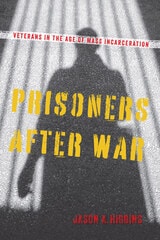
Prisoners after War
Veterans in the Age of Mass IncarcerationJason A. Higgins
University of Massachusetts Press, 2024
Winner of the 2025 Oral History Association Book Award • Winner of Virginia Tech's Albert Lee Sturm Award for Faculty Excellence • Finalist for the 2026 Veterans Studies Association Distinguished Book Award • Honorable Mention, National Council on Public History Book Award
The United States has both the largest, most expensive, and most powerful military and the largest, most expensive, and most punitive carceral system in the history of the world. Since the American War in Vietnam, hundreds of thousands of veterans have been incarcerated after their military service.
Identifying the previously unrecognized connections between American wars and mass incarceration, Prisoners after War reaches across lines of race, class, and gender to record the untold history of incarcerated veterans over the past six decades. Having conducted dozens of oral history interviews, Jason A. Higgins traces the lifelong effects of war, inequality, disability, and mental illness, and explores why hundreds of thousands of veterans, from Vietnam to Afghanistan, were caught up in the carceral system. This original study tells an intergenerational history of state-sanctioned violence, punishment, and inequality, but its pages also resonate with stories of survival and redemption, revealing future possibilities for reform and reparative justice.

Prisons of Poverty
Loïc Wacquant
University of Minnesota Press, 2009
An international best seller dissects the globalization of penal policies “made in U.S.A.” as part of the spread of neoliberalism
In the early 1990s, Mayor Rudolph Giuliani launched a zero-tolerance campaign aimed at street disorders and petty offenders, incarnated in the infamous “squeegee man.” New York City soon became a planetary showcase for an aggressive approach to law enforcement that, despite its extravagant costs and the absence of connection to the crime drop, came to be admired and imitated by other cities in the United States, Western Europe, and Latin America.
In Prisons of Poverty, Loïc Wacquant tracks the incubation and internationalization of the slogans, theories, and measures composing this new punitive “common sense,” fashioned to curb mounting urban inequality and marginality in the metropolis. He finds that a network of Reagan-era conservative think tanks (led by the Manhattan Institute) forged them as weapons in their crusade to dismantle the welfare state and, in effect, to criminalize poverty. He traces their import and export through the agency of the media and the pro-market policy institutes that have mushroomed across the European Union, particularly in Tony Blair’s Britain. And he shows how academics helped smuggle U.S. techniques of penalization into their countries by dressing them up in scholarly garb.Now available in English for the first time in an expanded edition, Prisons of Poverty reveals how the Washington consensus on economic deregulation and welfare retrenchment was extended to encompass punitive crime control because the invisible hand of the market necessitates and calls forth the iron fist of the penal state.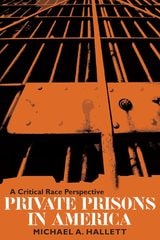
Private Prisons in America
A Critical Race PerspectiveMichael A. Hallett
University of Illinois Press, 2006
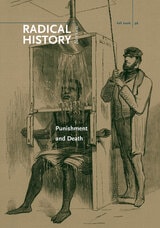
Punishment and Death
The Need for Radical Analysis, Volume 2006Ethan Blue and Patrick Timmons, eds.
Duke University Press, 0
The issue’s contributors—comprising both academics and activists—examine the practices of punishment and death imposed upon citizens, particularly through penal systems. One contributor exposes how the indignation and outrage many Americans expressed toward the military torture at Abu Ghraib do not extend to similar instances of torture (beatings, “shower-baths,” sexual abuse, etc.) against inmates of color within the U.S. prison system. Another contributor reflects on the unexpected but effective alliance between antiprison activists and the environmental justice movement in California, which worked to stop the massive prison-building boom of the late twentieth and early twenty-first centuries. Bringing a longer sweep of Western colonialism into view, another essay reveals the racial prejudices within disciplinary processes of Puerto Rico that lingered even after the island’s emancipation from the Spanish American empire, leading to unequal distribution of punishment on both colonial and domestic subject populations.
Contributors. Ethan Blue, Rose Braz, Helena Cobban, Craig Gilmore, Alan Eladio Gómez, R. J. Lambrose, Heather Jane McCarty, Dylan Rodríguez, Kelvin Santiago-Valles, Carolyn Strange, Patrick Timmons
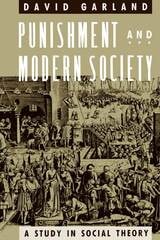
Punishment and Modern Society
A Study in Social TheoryDavid Garland
University of Chicago Press, 1990
"Punishment and Modern Society is an outstanding delineation of the sociology of punishment. At last the process that is surely the heart and soul of criminology, and perhaps of sociology as well—punishment—has been rescued from the fringes of these 'disciplines'. . . . This book is a first-class piece of scholarship."—Graeme Newman, Contemporary Sociology
"Garland's treatment of the theorists he draws upon is erudite, faithful and constructive. . . . Punishment and Modern Society is a magnificent example of working social theory."—John R. Sutton, American Journal of Sociology
"Punishment and Modern Society lifts contemporary penal issues from the mundane and narrow contours within which they are so often discussed and relocates them at the forefront of public policy. . . . This book will become a landmark study."—Andrew Rutherford, Legal Studies
"This is a superbly intelligent study. Its comprehensive coverage makes it a genuine review of the field. Its scholarship and incisiveness of judgment will make it a constant reference work for the initiated, and its concluding theoretical synthesis will make it a challenge and inspiration for those undertaking research and writing on the subject. As a state-of-the-art account it is unlikely to be bettered for many a year."—Rod Morgan, British Journal of Criminology
Winner of both the Outstanding Scholarship Award of the Crime and Delinquency Division of the Society for the Study of Social Problems and the Distinguished Scholar Award from the American Sociological Association's Crime, Law, and Deviance Section

Punishment in Paradise
Race, Slavery, Human Rights, and a Nineteenth-Century Brazilian Penal ColonyPeter M. Beattie
Duke University Press, 2015