Results by title
56 books match the query 'Philadelphia (Pa.)' and 7 start with p
P Is For Philadelphia
Susan Korman
Temple University Press, 2005
Philadelphia Battlefields
Disruptive Campaigns and Upset Elections in a Changing CityJohn Kromer
Temple University Press, 2020
Should the surprisingly successful outcomes achieved by outsider candidates in Philadelphia elections be interpreted as representing fundamental changes in the local political environment, or simply as one-off victories, based largely on serendipitous circumstances that advanced individual political careers? John Kromer’s insightful Philadelphia Battlefields considers key local campaigns undertaken from 1951 to 2019 that were extraordinarily successful despite the opposition of the city’s political establishment.
Kromer draws on election data and data-mapping tools that explain these upset elections as well as the social, economic, and demographic trends that influenced them to tell the story of why these campaign strategies were successful. He deftly analyzes urban political dynamics through case studies of newcomer Rebecca Rhynhart’s landslide victory over a veteran incumbent for Philadelphia City Controller; activist Chaka Fattah’s effective use of grassroots organizing skills to win a seat in Congress; and Maria Quiñones-Sánchez’s hard-fought struggle to become the first Hispanic woman to win a City Council seat, among others.
Philadelphia Battlefields shows how these candidates’ efforts to increase civic engagement, improve municipal governance, and become part of a new generation of political leadership at the local and state level were critical to their successes.
Philadelphia and the Development of Americanist Archaeology
Edited by Don Fowler and David R. Wilcox
University of Alabama Press, 2003
For two and a half centuries, Philadelphians have been actively involved in archaeological research. In particular, three vital and venerable cultural institutions—the American Philosophical Society (founded 1743), the Academy of Natural Sciences (founded 1812), and the University Museum of the University of Pennsylvania (founded 1893)—have nurtured the "systematic study of antiquities."
The ten essays in this volume focus on Philadelphians who were concerned with Americanist archaeology, or the "archaeology of the New World." As Europeans, and later, Euroamericans, spread across North, Central, and South America in the 16th through the 19th centuries, they encountered a bewildering variety of native peoples, customs, and languages, as well as tens of thousands of ancient ruins attesting to a long endemic culture history of obvious complexity.
The essays examine most of the key players in the development of the methods to study these phenomena. Enlightenment scholars such as Benjamin Smith Barton, Peter S. Duponceau, Thomas Jefferson, Daniel Garrison Brinton, John Wesley Powell, and Benjamin Rush all contributed to the surge of scientific study of America's prehistoric cultures. So did two pioneering women who have received scant attention to date—Sara Yorke Stevenson and Lucy W. Wilson—but whose work is well treated in this study. Other essays detail the varied contributions of C. C. Abbott, Frank Hamilton Cushing, Clarence B. Moore, Edgar Lee Hewett, and John L. Cotter. This volume should stimulate continued interest in the origins and history of archaeology and the relationship of Philadelphia patrons and institutions to scientific inquiry.
Philadelphia, Corrupt and Consenting
A City’s Struggle against an EpithetBrett H. Mandel
Temple University Press, 2023
He examines the costs of corruption, both financial and nonpecuniary, and considers the opportunity cost that corruption imposes. Mandel explores the nature and development of Philadelphia’s unique culture of corruption, emphasizing how machine politics and self-dealing are entwined with city history, creating a culture that allows corruption to thrive. In addition, he provides practical, achievable policies and actions that can produce positive change in Philadelphia and elsewhere.
Mandel seeks to provide insight into how our collective actions or inattention give consent to the corruption, as well as its roots and effects, and the reasons for its persistence. Philadelphia, Corrupt and Consenting is a critique, but above all, it is a call to action.
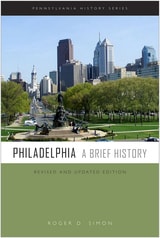
Philadelphia
A Brief HistoryRoger D. Simon
Temple University Press, 2017
Understanding Philadelphia’s history requires that we understand that nothing is inevitable; history is not made by abstract forces, but by the decisions of real individuals as they conduct their lives. With its insightful analysis and engaging prose, Philadelphia provides an accessible and readable overview of the history of the Quaker City from its founding by William Penn to the deindustrialization and gentrification of the early twenty-first century. Roger Simon asserts that the history of Philadelphia is a story of the efforts to sustain economic prosperity while fulfilling community needs, and the continued tension between those priorities.
Philadelphia devotes considerable attention to the evolving physical development of the city and to the social conditions and class structure of the people. Three dozen maps and illustrations enrich this edition, which has been fully updated and revised to reflect new scholarship on Philadelphia’s role in the post-industrial present and the diverse communities that incorporated women and minorities into the economic and social fabric of the city.
Published in association with the Pennsylvania Historical Association
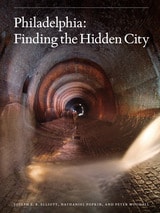
Philadelphia
Finding the Hidden CityJoseph E. B. Elliott
Temple University Press, 2017
Philadelphia possesses an exceptionally large number of places that have almost disappeared—from workshops and factories to sporting clubs and societies, synagogues, churches, theaters, and railroad lines. In Philadelphia: Finding the Hidden City, urban observers Nathaniel Popkin and Peter Woodall uncover the contemporary essence of one of America’s oldest cities. Working with accomplished architectural photographer Joseph Elliott, they explore secret places in familiar locations, such as the Metropolitan Opera House on North Broad Street, the Divine Lorraine Hotel, Reading Railroad, Disston Saw Works in Tacony, and mysterious parts of City Hall.
Much of the real Philadelphia is concealed behind facades. Philadelphia artfully reveals its urban secrets. Rather than a nostalgic elegy to loss and urban decline, Philadelphia exposes the city’s vivid layers and living ruins. The authors connect Philadelphia’s idiosyncratic history, culture, and people to develop an alternative theory of American urbanism, and place the city in American urban history. The journey here is as much visual as it is literary; Joseph Elliott’s sumptuous photographs reveal the city's elemental beauty.
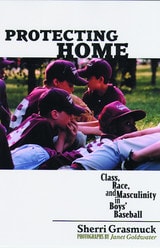
Protecting Home
Class, Race, and Masculinity in Boys' BaseballGrasmuck, Sherri
Rutgers University Press, 2005
What can neighborhood baseball tell us about class and gender cultures, urban change, and the ways that communities value public space? Through a close exploration of a boys’ baseball league in a gentrifying neighborhood of Philadelphia, sociologist Sherri Grasmuck reveals the accommodations and tensions that characterize multicultural encounters in contemporary American public life. Based on years of ethnographic observation and interviews with children, parents, and coaches, Protecting Home offers an analysis of the factors that account for racial accommodation in a space that was previously known for racial conflict and exclusion. Grasmuck argues that the institutional arrangements and social characteristics of children’s baseball create a cooperative environment for the negotiation of social, cultural, and class differences.
Chapters explore coaching styles, parental involvement, institutional politics, parent-child relations, and children’s experiences. Grasmuck identifies differences in the ways that the mostly white, working-class “old-timers” and the racially diverse, professional newcomers relate to the neighborhood. These distinctions reflect a competing sense of cultural values related to individual responsibility toward public space, group solidarity, appropriate masculine identities, and how best to promote children’s interests—a contrast between “hierarchical communalism” and “child-centered individualism.”
Through an innovative combination of narrative approaches, this book succeeds both in capturing the immediacy of boys’ interaction at the playing field and in contributing to sophisticated theoretical debates in urban studies, the sociology of childhood, and masculinity studies.