Results by title
64 books match the query 'Political corruption' and 7 start with p
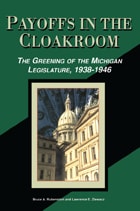
Payoffs in the Cloakroom
The Greening of the Michigan Legislature, 1938-1946Bruce A. Rubenstein
Michigan State University Press, 1995
Payoffs in the Cloakroom is a spellbinding follow-up to Rubenstein and Ziewacz's critically acclaimed Three Bullets Sealed His Lips. Three Bullets brought to life new evidence on the 1945 murder of Michigan Senator Warren Hooper. Payoffs in the Cloakroom takes up where Three Bullets left off, unraveling a complex web of political corruption and dirty state politics. In the process, the authors demonstrate that Senator Hooper was murdered to prevent his grand jury testimony against republican boss Frank McKay, who was facing bribery charges.
Making use of actual court proceeding, personal interviews, and newspaper accounts, and even a re-evaluation of police evidence, Rubenstein and Ziewacz tell a story that contains all the ingredients of first-class detective fiction—only in this instance, the story is based on fact. With chapter titles such as "Charlie and His Little Black Book," "I Never Dreamed Murder," and "Them Bones, Them Bones," the authors have, once again, provided a stimulating and absorbing account of one of the darker chapters of Michigan's political history.
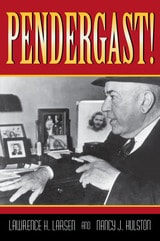
Pendergast!
Lawrence H. Larsen and Nancy J. Hulston
University of Missouri Press, 1997
Born in St. Joseph, Missouri, in 1872, Tom Pendergast moved to Kansas City around 1890 to work for his brother James, founder of the Pendergast "Goat" faction in Kansas City Democratic politics. In 1911, Pendergast became head of the Goats, and over the next fifteen years he created a powerful political machine that used illegal voting and criminal enforcers to gain power. Following a change in the city charter in 1925, Pendergast took control of Kansas City and ran it as his own personal business. In the 1930s, he received over $30 million annually from gambling, prostitution, and narcotics, putting him in the big leagues of American civic corruption. He also wielded great power in the National Democratic Party and started Harry S. Truman on the road to the presidency.
In this well-balanced biography, the authors examine Pendergast's rise to power, his successes as a political leader, his compassion for the destitute, and his reputation for keeping his word. They also examine Pendergast's character development and how his methods became more and more ruthless. Pendergast had no use for ideology in his "invisible government"—only votes counted.
In 1937 and 1938 the federal government broke the back of Pendergast's machine, convicting 259 of his campaign aides for vote fraud. In 1939 Pendergast, who was believed to be the largest bettor on horse racing in the United States, was jailed for income tax evasion, and he died in disgrace in 1945.
An insightful and comprehensive biography, Pendergast! will surely serve for years to come as the most thorough investigation of the life and infamous career of Tom Pendergast.
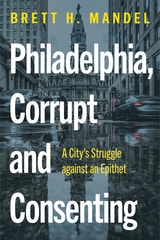
Philadelphia, Corrupt and Consenting
A City’s Struggle against an EpithetBrett H. Mandel
Temple University Press, 2023
He examines the costs of corruption, both financial and nonpecuniary, and considers the opportunity cost that corruption imposes. Mandel explores the nature and development of Philadelphia’s unique culture of corruption, emphasizing how machine politics and self-dealing are entwined with city history, creating a culture that allows corruption to thrive. In addition, he provides practical, achievable policies and actions that can produce positive change in Philadelphia and elsewhere.
Mandel seeks to provide insight into how our collective actions or inattention give consent to the corruption, as well as its roots and effects, and the reasons for its persistence. Philadelphia, Corrupt and Consenting is a critique, but above all, it is a call to action.
Political Corruption in Transition
A Sceptic's HandbookAndrás Sajó
Central European University Press, 2002
Based on two international conferences at Princeton University and the Central European University, this is a handy guide to the problem of corruption in transition countries, with an important comparative content. Political Corruption in Transition is distinguished from similar publications by at least two features: by the quality of the carefully selected and edited essays ans by its original treatment. Instead of the usual preaching and excommunications, this Skeptic`s Handbook represents down-to-earth realism.
Combines general issues with case studies and original research. The geographic coverage is wide, though it is ideas rather than a geography that drive the volume`s organization.
Political Monopolies in American Cities
The Rise and Fall of Bosses and ReformersJessica Trounstine
University of Chicago Press, 2008
Situating her in-depth studies of Chicago and San Jose in the broad context of data drawn from more than 240 cities over the course of a century, she finds that the answer—a resounding yes—illuminates the nature of political power. Both political machines and reform governments, she reveals, bias the system in favor of incumbents, effectively establishing monopolies that free governing coalitions from dependence on the support of their broader communities. Ironically, Trounstine goes on to show, the resulting loss of democratic responsiveness eventually mobilizes residents to vote monopolistic regimes out of office. Envisioning an alternative future for American cities, Trounstine concludes by suggesting solutions designed to free urban politics from this damaging cycle.
Post-Communist Mafia State
The Case of HungaryBálint Magyar
Central European University Press, 2016
Public Affairs
Politics in the Age of Sex ScandalsPaul Apostolidis and Juliet A. Williams, eds.
Duke University Press, 2004
The essays in Public Affairs reflect on a number of sex scandals while emphasizing the Clinton/Lewinsky affair, certainly the most avidly followed and momentous sex scandal in American political history. Leading scholars situate contemporary public affairs in the context not only of earlier sex scandals in American politics (such as Thomas Jefferson’s and Sally Hemings’s affair), but also of more purely political scandals (including Teapot Dome and Watergate) and sex scandals centered around public figures other than politicians (such as the actor Hugh Grant and the minister Jimmy Swaggart). Some essays consider the Clinton affair in light of feminist and anti-racist politics, while others discuss the dynamics of scandals as major media events. By charting a critical path through the muck of scandal rather than around it, Public Affairs illuminates why sex scandals have become such a prominent feature of American public life.
Contributors. Paul Apostolidis, Jodi Dean, Joshua Gamson, Theodore J. Lowi, Joshua D. Rothman, George Shulman, Anna Marie Smith, Jeremy Varon, Juliet A. Williams