Results by title
52 books match the query 'Popular literature' and 6 start with p
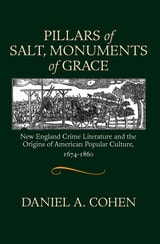
Pillars of Salt, Monuments of Grace
New England Crime Literature and the Origins of American Popular Culture, 1674-1860Daniel A. Cohen
University of Massachusetts Press, 2006
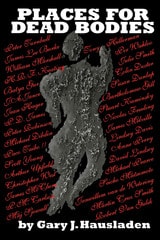
Places for Dead Bodies
By Gary J. Hausladen
University of Texas Press, 2000
From Tony Hillerman's Navajo Southwest to Martin Cruz Smith's Moscow, an exotic, vividly described locale is one of the great pleasures of many murder mysteries. Indeed, the sense of place, no less than the compelling character of the detective, is often what keeps authors writing and readers reading a particular series of mystery novels.
This book investigates how "police procedural" murder mysteries have been used to convey a sense of place. Gary Hausladen delves into the work of more than thirty authors, including Tony Hillerman, Martin Cruz Smith, James Lee Burke, David Lindsey, P. D. James, and many others. Arranging the authors by their region of choice, he discusses police procedurals set in America, the United Kingdom and Ireland, Europe, Moscow, Asia, and selected locales in other parts of the world, as well as in historical places ranging from the Roman Empire to turn-of-the-century Cairo.
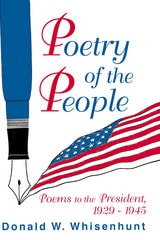
Poetry of the People
Poems to the President, 1929–1945Donald W. Whisenhunt
University of Wisconsin Press, 1996
The poets of the era voiced their opinions on virtually every subject. They wrote about New Deal agencies, they praised and condemned Hoover and Roosevelt. They expressed their views about the Supreme Court, the third term, and the approaching war in Europe. The resulting study, arranged topically rather than chronologically, provides a unique perspective on American popular culture and American politics.
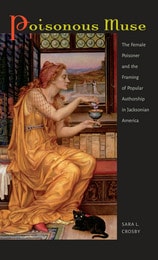
Poisonous Muse
The Female Poisoner and the Framing of Popular Authorship in Jacksonian AmericaSara L. Crosby
University of Iowa Press, 2016
This difference in outcome doesn’t mean that poisonous women didn’t preoccupy Americans. In the decades following Andrew Jackson’s first presidential bid, Americans buzzed over women who used poison to kill men. They produced and devoured reams of ephemeral newsprint, cheap trial transcripts, and sensational “true” pamphlets, as well as novels, plays, and poems. Female poisoners served as crucial elements in the literary manifestos of writers from Nathaniel Hawthorne and Edgar Allan Poe to George Lippard and the cheap pamphleteer E. E. Barclay, but these characters were given a strangely positive spin, appearing as innocent victims, avenging heroes, or engaging humbugs.
The reason for this poison predilection lies in the political logic of metaphor. Nineteenth-century Britain strove to rein in democratic and populist movements by labeling popular print “poison” and its providers “poisoners,” drawing on centuries of established metaphor that negatively associated poison, women, and popular speech or writing. Jacksonian America, by contrast, was ideologically committed to the popular—although what and who counted as such was up for serious debate. The literary gadfly John Neal called on his fellow Jacksonian writers to defy British critical standards, saying, “Let us have poison.” Poisonous Muse investigates how they answered, how they deployed the figure of the female poisoner to theorize popular authorship, to validate or undermine it, and to fight over its limits, particularly its political, gendered, and racial boundaries.
Poisonous Muse tracks the progress of this debate from approximately 1820 to 1845. Uncovering forgotten writers and restoring forgotten context to well-remembered authors, it seeks to understand Jacksonian print culture from the inside out, through its own poisonous language.
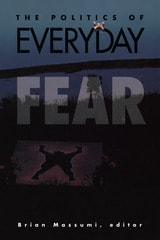
Politics Of Everyday Fear
Brian Massumi
University of Minnesota Press, 1993
The contemporary consumer is bombarded with fear-inducing images and information. This media shower of imagery is equaled only by the sheer quantity of fear-assuaging products offered for our consumption. The contributors address questions raised by the saturation of social space by capitalized fear.
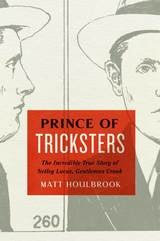
Prince of Tricksters
The Incredible True Story of Netley Lucas, Gentleman CrookMatt Houlbrook
University of Chicago Press, 2016
The lives of Netley Lucas are as flamboyant as they are unlikely. In Prince of Tricksters, Matt Houlbrook picks up the threads of Lucas’s colorful lies and lives. Interweaving crime writing and court records, letters and life-writing, Houlbrook tells Lucas’s fascinating story and, in the process, provides a panoramic view of the 1920s and ’30s. In the restless times after the Great War, the gentlemanly trickster was an exemplary figure, whose tall tales and bogus biographies exposed the everyday difficulties of knowing who and what to trust. Tracing how Lucas both evoked and unsettled the world through which he moved, Houlbrook shows how he prompted a pervasive crisis of confidence that encompassed British society, culture, and politics.
Taking readers on a romp through Britain, North America, and eventually into Africa, Houlbrook confronts readers with the limits of our knowledge of the past and challenges us to think anew about what history is and how it might be made differently.