292 books match the query 'Power resources' and 38 start with p

cover of Performance, Modelling and Reliability of Photovoltaic Systems

Performance, Modelling and Reliability of Photovoltaic Systems

George E. Georghiou

The Institution of Engineering and Technology, 2020

This book provides a comprehensive range of topics for monitoring, modelling and assessing the performance of photovoltaic plants, and enabling effective asset management. Using real-world data, the book emphasises practical usability, systematically covering the knowledge needed to perform these tasks, from the basics all the way through to the evaluation of key performance indicators. Source code used to perform data analysis is also included. This book is ideal for anyone working with photovoltaic systems or plants.
[more]
cover of Periodic Control of Power Electronic Converters

Periodic Control of Power Electronic Converters

Keliang Zhou

The Institution of Engineering and Technology, 2017

A key issue for power electronic converters is the ability to tackle periodic signals in electrical power processing to precisely and flexibly convert and regulate electrical power.
[more]
cover of Petroforms: Oil and the Shaping of Nigerian Aesthetics

Petroforms

Oil and the Shaping of Nigerian Aesthetics

Helen Kapstein

West Virginia University Press, 2025

2026 PROSE Award Finalist, Humanities: Literature

Petroforms contributes a much-needed theory of form and genre to the cutting-edge field of petrocriticism, itself an offshoot of developments in postcolonial ecocriticism. Studies of resource fiction and inquiries in the energy humanities have recently taken their rightful place as necessary reflections on the role of the literary imagination in intervening in the Anthropocene as we find ourselves precariously placed in the face of a fossil fuel crisis, climate change, and mass extinctions.

With Petroforms, Helen Kapstein undertakes close readings of a range of Nigerian aesthetic forms: short stories, romance novels, documentary film, the “Nollywood” film industry, fine art sculpture, and poetry. She uses these forms to argue that the demands of paying attention to petroleum extraction, production, consumption, and distribution in the creation of resource fictions must necessarily alter and affect conventional forms and structures. What results is a new set of genre-bending forms, like documentary film that we can read as horror, in response to the forceful and fluid demands of the petroleum industry and its master narrative.
Nigeria is one of the world’s largest oil-producing nations, in which that production is concentrated in the Niger Delta, resulting in a local environment that has been steadily degraded by oil spills, flares, pollution, and contamination, and a local culture shaped by false scarcity in a space of abundance, murderous politics, and escalating violence. At the same time as the Niger Delta grounds Kapstein’s argument in its own political realities and cultural responses, Nigeria’s participation in a global economy of petrodependency allows her theory of petroforms to be extended and applied more generally.

What Peter Hitchcock calls “oil’s generative law” is that it is “everywhere and obvious, it must be opaque or otherwise fantastic.” He means the coexistence of oil’s taken-for-granted qualities is something constitutive of every level of everyday life and its spectacular displays—gushers, spills, explosions. Oil’s nature, the fact that it is everywhere, unctuously oozing into every corner of everyday life, means that it constantly spills over out of our existing forms, genres, and systems, demanding accommodation. To try to contain it, we create new forms. Thus, a petroform is simultaneously reactionary (a necessary response to oil’s pressures, a by-product of the commodity itself) and resistant (an attempt at containment, at generating a retort to the very thing that shapes it). Each form figures oil and then configures and reconfigures itself in reaction to it.
[more]
cover of Photovoltaic Technology for Hot and Arid Environments

Photovoltaic Technology for Hot and Arid Environments

Brahim Aïssa

The Institution of Engineering and Technology, 2023

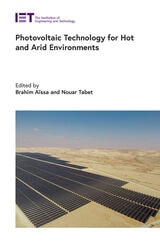
The need to reduce greenhouse gas emissions and dependency on fossil fuels necessitates accelerated deployment of renewable energy, such as photovoltaics (PV). Regions with high insolation in the "Sun Belt" covering north Africa and the middle east, as well as in Australia, parts of Latin America, and elsewhere offer tremendous potential for PV, including for green hydrogen production. However, these regions are characterized by a hot climate and a dusty environment, both causing reduction of PV panel performance by 25% or more. The development of solar cells with enhanced resistance to thermal degradation and the reduction of panel soiling have therefore been subjects of intense study.
[more]
cover of Power Circuit Breaker Theory and Design

Power Circuit Breaker Theory and Design

C.H. Flurscheim

The Institution of Engineering and Technology, 1982
The aim has been to provide an up-to-date analysis of the theoretical and practical problems involved in circuit breaker design. Circuit breakers present very special design problems because of the wide mixture of experience required.
[more]
cover of Power Distribution Automation

Power Distribution Automation

Biswarup Das

The Institution of Engineering and Technology, 2016
Utilities around the world are under increasing pressure to provide reliable and good quality power supply to their retail customers, and to reduce their operational costs. These concerns call for real time monitoring and control of the distribution system, which can be accomplished by deploying distribution automation (DA) systems, a key enabling technology for smart grids.
[more]
cover of Power Distribution System State Estimation

Power Distribution System State Estimation

Elizete Maria Lourenço

The Institution of Engineering and Technology, 2022
State estimation is a key function for real-time operation and control of electrical power systems since its role is to provide a complete, coherent, and reliable network real-time model used to set up other real-time operation and control functions. In recent years it has extended its applications to monitoring active distribution networks with distributed energy resources. The inputs of a conventional state estimator are a redundant collection of real-time measurement, load and production forecasts and a mathematical model that relates these measurements to the complex nodal voltages, which are taken as the state variables of the system. The goal of state estimation is to adjust models so that they are closer to observed values and deliver better forecasts. In power systems, this is key to maintaining power quality and operating generation and storage units well.
[more]
cover of Power Electronic Converters and Systems: Applications, Volume 2

Power Electronic Converters and Systems

Applications, Volume 2

Marcelo Godoy Simões

The Institution of Engineering and Technology, 2024
Power electronics is a field in constant evolution. Power grids require further developments, and the overall society electrification requires enhanced power electronics and motor drives. New semiconductor wide bandgap devices and modern implementation hardware software play a key role, power converters for the direct current and alternating current electrical conversion, for changing voltage or frequency have become integrated with layers of communication, control, and information processing.
[more]
cover of Power Electronic Converters and Systems: Converters and machine drives, Volume 1

Power Electronic Converters and Systems

Converters and machine drives, Volume 1

Marcelo Godoy Simões

The Institution of Engineering and Technology, 2024
Power electronics is a field in constant evolution. Power grids require further developments, and the overall society electrification requires enhanced power electronics and motor drives. New semiconductor wide bandgap devices and modern implementation hardware software play a key role, power converters for the direct current and alternating current electrical conversion, for changing voltage or frequency have become integrated with layers of communication, control, and information processing.
[more]
cover of Power Electronic Converters and Systems: Frontiers and applications

Power Electronic Converters and Systems

Frontiers and applications

Andrzej M. Trzynadlowski

The Institution of Engineering and Technology, 2016

Power electronics is a branch of electrical engineering dealing with conversion and control of electric power using semiconductor power switches. This book, written by an international panel of more than 40 experts, provides an overview of modern power electronic converters and systems, and their applications. Topics covered include semiconductor power switches, multilevel, multi-input, modular, matrix, soft-switching, and Z-source converters, switching power supplies, and smart power electronic modules. Applications discussed encompass permanent magnet synchronous motor and induction motor drives, wind, photovoltaic, and automotive energy systems, shipboard power systems, the power grid, distributed generation and microgrids, uninterruptable power supplies, and wireless power transfer. Advanced control of power electronic systems is also examined. The book is essential reading for researchers and students working in power electronics, and for practising engineers specialising in the development and application of power electronic converters and systems.
[more]
cover of Power Electronics Packaging Reliability

Power Electronics Packaging Reliability

Mark Johnson

The Institution of Engineering and Technology, 2020
Unpredictable fluctuating loads and exposure to widely varying environmental conditions (including heat, vibration, humidity and dust) present a particularly challenging environment for power electronics modules. This book describes the technologies involved in power electronic device manufacturing with an emphasis on characterising the key wear-out mechanisms and technologies to increase reliability. This book is a must-read for all engineers involved with electronics or reliable power systems.
[more]
cover of Power Electronics for Next-Generation Drives and Energy Systems: Clean generation and power grids, Volume 2

Power Electronics for Next-Generation Drives and Energy Systems

Clean generation and power grids, Volume 2

Nayan Kumar

The Institution of Engineering and Technology, 2022
Power electronics converters are devices that change parameters of electric power, such as voltage and frequency, as well as between AC and DC. They are essential parts of both advanced drives, for machines and vehicles, and energy systems to meet required flexibility and efficiency criteria. In energy systems both stationary and mobile, control and converters help ensure reliability and quality of electric power supplies.
[more]
cover of Power Electronics for Next-Generation Drives and Energy Systems: Converters and control for drives, Volume 1

Power Electronics for Next-Generation Drives and Energy Systems

Converters and control for drives, Volume 1

Nayan Kumar

The Institution of Engineering and Technology, 2022
Power electronics converters are devices that change parameters of electric power, such as voltage and frequency, as well as between AC and DC. They are essential parts of both advanced drives, for machines and vehicles, and energy systems to meet required flexibility and efficiency criteria. In energy systems both stationary and mobile, control and converters help ensure reliability and quality of electric power supplies.
[more]
cover of Power Grids with Renewable Energy: Storage, integration and digitalization

Power Grids with Renewable Energy

Storage, integration and digitalization

Abdelhay A. Sallam

The Institution of Engineering and Technology, 2021
Generation of electricity from renewable sources has become a necessity, particularly due to environmental concerns. In order for renewable sources to provide reliable power, their sporadic availability under certain conditions and the lack of control over the resource must be addressed. Different renewable energy sources and storage technologies bring various properties to the table, and power systems must be adapted and constructed to accommodate these. Power electronics and micro-grids play key roles in enabling the use of renewable energy in the evolving smarter grids.
[more]
cover of Power Line Communication Systems for Smart Grids

Power Line Communication Systems for Smart Grids

Ivan R.S. Casella

The Institution of Engineering and Technology, 2019
Power Line Communication (PLC) is a well-established technology that allows the transmission of data through electrical wires. A key advantage of PLC is its low cost of deployment when the electrical wiring infrastructure already exists, enabling it to compete or work in conjunction with wireless technologies. PLC has recently received growing attention and significant investments within the development of the Smart Grid (SG), that in turn requires sophisticated data exchange and communication.
[more]
cover of Power Line Communication Systems for Smart Grids

Power Line Communication Systems for Smart Grids

Ivan R.S. Casella

The Institution of Engineering and Technology, 2024
Power Line Communication Systems for Smart Grids presents the fundamentals and principles behind narrowband and broadband PLC technologies, covering the particularities of coupling PLC signals to the electrical grid and the main modulation and coding techniques used, to their standardisation and use in monitoring and control operations involved in energy management, charging of electric vehicles and distributed generation, taking into account the use of intermittent renewable energy sources.
[more]
cover of Power Lines: The Human Costs of American Energy in Transition

Power Lines

The Human Costs of American Energy in Transition

Sanya Carley and David Konisky

University of Chicago Press, 2025

On American energy and its persisting power to destroy.

In the United States, the promise of a green-energy future is complicated by its realities. The country’s legacy energy systems are decrepit; the rollout of new technologies is unequal and piecemeal; households find themselves increasingly without reliable or affordable access; and Americans are excluded from the decisions that shape their energy futures. Having power in America has become an exercise in race, class, and wealth—in more ways than one.

Power Lines is a sweeping portrait of American energy in the twenty-first century, rendered in terms of its increasing—and inevitable—human costs. Coal miners in West Virginia lose their livelihoods as energy markets change; historically marginalized households cannot easily access new technologies; children in “sacrifice zones” adjacent to mineral-mining sites suffer health problems and limited resources; and cities and towns are burdened from the production of alternative energies.

Sanya Carley and David Konisky show current challenges and an uncertain future of America’s greatest policy imperative. The result is not only sobering but also essential for planning and pursuing a clean-energy transition that improves on the errors of the past.
[more]
cover of Power Market Transformation: Reducing emissions and empowering consumers

Power Market Transformation

Reducing emissions and empowering consumers

Barrie Murray

The Institution of Engineering and Technology, 2018

This book describes recent developments in the power and energy markets that are driving major changes in the generation mix, network requirements and customer engagement. The industry now faces new challenges associated with global warming and escalating demand from developing countries such as China and India. The effect of government interventions to manage changes and to meet emission targets has resulted in an industry that is neither a free market nor centrally coordinated and often lacks strategic direction. The uncertainty has resulted in a dearth of investment in generation and unprecedented low margins of spare capacity. This book provides an analysis of the changes and quantifies their impact. It reviews strategic decisions in the management of changes in the sector and aims to identify the optimal way forward to meet the triple objectives of security, affordability and sustainability with low emissions. It focuses on the economic aspects of initiatives to provide insight into their interaction. It also provides insight into the opportunities in the sector to the many new potential players.
[more]
cover of Power Plant Control and Instrumentation: The control of boilers and HRSG systems

Power Plant Control and Instrumentation

The control of boilers and HRSG systems

David Lindsley

The Institution of Engineering and Technology, 2000
This book provides a practical and comprehensive analysis of control systems for boilers and HRSGs (heat-recovery steam generators) in a variety of applications from waste-to-energy plants through to combined-cycle gas-turbine power stations (CCGTs).
[more]
cover of Power Quality in Future Electrical Power Systems

Power Quality in Future Electrical Power Systems

Ahmed F. Zobaa

The Institution of Engineering and Technology, 2017

Power quality is necessary for electrical systems to operate in their intended manner without any deterioration of performance. This book highlights the new emerging challenges of power quality due to the penetration of large-scale renewable energy generation technologies, the advances in nonlinear loads, the increased electricity demands in the deregulated market, and the recent requirements of smart grids that need better hierarchical design with enhanced quality, improved controllability, higher reliability, and security. Novel research that links the past, present and future of electrical power grids from a power quality perspective is also introduced. Topics include power quality definitions; frequency-domain power theory and metering of harmonic pollution responsibility; active and passive harmonic filters; shunt flexible AC transmission; power quality improvement using series FACTS; distributed generation systems; islanding scenario generation algorithm; decentralised voltage control in smart grids; techno-economic issues of power quality; economic robust programming for energy management systems; and future trends in power quality.
[more]
cover of Power System Commissioning and Maintenance Practice

Power System Commissioning and Maintenance Practice

Keith Harker

The Institution of Engineering and Technology, 1997
Power system reliability and security is highly dependent on the practices employed in both the commissioning and maintenance processes. Both must be to a high standard to ensure that equipment does not enter service with latent deficiencies. This demands engineers who understand the necessary management involved as well as the technical processes. There is very little literature currently available on the subject; a situation which this book seeks to redress.
[more]
cover of Power System Protection: Application, Volume 3

Power System Protection

Application, Volume 3

The Electricity Training Association Electricity Training Association

The Institution of Engineering and Technology, 1995
The worldwide growth in demand for electricity has forced the pace of developments in electrical power system design to meet consumer needs for reliable, secure and cheap supplies. Power system protection, as a technology essential to high quality supply, is widely recognised as a specialism of growing and often critical importance, in which power system needs and technological progress have combined to result in rapid developments in policy and practice in recent years. In the United Kingdom, the need for appropriate training in power system protection was recognised in the early 1960s with the launch of a correspondence course from which these books emerged and have since developed designed to meet the needs of protection staff throughout the world.
[more]
cover of Power System Protection: Digital protection and signalling, Volume 4

Power System Protection

Digital protection and signalling, Volume 4

The Electricity Training Association Electricity Training Association

The Institution of Engineering and Technology, 1995
The worldwide growth in demand for electricity has forced the pace of developments in electrical power system design to meet consumer needs for reliable, secure and cheap supplies. Power system protection, as a technology essential to high quality supply, is widely recognised as a specialism of growing and often critical importance, in which power system needs and technological progress have combined to result in rapid developments in policy and practice in recent years. In the United Kingdom, the need for appropriate training in power system protection was recognised in the early 1960s with the launch of a correspondence course from which these books emerged and have since developed designed to meet the needs of protection staff throughout the world.
[more]
cover of Power System Protection: Principles and components, Volume 1

Power System Protection

Principles and components, Volume 1

The Electricity Training Association Electricity Training Association

The Institution of Engineering and Technology, 1995
The worldwide growth in demand for electricity has forced the pace of developments in electrical power system design to meet consumer needs for reliable, secure and cheap supplies. Power system protection, as a technology essential to high quality supply, is widely recognised as a specialism of growing and often critical importance, in which power system needs and technological progress have combined to result in rapid developments in policy and practice in recent years. In the United Kingdom, the need for appropriate training in power system protection was recognised in the early 1960s with the launch of a correspondence course from which these books emerged and have since developed designed to meet the needs of protection staff throughout the world.
[more]
cover of Power System Protection: Systems and methods, Volume 2

Power System Protection

Systems and methods, Volume 2

The Electricity Training Association Electricity Training Association

The Institution of Engineering and Technology, 1995
The worldwide growth in demand for electricity has forced the pace of developments in electrical power system design to meet consumer needs for reliable, secure and cheap supplies. Power system protection, as a technology essential to high quality supply, is widely recognised as a specialism of growing and often critical importance, in which power system needs and technological progress have combined to result in rapid developments in policy and practice in recent years. In the United Kingdom, the need for appropriate training in power system protection was recognised in the early 1960s with the launch of a correspondence course from which these books emerged and have since developed designed to meet the needs of protection staff throughout the world.
[more]
cover of Power System Stability: Modelling, analysis and control

Power System Stability

Modelling, analysis and control

Abdelhay A. Sallam

The Institution of Engineering and Technology, 2015
To ensure stable operation of a power system, it is necessary to analyse the power system performance under various operating conditions. Analysis includes studies such as power flow and both steady-state and transient stability. To perform such studies requires knowledge about the models used to represent the various components that constitute an integrated power system. In situations where there is a risk of loss of stability, it is necessary to apply controls that can ensure stable and uninterrupted supply of electricity following a disturbance.
[more]
cover of Power System Strength: Evaluation methods, best practice, case studies, and applications

Power System Strength

Evaluation methods, best practice, case studies, and applications

Hassan Haes Alhelou

The Institution of Engineering and Technology, 2024
Power systems need to incorporate rising shares of intermittent renewables. The penetration levels of renewable energy sources, inverter-based resources and inverter-based loads have grown, which has negative impacts on the stability and system strength of existing power systems.
[more]
cover of Power Systems Electromagnetic Transients Simulation

Power Systems Electromagnetic Transients Simulation

Neville Watson

The Institution of Engineering and Technology, 2003
Accurate knowledge of electromagnetic power system transients is crucial to the operation of an economic, efficient and environmentally-friendly power system network, without compromising on the reliability and quality of the electrical power supply. Simulation has become a universal tool for the analysis of power system electromagnetic transients and yet is rarely covered in-depth in undergraduate programmes. It is likely to become core material in future courses.
[more]
cover of Power Systems Electromagnetic Transients Simulation

Power Systems Electromagnetic Transients Simulation

Neville Watson

The Institution of Engineering and Technology, 2019
Accurate knowledge of electromagnetic power system transients is crucial to the operation of an economic, efficient and environmentally friendly power systems network without compromising on the reliability and quality of electrical power supply. Electromagnetic transient (EMT) simulation has therefore become a universal tool for the analysis of power system electromagnetic transients in the range of nanoseconds to seconds, and is the backbone for the design and planning of power systems, as well as for the investigation of problems.
[more]
cover of Power Systems and Smart Grids: Control, management and power quality of smart grids, Volume 2

Power Systems and Smart Grids

Control, management and power quality of smart grids, Volume 2

Ali Mohamed Eltamaly

The Institution of Engineering and Technology, 2025
Power systems need to be optimised for efficient use of resources and in order to meet stringent requirements for power quality and reliability. Algorithms exist and are in development for various tasks including sizing, voltage and frequency control, demand response, fault identification, and for specific situations and systems such as hybrid energy systems and hot climates. Especially in urban areas with high population densities, researchers and experts need to be abreast of R&D trends, both for energy systems for communities as well as for smart grid developments.
[more]
cover of Power Systems and Smart Grids: Sizing and optimization of energy systems for communities, Volume 1

Power Systems and Smart Grids

Sizing and optimization of energy systems for communities, Volume 1

Ali Mohamed Eltamaly

The Institution of Engineering and Technology, 2025
Power systems need to be optimised for efficient use of resources and in order to meet stringent requirements for power quality and reliability. Algorithms exist and are in development for various tasks including sizing, voltage and frequency control, demand response, fault identification, and for specific situations and systems such as hybrid energy systems and hot climates. Especially in urban areas with high population densities, researchers and experts need to be abreast of R&D trends, both for energy systems for communities as well as for smart grid developments.
[more]
cover of Power Transformer Condition Monitoring and Diagnosis

Power Transformer Condition Monitoring and Diagnosis

Ahmed Abu-Siada

The Institution of Engineering and Technology, 2018

Power transformers are a key asset for electricity utilities around the globe. However, aging populations of large power transformers require reliable monitoring and diagnostics techniques to extend the asset's lifetime and minimise the possibility of catastrophic failure. This book describes the most popular power transformer condition monitoring techniques from principles to practice.
[more]
cover of Powerline: The First Battle of America’s Energy War

Powerline

The First Battle of America’s Energy War

Paul Wellstone

University of Minnesota Press, 2003

The inspiring story of a grassroots rebellion

Powerline describes the opposition of rural Minnesotans to the building of a high voltage powerline across 430 miles of farmland from central North Dakota to the Twin Cities suburbs. Convinced that the safety of their families and the health of their land was disregarded in favor of the gluttonous energy consumption of cities, the farmer-led revolt began as questioning and escalated to rampant civil disobedience, peaking in 1978 when nearly half of Minnesota’s state highway patrol was engaged in stopping sabotage of the project.

After construction was completed, the powerline proved difficult to defend and unprecedented guerrilla warfare brought many towers to the ground (due to “bolt weevils”). Through pulse-quickening personal interviews and big-picture analysis, Powerline lays bare the latent and unexpected power of the people of rural America—and resonates strongly with today’s energy debates.
[more]
cover of Processing and Manufacturing of Electrodes for Lithium-Ion Batteries

Processing and Manufacturing of Electrodes for Lithium-Ion Batteries

Jianlin Li

The Institution of Engineering and Technology, 2023
Lithium-ion batteries (LIBs) are key to storing clean energy. However, process design, including electrode processing, is critical for performance. There are many reviews addressing material development for LIBs, but comparatively few on correlating the material properties with processing design and constraints. While these technologies are becoming familiar in industry, they are not yet widely accessible to the research community.
[more]
cover of Propulsion Systems for Hybrid Vehicles

Propulsion Systems for Hybrid Vehicles

John M. Miller

The Institution of Engineering and Technology, 2004
The automotive industry is waking up to the fact that hybrid electric vehicles could provide an answer to the ever-increasing need for lower-polluting and more fuel-efficient forms of personal transport. This is the first book to give comprehensive coverage of all aspects of the hybrid vehicle design, from its power plant and energy storage systems, to supporting chassis subsystems necessary for realising hybrid modes of operation. Key topics covered include hybrid propulsion system architectures, propulsion system sizing, electric traction system sizing and design, loss mechanisms, system simulation and vehicle certification. Offering in-depth coverage of hybrid propulsion topics, energy storage systems and modelling, and supporting electrical systems, this book will be an invaluable resource for practising engineers and managers involved in all aspects of hybrid vehicle development, modelling, simulation and testing. It will also be of interest to postgraduate students in the field.
[more]
cover of Propulsion Systems for Hybrid Vehicles

Propulsion Systems for Hybrid Vehicles

John M. Miller

The Institution of Engineering and Technology, 2010
Worldwide, the automotive industry is being challenged to make dramatic improvements in vehicle fuel economy. In Europe there are CO2 emissions penalties prorated by the degree to which vehicles exceed mandated CO2 levels. In the United States, vehicle fuel economy targets set by Congress in 2007 for 20 per cent fuel economy improvement by 2020 are now being accelerated by the Obama administration to 35.5 mpg by 2016 for a passenger car. Taking effect in 2012, the new rules set more aggressive fuel economy measures that will require significant gains in engine and driveline efficiency, better performance cabin climate control and the introduction of electric hybridization. This 2nd Edition of Propulsion Systems for Hybrid Vehicles addresses the electrification innovations that will be required, ranging from low end brake energy recuperators, idle-stop systems and mild hybrids on to strong hybrids of the power split architecture in both single mode and two mode and introducing new topics in plug-in hybrid and battery electrics. Important topics of the 1st Edition are retained and expanded and some outdated material has been replaced with new information.
[more]
cover of Protection of Electricity Distribution Networks

Protection of Electricity Distribution Networks

Juan M. Gers

The Institution of Engineering and Technology, 2011
High quality electrical service is everyday more stringent in utilities and industrial facilities around the world. One of the main players to achieve this is the protection system, which has to be reliable, fast and with a good cost/benefit ratio. This book refers to most aspects of electrical protections, with emphasis on Distribution Systems. Protection of generation and transmission systems are also treated in the text. References to modern topics such as the Distributed Generation, Smart Grid and Standard IEC 61850 have been introduced. Written by two well experienced engineers who combine a comprehensive theoretical background with examples and exercises, this book will allow the reader to easily follow the ideas explored. The book will be valuable to pre and postgraduate students, design, maintenance and consulting engineers as well as instructors looking for proper references.
[more]
cover of Protection of Electricity Distribution Networks

Protection of Electricity Distribution Networks

Juan M. Gers

The Institution of Engineering and Technology, 2022

High quality electrical service is key to power systems around the world, particularly in utilities and industrial facilities. Both voltage and grid frequency must be kept within tight limits to maintain functioning of critical infrastructure. The growing use of renewable power of intermittent character is adding to that challenge.
[more]