60 books match the query 'Problem' and 4 start with p
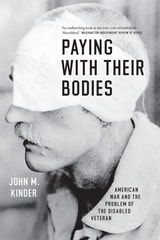
cover of Paying with Their Bodies: American War and the Problem of the Disabled Veteran

Paying with Their Bodies

American War and the Problem of the Disabled Veteran

John M. Kinder

University of Chicago Press, 2015

Christian Bagge, an Iraq War veteran, lost both his legs in a roadside bomb attack on his Humvee in 2006. Months after the accident, outfitted with sleek new prosthetic legs, he jogged alongside President Bush for a photo op at the White House. The photograph served many functions, one of them being to revive faith in an American martial ideal—that war could be fought without permanent casualties, and that innovative technology could easily repair war’s damage. When Bagge was awarded his Purple Heart, however, military officials asked him to wear pants to the ceremony, saying that photos of the event should be “soft on the eyes.” Defiant, Bagge wore shorts.

America has grappled with the questions posed by injured veterans since its founding, and with particular force since the early twentieth century: What are the nation’s obligations to those who fight in its name? And when does war’s legacy of disability outweigh the nation’s interests at home and abroad? In Paying with Their Bodies, John M. Kinder traces the complicated, intertwined histories of war and disability in modern America. Focusing in particular on the decades surrounding World War I, he argues that disabled veterans have long been at the center of two competing visions of American war: one that highlights the relative safety of US military intervention overseas; the other indelibly associating American war with injury, mutilation, and suffering. Kinder brings disabled veterans to the center of the American war story and shows that when we do so, the history of American war over the last century begins to look very different. War can no longer be seen as a discrete experience, easily left behind; rather, its human legacies are felt for decades.

The first book to examine the history of American warfare through the lens of its troubled legacy of injury and disability, Paying with Their Bodies will force us to think anew about war and its painful costs.

[more]
cover of Phenomenology and the Problem of History: A Study of Husserl's Transcendental Philosophy

Phenomenology and the Problem of History

A Study of Husserl's Transcendental Philosophy

David Carr

Northwestern University Press, 2009
In Phenomenology and the Problem of History, David Carr examines the paradox involving Husserl's transcendental philosophy and his later historicist theory. Rejecting the arguments of earlier critics that compromise aspects of Husserl's writing, Carr proposes a model of the transcendental philosopher who balances necessary historical reduction with a strict mind to historical context. 
[more]
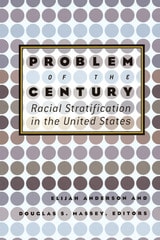
cover of Problem of the Century: Racial Stratification in the United States

Problem of the Century

Racial Stratification in the United States

Elijah Anderson

Russell Sage Foundation, 2001
In 1899 the great African American scholar, W.E.B. DuBois, published The Philadelphia Negro, the first systematic case study of an African American community and one of the foundations of American sociology. DuBois prophesied that the color line would be the problem of the twentieth century. One hundred years later, Problem of the Century reflects upon his prophecy, exploring the ways in which the color line is still visible in the labor market, the housing market, education, family structure, and many other aspects of life at the turn of a new century. The book opens with a theoretical discussion of the way racial identity is constructed and institutionalized. When the government classifies races and confers group rights upon them, is it subtly reenforcing damaging racial divisions, or redressing the group privileges that whites monopolized for so long? The book also delineates the social dynamics that underpin racial inequality. The contributors explore the causes and consequences of high rates of mortality and low rates of marriage in black communities, as well as the way race affects a person's chances of economic success. African Americans may soon lose their historical position as America's majority minority, and the book also examines how race plays out in the sometimes fractious relations between blacks and immigrants. The final part of the book shows how the color line manifests itself at work and in schools. Contributors find racial issues at play on both ends of the occupational ladder—among absentee fathers paying child support from their meager earnings and among black executives prospering in the corporate world. In the schools, the book explores how race defines a student's peer group and how peer pressure affects a student's grades. Problem of the Century draws upon the distinguished faculty of sociologists at the University of Pennsylvania, where DuBois conducted his research for The Philadelphia Negro. The contributors combine a scrupulous commitment to empirical inquiry with an eclectic openness to different methods and approaches. Problem of the Century blends ethnographies and surveys, statistics and content analyses, census data and historical records, to provide a far-reaching examination of racial inequality in all its contemporary manifestations.
[more]
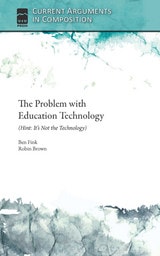
cover of Problem with Education Technology (Hint: It's Not the Technology)

Problem with Education Technology (Hint

It's Not the Technology)

Ben Fink

Utah State University Press, 2016

Education is in crisis—at least, so we hear. And at the center of this crisis is technology. New technologies like computer-based classroom instruction, online K–12 schools, MOOCs (massive open online courses), and automated essay scoring may be our last great hope—or the greatest threat we have ever faced.

In The Problem with Education Technology, Ben Fink and Robin Brown look behind the hype to explain the problems—and potential—of these technologies. Focusing on the case of automated essay scoring, they explain the technology, how it works, and what it does and doesn’t do. They explain its origins, its evolution (both in the classroom and in our culture), and the controversy that surrounds it. Most significantly, they expose the real problem—the complicity of teachers and curriculum-builders in creating an education system so mechanical that machines can in fact often replace humans—and how teachers, students, and other citizens can work together to solve it.

Offering a new perspective on the change that educators can hope, organize, and lobby for, The Problem with Education Technology challenges teachers and activists on “our side,” even as it provides new evidence to counter the profit-making, labor-saving logics that drive the current push for technology in the classroom.


[more]