Results by title
110 books match the query 'Romanticism' and 3 start with p
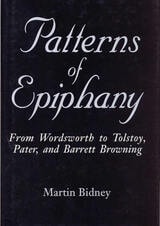
Patterns of Epiphany
From Wordsworth to Tolstoy, Pater, and Barrett BrowningMartin Bidney
Southern Illinois University Press, 1997
After explaining his new methodology, Bidney identifies and discusses epiphanies in the works of William Wordsworth, Samuel Taylor Coleridge, Matthew Arnold, Alfred Lord Tennyson, Walter Pater, Thomas Carlyle, Leo Tolstoy, and Elizabeth Barrett Browning. Taking his cue from the French philosopher Gaston Bachelard, Bidney postulates that any writer’s epiphany pattern usually shows characteristic elements (earth, air, fire, water), patterns of motion (pendular, eruptive, trembling), and/or geometric shapes. Bachelard’s analytic approach involves studying patterns of perceived experience—phenomenology—but unlike most phenomenologists, Bidney does not speculate on internal processes of consciousness. Instead, he concentrates on literary epiphanies as objects on the printed page, as things with structures that can be detected and analyzed for their implications.
Bidney, then, first identifies each author’s paradigm epiphany, finding that both the Romantics and the Victorians often label such a paradigm as a vision or dream, thereby indicating its exceptional intensity, mystery, and expansiveness. Once he identifies the paradigm and shows how it is structured, he traces occurrences of each writer’s epiphany pattern, thus providing an inclusive epiphanic portrait that enables him to identify epiphanies in each writer’s other works. Finally, he explores the implications of his analysis for other literary approaches: psychoanalytical, feminist, influence-oriented or intertextual, and New Historical.
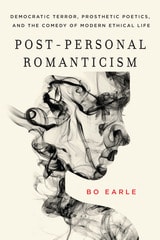
Post-Personal Romanticism
Democratic Terror, Prosthetic Poetics, and the Comedy of Modern Ethical LifeBo Earle
The Ohio State University Press, 2017
Tracing this insight to Hegel’s suggestion that modern subjectivity is in some sense post-individual or even posthumous, Earle argues that signature Romantic lyrics offer a way forward that avoids postmodernism’s wholesale rejection of autonomous selfhood. With chapters on Wordsworth, Blake, Byron, Shelley, and Keats, Earle traces how Romantic lyrics mine this interminability to recover figurative emblems or masks of selfhood from experiences of its inevitable normative failure. This model is of particularly urgent value today when the costs of modern narcissism, economic exploitation, and political imperialism have come to include the normalization of torture, signature drone strikes, and climate change.
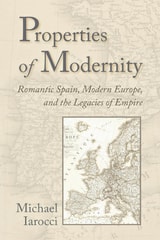
Properties of Modernity
Romantic Spain, Modern Europe, and the Legacies of EmpireMichael Iarocci
Vanderbilt University Press, 2006
Through a close study of Cadalso, Saavedra, and Larra, Iarocci argues that Spanish writers were intensely concerned with the same issues taken up by more famous Romantics and that the ways in which they address these issues provides us with a richer notion, not only of Spain, but of all of Europe.