Results by title
11 books match the query 'Nowhere'
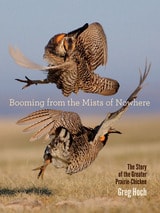
Booming from the Mists of Nowhere
The Story of the Greater Prairie-ChickenGreg Hoch
University of Iowa Press, 2015
Skillfully interweaving lyrical accounts from early settlers, hunters, and pioneer naturalists with recent scientific research on the grouse and its favored grasslands, Hoch reveals that the prairie-chicken played a key role in the American settlement of the Midwest. Many hungry pioneers regularly shot and ate the bird, as well as trapping hundreds of thousands, shipping them eastward by the trainload for coastal suppers. As a result of both hunting and habitat loss, the bird’s numbers plummeted to extinction across 90 percent of its original habitat. Iowa, whose tallgrass prairies formed the very center of the greater prairie-chicken’s range, no longer supports a native population of the bird most symbolic of prairie habitat.
The steep decline in the prairie-chicken population is one of the great tragedies of twentieth-century wildlife management and agricultural practices. However, Hoch gives us reason for optimism. These birds can thrive in agriculturally productive grasslands. Careful grazing, reduced use of pesticides, well-placed wildlife corridors, planned burning, higher plant, animal, and insect diversity: these are the keys. If enough blocks of healthy grasslands are scattered over the midwestern landscape, there will be prairie-chickens—and many of their fellow creatures of the tall grasses. Farmers, ranchers, conservationists, and citizens can reverse the decline of grassland birds and insure that future generations will hear the booming of the prairie-chicken.
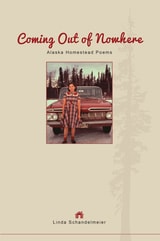
Coming Out of Nowhere
Alaska Homestead PoemsLinda Schandelmeier
University of Alaska Press, 2018
Homestead life is often romanticized as a valiant, resilient family persisting in the clean isolation of pristine wilderness, living off the land and depending only on each other. But there can be a darker side to this existence.
Linda Schandelmeier was raised on a family homestead six miles south of the fledgling town of Anchorage, Alaska in the 1950s and ’60s. But hers is not a typical homestead story. In this book, part poetic memoir and part historical document, a young girl comes of age in a family fractured by divorce and abuse. Schandelmeier does not shy away from these details of her family history, but she also recognizes her childhood as one that was unique and nurturing, and many of her poems celebrate homestead life. Her words hint at her way of surviving and even transcending the remoteness by suggesting a deeper level of human experience beyond the daily grind of homestead life; a place in which the trees and mountains are almost members of the family. These are poems grounded in the wilds that shimmer with a mythic quality. Schandelmeier’s vivid descriptions of homesteading will draw in readers from all types of lives.
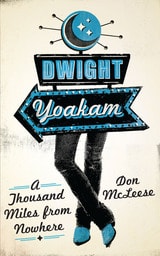
Dwight Yoakam
A Thousand Miles from NowhereBy Don McLeese
University of Texas Press, 2012
From his formative years playing pure, hardcore honky-tonk for mid-’80s Los Angeles punk rockers through his subsequent surge to the top of the country charts, Dwight Yoakam has enjoyed a singular career. An electrifying live performer, superb writer, and virtuosic vocalist, he has successfully bridged two musical worlds that usually have little use for each other—commercial country and its alternative/Americana/roots-rocking counterpart. Defying the label “too country for rock, too rock for country,” Yoakam has triumphed while many of his peers have had to settle for cult acceptance. Four decades into his career, he has sold more than 25 million records and continues to tour regularly, with an extremely loyal fan base.
In Dwight Yoakam, award-winning music journalist Don McLeese offers the first musical biography of this acclaimed artist. Tracing the seemingly disparate influences in Yoakam’s music, McLeese shows how he has combined rock and roll, rockabilly, country, blues, and gospel into a seamless whole. In particular, McLeese explores the essential issue of “authenticity” and how it applies to Yoakam, as well as to country music and popular culture in general. Drawing on wide-ranging interviews with Yoakam and his management, while also benefitting from the perspectives of others closely associated with his musical success (including producer-guitarist Pete Anderson, Yoakam’s partner throughout his most popular and creative decades), Dwight Yoakam pays tribute to the musician who has established himself as a visionary beyond time, an artist who could title an album Tomorrow’s Sounds Today and deliver it.
Everywhere and Nowhere
Anonymity and Mediation in Eighteenth-Century BritainMark Vareschi
University of Minnesota Press, 2018
A fascinating analysis of anonymous publication centuries before the digital age
Everywhere and Nowhere considers the ubiquity of anonymity and mediation in the publication and circulation of eighteenth-century British literature—before the Romantic creation of the “author”—and what this means for literary criticism. Anonymous authorship was typical of the time, yet literary scholars and historians have been generally unable to account for it as anything more than a footnote or curiosity.
Mark Vareschi shows the entangled relationship between mediation and anonymity, revealing the nonhuman agency of the printed text. Drawing richly on quantitative analysis and robust archival work, Vareschi brings together philosophy, literary theory, and media theory in a trenchant analysis, uncovering a history of textual engagement and interpretation that does not hinge on the known authorial subject.
In discussing anonymous poetry, drama, and the novel along with anonymously published writers such as Daniel Defoe, Frances Burney, and Walter Scott, he unveils a theory of mediation that renews broader questions about agency and intention. Vareschi argues that textual intentionality is a property of nonhuman, material media rather than human subjects alone, allowing the anonymous literature of the eighteenth century to speak to contemporary questions of meaning in the philosophy of language. Vareschi closes by exploring dubious claims about the death of anonymity and the reexplosion of anonymity with the coming of the digital. Ultimately, Everywhere and Nowhere reveals the long history of print anonymity so central to the risks and benefits of the digital culture.
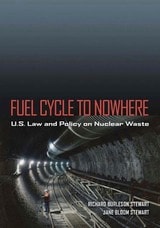
Fuel Cycle to Nowhere
U.S. Law and Policy on Nuclear WasteRichard Burleson Stewart
Vanderbilt University Press, 2011
The first comprehensive history and overview of U.S. nuclear waste law and regulation, Fuel Cycle to Nowhere traces sixty years of nuclear weapons programs, the growth of nuclear power, and their waste legacies, the rise of environmentalism, and the responses of federal agencies. Richard and Jane Stewart expertly analyze the changing policies for storing low-level waste, transuranic waste, spent nuclear fuel, and high-level waste and for regulating their transport by rail and by truck. They also chronicle "a tale of two repositories"--one, the Waste Isolation Pilot Plant in New Mexico, known as WIPP, the world's only operating deep geologic nuclear waste disposal facility, which emerged from a contentious but ultimately successful struggle between federal and state interests; the other, Yucca Mountain, mandated top down by Congress and a failure.
Fuel Cycle to Nowhere provides the critical information and analysis on the waste disposal issues and solutions that the commission, Congress, the administration, journalists, policymakers, and the public so urgently need.
This book is a project of the Consortium for Risk Evaluation with Stakeholder Participation (CRESP), a Vanderbilt University-led, multi-university consortium supported as a cooperative agreement by the U.S. Department of Energy, Office of Environmental This book is a project of the Consortium for Risk Evaluation with Stakeholder Participation (CRESP), a Vanderbilt University-led, multi-university consortium supported as a cooperative agreement by the U.S. Department of Energy, Office of Environmental Management to support safe, effective, publicly credible, risk informed management of existing and future nuclear waste from government and civilian sources through independent strategic analysis, review, applied research and education.
In the Middle of Nowhere
Fanny Howe
University of Alabama Press, 1984
Notes on Nowhere
Feminism, Utopian Logic, and Social TransformationJennifer Burwell
University of Minnesota Press, 1997
Notes on Nowhere was first published in 1997. Minnesota Archive Editions uses digital technology to make long-unavailable books once again accessible, and are published unaltered from the original University of Minnesota Press editions.
The term utopia implies both "good place" and "nowhere." Since Sir Thomas More wrote Utopia in 1516, debates about utopian models of society have sought to understand the implications of these somewhat contradictory definitions. In Notes on Nowhere, author Jennifer Burwell uses a cross section of contemporary feminist science fiction to examine the political and literary meaning of utopian writing and utopian thought.
Burwell provides close readings of the science fiction novels of five feminist writers-Marge Piercy, Sally Gearhart, Joanna Russ, Octavia Butler, and Monique Wittig-and poses questions central to utopian writing: Do these texts promote a tradition in which narratives of the ideal society have been used to hide rather than reveal violence, oppression, and social divisions? Can a feminist critical utopia offer a departure from this tradition by using utopian narratives to expose contradiction and struggle as central aspects of the utopian impulse? What implications do these questions have for those who wish to retain the utopian impulse for emancipatory political uses?
As one way of answering these questions, Burwell compares two "figures" that inform utopian writing and social theory. The first is the traditional abstract "revolutionary" subject who contradicts existing conditions and who points us to the ideal body politic. The second, "resistant," subject is partial, concrete, and produced by conditions rather than operating outside of them. In analyzing contemporary changes in the subject's relationship to social space, Burwell draws from and revises "standpoint approaches" that tie visions of social transformation to a group's position within existing conditions.
By exploring the dilemmas, antagonisms, and resolutions within the critical literary feminist utopia, Burwell creates connections to a similar set of problems and resolutions characterizing "nonliterary" discourses of social transformation such as feminism, gay and lesbian studies, and Marxism. Notes on Nowhere makes an original, significant, and persuasive contribution to our understanding of the political and literary dimensions of the utopian impulse in literature and social theory.
Jennifer Burwell teaches in the Department of English at Wesleyan University in Connecticut.
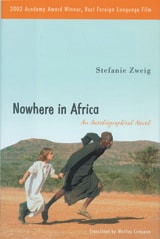
Nowhere in Africa
An Autobiographical NovelStefanie Zweig, Translated by Marlies Comjean
University of Wisconsin Press, 2007
Visit the Web site for the film at www.nowhereinafrica.com
Nowhere to Arrive
PoemsJenny Xie, foreword by Chris Abani
Northwestern University Press, 2017
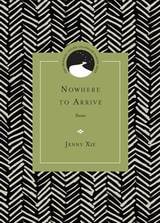
At the chapbook's center are two long poems, titled "Phnom Penh Diptych: Wet Season" and "Phnom Penh Diptych: Dry Season," that examine the escapist narratives that draw tourists and expatriates to Cambodia, and the speaker’s own privileged positioning.
On a formal level, the poems in Nowhere to Arrive make room for the unsaid and that which cannot be articulated. Here, we have a vocabulary of silence alongside stark imagistic juxtapositions, poems that celebrate compression and the force of paratactic constructions. Attentiveness and concentration emerge as virtues, as the speaker surveys the vast territory of the present with a wakeful gaze.
Out of Nowhere
New and Selected PoemsMary Ann Taylor-Hall
Ohio University Press, 2017
Road to Nowhere
How a Highway Map Wrecked BaltimoreEmily Lieb
University of Chicago Press, 2025
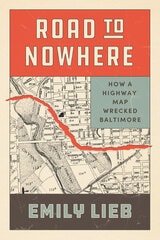
In the mid-1950s Baltimore’s Rosemont neighborhood was alive and vibrant with smart rowhouses, a sprawling park, corner grocery stores, and doctor’s offices. By 1957, a proposed expressway threatened to gut this Black, middle-class community from stem to stern.
That highway was never built, but it didn’t matter—even the failure to build it destroyed Rosemont economically, if not physically. In telling the history of the neighborhood and the notional East–West Expressway, Emily Lieb shows the interwoven tragedies caused by racism in education, housing, and transportation policy. Black families had been attracted to the neighborhood after Baltimore’s Board of School Commissioners converted several white schools into “colored” ones, which had also laid the groundwork for predatory real-estate agents who bought low from white sellers and sold high to determined Black buyers. Despite financial discrimination, Black homeowners built a thriving community before the city council formally voted to condemn some nine hundred homes in Rosemont for the expressway, leading to deflated home values and even more predatory real estate deals.
Drawing on land records, oral history, media coverage, and policy documents, Lieb demystifies blockbusting, redlining, and prejudicial lending, highlighting the national patterns at work in a single neighborhood. The result is an absorbing story about the deliberate decisions that produced racial inequalities in housing, jobs, health, and wealth—as well as a testament to the ingenuity of the residents who fought to stay in their homes, down to today.