Results by title
149 books match the query 'Russia (Federation)' and 6 start with p

Performing Violence
Literary and Theatrical Experiments of New Russian DramaBirgit Beumers and Mark Lipovetsky
Intellect Books, 2009
The so-called “New Russian Drama” emerged at the end of the twentieth century, following a long period of decline in dramatic writing in the late Soviet and post-Soviet era. In Performing Violence, Birgit Beumers and Mark Lipovetsky examine the representation of violence in these new dramatic works by young Russian playwrights. Reflecting the disappointment in Yeltsin’s democratic reforms and Putin’s neoconservative politics, the plays focus on political and social representations of violence, its performances, and its justifications.
As the first English-language study of Russian drama and theatre in the twenty-first century, Performing Violence seeks a vantage point for the analysis of brutality in post-Soviet culture. While previous generations had preferred poetry and prose, this new breed of authors—the Presnyakov brothers, Evgeni Grishkovets, and Vasili Sigarev among them—have garnered international recognition for their fierce plays. This book investigates the violent portrayal of the identity crisis of a generation as represented in their theatrical works, and will be a key text for students and scholars of drama, Russian studies, and literature.
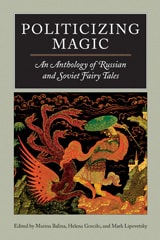
Politicizing Magic
An Anthology of Russian and Soviet Fairy TalesBalina/Goscilo/Lipovetsky
Northwestern University Press, 2005
We were born to make fairy tales come true. As one of Stalinism's more memorable slogans, this one suggests that the fairy tale figured in Soviet culture as far more than a category of children's literature. How much more-and how cannily Russian fairy tales reflect and interpret Soviet culture, especially in its utopian ambitions-becomes clear for the first time in Politicizing Magic, a compendium of folkloric, literary, and critical texts that demonstrate the degree to which ancient fairy-tale fantasies acquired political and historical meanings during the catastrophic twentieth century.
Introducing Western readers to the most representative texts of Russian folkloric and literary tales, this book documents a rich exploration of this colorful genre through all periods of Soviet literary production (1920-1985) by authors with varied political and aesthetic allegiances. Here are traditional Russian folkloric tales and transformations of these tales that, adopting the didacticism of Soviet ideology, proved significant for the official discourse of Socialist Realism. Here, too, are narratives produced during the same era that use the fairy-tale paradigm as a deconstructive device aimed at the very underpinnings of the Soviet system. The editors' introductory essays acquaint readers with the fairy-tale paradigm and the permutations it underwent within the utopian dream of Soviet culture, deftly placing each-from traditional folklore to fairy tales of Socialist Realism, to real-life events recast as fairy tales for ironic effect-in its literary, historical, and political context.
Politics and Policies in Post-Communist Transition
Primary and Secondary Privatisation in Central Europe and the Former Soviet UnionKároly Attila Soós
Central European University Press, 2011

Presumption
An Entertainment: A Sequel to Pride and PrejudiceJulia Barrett
University of Chicago Press, 1995
"An elegant emulation and continuation of Pride and Prejudice. . . . Jointly composed by two admirers of Jane Austen, the book often achieves crisp replication of her style. . . . Presumption shows how sequel-writing can, like parody, be a sharp exercise in literary appreciation."—Peter Kemp, Times Literary Supplement
Julia Barrett is a pseudonym for Julia Braun Kessler and Gabrielle Donnelly.
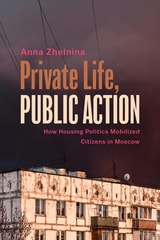
Private Life, Public Action
How Housing Politics Mobilized Citizens in MoscowAnna Zhelnina
Temple University Press, 2026
Private Life, Public Action traces how residents impacted by the relocation plan became activists despite having little to no experience organizing or even forming political affiliations and opinions. Author Anna Zhelnina details the ways in which neighbors engaged in collective action, as well as the individual and structural changes these interactions caused.
Zhelnina develops the concept of “housing strategies” to explain how residents’ debates with their neighbors about housing were shaped by their private life strategies. She applies her findings about housing in Moscow to ongoing questions about political mobilization, demonstrating how public engagement is shaped by historical and social contexts.
Examining the intersection of housing, politics, and citizenship in contemporary Russia, Private Life, Public Action offers a new way to look at urban change.
In the series Politics, History, and Social Change
Protest and the Politics of Blame
The Russian Response to Unpaid WagesDebra Javeline
University of Michigan Press, 2003