Results by title
857 books match the query 'Schools' and 39 start with p
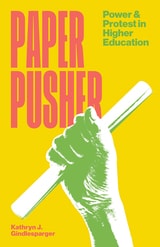
Paper Pusher
Power and Protest in Higher EducationKathryn J. Gindlesparger
University of Minnesota Press, 2027
Paperwork is the new protest: leveraging bureaucracy for progressive action
In contemporary higher education, power increasingly circulates through documents rather than debate, making paperwork one of the most consequential sites of protest. Yet as universities become more corporatized and subject to authoritarian influence, bureaucratic writing is often treated as passive, procedural, or politically neutral. Paper Pusher shows how paperwork is a central mechanism of governance and therefore a formidable, underused medium for democratic action and protest within bureaucracies.
Kathryn J. Gindlesparger reframes the “paper pusher” from a symbol of compliance into an agent of institutional accountability and resistance. She develops four avenues for protesting through bureaucracy—voice, filing, circulation, and stasis-seeking—showing how everyday documents such as meeting minutes, policy drafts, budgets, and accreditation reports can be used to push back against authoritarian and corporate forces that undermine an institution’s mission. Rather than emphasizing visible confrontation, Paper Pusher demonstrates how activism can operate quietly and credibly from within systems where overt protest may carry professional risk.
Grounded in story and lived experience, this book is a love letter to office workers, staff, and middle managers whose labor sustains institutions and whose expertise is often overlooked. It foregrounds feminist, working-class, queer, disabled, Black, and brown voices, highlighting how marginalized workers have long used bureaucratic knowledge to create access, protection, and change. Practical and people-centered, Paper Pusher calls for bureaucratic literacy to be taught wherever writing is taught, insisting that paperwork is not grunt work but power work.
Retail e-book files for this title are screen-reader friendly with images accompanied by short alt text and/or extended descriptions.
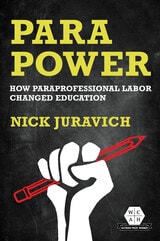
Para Power
How Paraprofessional Labor Changed EducationNick Juravich
University of Illinois Press, 2024
Understanding paras as key players in Black and Latino struggles for jobs and freedom, Nick Juravich details how the first generation of paras in New York City transformed work in public schools and the relationships between schools and the communities they served. Paraprofessional programs created hundreds of thousands of jobs in working-class Black and Latino neighborhoods. These programs became an important pipeline for the training of Black and Latino teachers in the1970s and early 1980s while paras’ organizing helped drive the expansion and integration of public sector unions.
An engaging portrait of an invisible profession, Para Power examines the lives and practices of the first generation of paraprofessional educators against the backdrop of struggles for justice, equality, and self-determination.
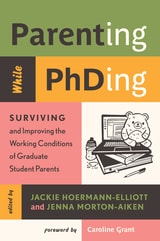
Parenting While PhDing
Surviving and Improving the Working Conditions of Graduate Student ParentsJackie Hoermann-Elliott
Rutgers University Press, 2025
Featuring contributions from more than forty current and former graduate students raising children, Parenting While PhDing offers valuable advice for students and administrators. Parents will get practical recommendations on both child care and self-care, learning how to form supportive personal and professional networks while establishing a healthy work/life balance. The collection also offers thoughtful suggestions on how to make graduate programs less toxic and more inclusive.
Recognizing that not all graduate students have similar backgrounds or needs, Parenting While PhDing features a diverse range of viewpoints, including queer, trans, disabled, BIPOC, immigrant, and first-generation college students. The authors represent a variety of disciplines, from the natural and social sciences to the humanities and health care professions. Together, they share fresh perspectives on the experiences of graduate students with children and offer strategies they can use to navigate the dual pressures of the academy and parenting.
Parenting and Professing
Balancing Family Work with an Academic CareerRachel Hile Bassett
Vanderbilt University Press, 2005
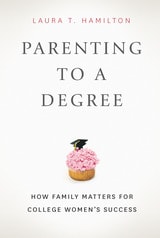
Parenting to a Degree
How Family Matters for College Women's SuccessLaura T. Hamilton
University of Chicago Press, 2016
Hamilton vividly captures the parenting approaches of mothers and fathers from all walks of life—from a CFO for a Fortune 500 company to a waitress at a roadside diner. As she shows, parents are guided by different visions of the ideal college experience, built around classed notions of women’s work/family plans and the ideal age to “grow up.” Some are intensively involved and hold adulthood at bay to cultivate specific traits: professional helicopters, for instance, help develop the skills and credentials that will advance their daughters’ careers, while pink helicopters emphasize appearance, charm, and social ties in the hopes that women will secure a wealthy mate. In sharp contrast, bystander parents—whose influence is often limited by economic concerns—are relegated to the sidelines of their daughter’s lives. Finally, paramedic parents—who can come from a wide range of class backgrounds—sit in the middle, intervening in emergencies but otherwise valuing self-sufficiency above all.
Analyzing the effects of each of these approaches with clarity and depth, Hamilton ultimately argues that successfully navigating many colleges and universities without involved parents is nearly impossible, and that schools themselves are increasingly dependent on active parents for a wide array of tasks, with intended and unintended consequences. Altogether, Parenting to a Degree offers an incisive look into the new—and sometimes problematic—relationship between students, parents, and universities.
Parents and Schools
The 150-Year Struggle for Control in American EducationWilliam W. Cutler III
University of Chicago Press, 2000
Cutler shows how in the 1920s and 1930s schools expanded their responsibility for children's well-being outside the classroom. These efforts sowed the seeds for later conflict as schools came to be held accountable for solving society's problems. Finally, he brings the reader into recent decades, in which a breakdown of trust, racial tension, and "parents' rights" have taken the story full circle, with parents and schools once again at odds.
Cutler's book is an invaluable guide to understanding how parent-teacher cooperation, which is essential for our children's educational success, might be achieved.
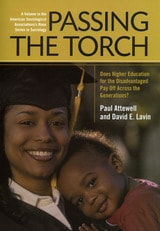
Passing the Torch
Does Higher Education for the Disadvantaged Pay Off Across the Generations?Paul Attewell
Russell Sage Foundation, 2007
The steady expansion of college enrollment rates over the last generation has been heralded as a major step toward reducing chronic economic disparities. But many of the policies that broadened access to higher education—including affirmative action, open admissions, and need-based financial aid—have come under attack in recent years by critics alleging that schools are admitting unqualified students who are unlikely to benefit from a college education. In Passing the Torch, Paul Attewell, David Lavin, Thurston Domina, and Tania Levey follow students admitted under the City University of New York’s “open admissions” policy, tracking its effects on them and their children, to find out whether widening college access can accelerate social mobility across generations.
Unlike previous research into the benefits of higher education, Passing the Torch follows the educational achievements of three generations over thirty years. The book focuses on a cohort of women who entered CUNY between 1970 and 1972, when the university began accepting all graduates of New York City high schools and increasing its representation of poor and minority students. The authors survey these women in order to identify how the opportunity to pursue higher education affected not only their long-term educational attainments and family well-being, but also how it affected their children’s educational achievements. Comparing the record of the CUNY alumnae to peers nationwide, the authors find that when women from underprivileged backgrounds go to college, their children are more likely to succeed in school and earn college degrees themselves. Mothers with a college degree are more likely to expect their children to go to college, to have extensive discussions with their children, and to be involved in their children’s schools. All of these parenting behaviors appear to foster higher test scores and college enrollment rates among their children. In addition, college-educated women are more likely to raise their children in stable two-parent households and to earn higher incomes; both factors have been demonstrated to increase children’s educational success.
The evidence marshaled in this important book reaffirms the American ideal of upward mobility through education. As the first study to indicate that increasing access to college among today’s disadvantaged students can reduce educational gaps in the next generation, Passing the Torch makes a powerful argument in favor of college for all.
Pay for Play
A History of Big-Time College Athletic ReformRonald A. Smith
University of Illinois Press, 2011
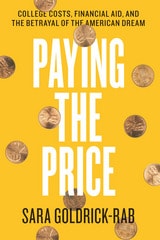
Paying the Price
College Costs, Financial Aid, and the Betrayal of the American DreamSara Goldrick-Rab
University of Chicago Press, 2016
Not necessarily, says Sara Goldrick-Rab, and with Paying the Price, she shows in damning detail exactly why. Quite simply, college is far too expensive for many people today, and the confusing mix of federal, state, institutional, and private financial aid leaves countless students without the resources they need to pay for it.
Drawing on an unprecedented study of 3,000 young adults who entered public colleges and universities in Wisconsin in 2008 with the support of federal aid and Pell Grants, Goldrick-Rab reveals the devastating effect of these shortfalls. Half the students in the study left college without a degree, while less than 20 percent finished within five years. The cause of their problems, time and again, was lack of money. Unable to afford tuition, books, and living expenses, they worked too many hours at outside jobs, dropped classes, took time off to save money, and even went without adequate food or housing. In many heartbreaking cases, they simply left school—not with a degree, but with crippling debt. Goldrick-Rab combines that shocking data with devastating stories of six individual students, whose struggles make clear the horrifying human and financial costs of our convoluted financial aid policies.
America can fix this problem. In the final section of the book, Goldrick-Rab offers a range of possible solutions, from technical improvements to the financial aid application process, to a bold, public sector–focused “first degree free” program. What’s not an option, this powerful book shows, is doing nothing, and continuing to crush the college dreams of a generation of young people.
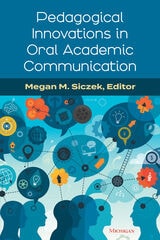
Pedagogical Innovations in Oral Academic Communication
Megan M. Siczek, Editor
University of Michigan Press, 2022
Pedagogical Innovations in Oral Academic Communication is grounded in four key principles: academic discourse socialization; context-responsive instruction; instructional approaches of English for Academic Purposes and English for Specific Purposes; and asset-oriented pedagogy. In the chapters in this collection, the authors share their teaching context, the details and underlying principles of their pedagogical approach, and recommendations for practitioners. Readers will develop a deeper understanding of the communicative contexts their students inhabit, including the types of speaking situations they are likely to encounter, and understand how to innovate their approach to teaching oral communication to students from diverse cultural, linguistic, educational, and disciplinary backgrounds. Such innovations prepare students for more effective communication during their academic studies and professional career, a goal that is of central importance in our globally interconnected society.
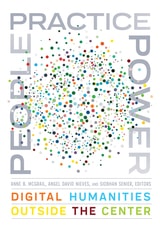
People, Practice, Power
Digital Humanities outside the CenterAnne B. McGrail
University of Minnesota Press, 2021
An illuminating volume of critical essays charting the diverse territory of digital humanities scholarship
The digital humanities have traditionally been considered to be the domain of only a small number of prominent and well-funded institutions. However, through a diverse range of critical essays, this volume serves to challenge and enlarge existing notions of how digital humanities research is being undertaken while also serving as a kind of alternative guide for how it can thrive within a wide variety of institutional spaces.
Focusing on the complex infrastructure that undergirds the field of digital humanities, People, Practice, Power examines the various economic, social, and political factors that shape such academic endeavors. The multitude of perspectives comprising this collection offers both a much-needed critique of the existing structures for digital scholarship and the means to generate broader representation within the field.
This collection provides a vital contribution to the realm of digital scholarly research and pedagogy in acknowledging the role that small liberal arts colleges, community colleges, historically black colleges and universities, and other underresourced institutions play in its advancement. Gathering together a range of voices both established and emergent, People, Practice, Power offers practitioners a self-reflexive examination of the current conditions under which the digital humanities are evolving, while helping to open up new sustainable pathways for its future.
Contributors: Matthew Applegate, Molloy College; Taylor Arnold, U of Richmond; Eduard Arriaga, U of Indianapolis; Lydia Bello, Seattle U; Kathi Inman Berens, Portland State U; Christina Boyles, Michigan State U; Laura R. Braunstein, Dartmouth College; Abby R. Broughton; Maria Sachiko Cecire, Bard College; Brennan Collins, Georgia State U; Kelsey Corlett-Rivera, U of Maryland; Brittany de Gail, U of Maryland; Madelynn Dickerson, UC Irvine Libraries; Nathan H. Dize, Vanderbilt U; Quinn Dombrowski, Stanford U; Ashley Sanders Garcia, UCLA; Laura Gerlitz; Erin Rose Glass; Kaitlyn Grant; Margaret Hogarth, Claremont Colleges; Maryse Ndilu Kiese, U of Alberta; Pamella R. Lach, San Diego State U; James Malazita, Rensselaer Polytechnic Institute; Susan Merriam, Bard College; Chelsea Miya, U of Alberta; Jamila Moore Pewu, California State U, Fullerton; Urszula Pawlicka-Deger, Aalto U, Finland; Jessica Pressman, San Diego State U; Jana Remy, Chapman U; Roopika Risam, Salem State U; Elizabeth Rodrigues, Grinnell College; Dylan Ruediger, American Historical Association; Rachel Schnepper, Wesleyan U; Anelise Hanson Shrout, Bates College; Margaret Simon, North Carolina State U; Mengchi Sun, U of Alberta; Lauren Tilton, U of Richmond; Michelle R. Warren, Dartmouth College.
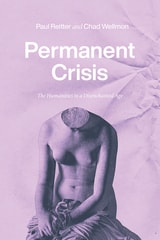
Permanent Crisis
The Humanities in a Disenchanted AgePaul Reitter and Chad Wellmon
University of Chicago Press, 2021
Leads scholars and anyone who cares about the humanities into more effectively analyzing the fate of the humanities and digging into the very idea of the humanities as a way to find meaning and coherence in the world.
The humanities, considered by many as irrelevant for modern careers and hopelessly devoid of funding, seem to be in a perpetual state of crisis, at the mercy of modernizing and technological forces that are driving universities towards academic pursuits that pull in grant money and direct students to lucrative careers. But as Paul Reitter and Chad Wellmon show, this crisis isn’t new—in fact, it’s as old as the humanities themselves.
Today’s humanities scholars experience and react to basic pressures in ways that are strikingly similar to their nineteenth-century German counterparts. The humanities came into their own as scholars framed their work as a unique resource for resolving crises of meaning and value that threatened other cultural or social goods. The self-understanding of the modern humanities didn’t merely take shape in response to a perceived crisis; it also made crisis a core part of its project. Through this critical, historical perspective, Permanent Crisis can take scholars and anyone who cares about the humanities beyond the usual scolding, exhorting, and hand-wringing into clearer, more effective thinking about the fate of the humanities. Building on ideas from Max Weber and Friedrich Nietzsche to Helen Small and Danielle Allen, Reitter and Wellmon dig into the very idea of the humanities as a way to find meaning and coherence in the world.
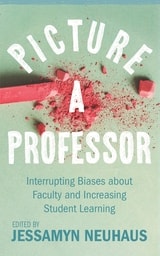
Picture a Professor
Interrupting Biases about Faculty and Increasing Student LearningJessamyn Neuhaus
West Virginia University Press, 2022
“Does a service to all who would prefer a different path, offering realistic strategies to engage students in undermining scholarly stereotypes.”—Science
Picture a Professor is a collection of evidence-based insights and intersectional teaching strategies crafted by and for college instructors. It aims to inspire transformative student learning while challenging stereotypes about what a professor looks like.
Representing a variety of scholarly disciplines, the volume’s contributing authors offer practical advice for effectively navigating student preconceptions about embodied identity and academic expertise. Each contributor recognizes the pervasiveness of racialized, gendered, and other biases about professors and recommends specific ways to respond to and interrupt such preconceptions—helping students, teachers, and others reenvision what we think of when we picture a professor.
Educators at every stage of their career will find affirming acknowledgment of the ways systemic inequities affect college teaching conditions, as well as actionable advice about facilitating student learning with innovative course design, classroom activities, assessment techniques, and more.

Playwriting in Schools
Dramatic NavigationJohn Newman
Intellect Books, 2018
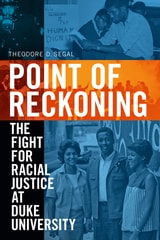
Point of Reckoning
The Fight for Racial Justice at Duke UniversityTheodore D. Segal
Duke University Press, 2021
Point of View
Talks on EducationEdward H. Levi
University of Chicago Press, 2007
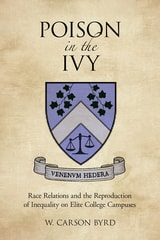
Poison in the Ivy
Race Relations and the Reproduction of Inequality on Elite College CampusesByrd, W. Carson
Rutgers University Press, 2017
Poison in the Ivy challenges popular beliefs about the importance of cross-racial interactions as an antidote to racism in the increasingly diverse United States. He shows that it is the context and framing of such interactions on college campuses that plays an important role in shaping students’ beliefs about race and inequality in everyday life for the future political and professional leaders of the nation. Poison in the Ivy is an eye-opening look at race on elite college campuses, and offers lessons for anyone involved in modern American higher education.
Polished
College, Class, and the Burdens of Social MobilityMelissa Osborne
University of Chicago Press, 2024
While college initiates a major transition in all students’ lives, low-income and first-generation students attending elite schools are often entering entirely new worlds. Amid the financial and academic challenges of adapting to college, their emotional lives, too, undergo a transformation. Surrounded by peers from different classes and cultural backgrounds, they are faced with an impossible choice: turn away from their former lives to blend in or stay true to themselves and remain on the outside.
An ethnography that draws on in-depth interviews with one hundred and fifty first-generation and low-income students across eighteen elite institutions, Polished uncovers the hidden consequences of the promise of social mobility in today’s educational landscape. Sociologist Melissa Osborne reveals how the very support designed to propel first-generation students forward can unexpectedly reshape their identities, often putting them at odds with their peers and families. Without direct institutional support, this emotional journey can lead to alienation, mental health challenges, poor academic outcomes, and difficult choices between upward mobility or maintaining authenticity and community. Whether you're an educator, advocate, or student, Polished provides a powerful perspective on the uncharted challenges of social mobility and personal identity during college.
Polished
College, Class, and the Burdens of Social MobilityMelissa Osborne
University of Chicago Press, 2024
An illuminating look at the emotional costs of mobility faced by first-generation and low-income college students.
While college initiates a major transition in all students’ lives, low-income and first-generation students attending elite schools are often entering entirely new worlds. Amid the financial and academic challenges of adapting to college, their emotional lives, too, undergo a transformation. Surrounded by peers from different classes and cultural backgrounds, they are faced with an impossible choice: turn away from their former lives to blend in or stay true to themselves and remain on the outside.
An ethnography that draws on in-depth interviews with one hundred and fifty first-generation and low-income students across eighteen elite institutions, Polished uncovers the hidden consequences of the promise of social mobility in today’s educational landscape. Sociologist Melissa Osborne reveals how the very support designed to propel first-generation students forward can unexpectedly reshape their identities, often putting them at odds with their peers and families. Without direct institutional support, this emotional journey can lead to alienation, mental health challenges, poor academic outcomes, and difficult choices between upward mobility or maintaining authenticity and community. Whether you're an educator, advocate, or student, Polished provides a powerful perspective on the uncharted challenges of social mobility and personal identity during college.
Political Literacy in Composition and Rhetoric
Defending Academic Discourse against Postmodern PluralismDonald Lazere
Southern Illinois University Press, 2015
Poor Queer Studies
Confronting Elitism in the UniversityMatt Brim
Duke University Press, 2020
Post-Crisis Leadership
Resilience, Renewal, and Reinvention in the Aftermath of DisruptionRalph A. Gigliotti
Rutgers University Press, 2025
Potential on the Periphery
College Access from the Ground UpOmari Scott Simmons
Rutgers University Press, 2019
Powers of the Mind
The Reinvention of Liberal Learning in AmericaDonald N. Levine
University of Chicago Press, 2006
It is one thing to lament the financial pressures put on universities, quite another to face up to the poverty of resources for thinking about what universities should do when they purport to offer a liberal education. In Powers of the Mind, former University of Chicago dean Donald N. Levine enriches those resources by proposing fresh ways to think about liberal learning with ideas more suited to our times.
He does so by defining basic values of modernity and then considering curricular principles pertinent to them. The principles he favors are powers of the mind—disciplines understood as fields of study defined not by subject matter but by their embodiment of distinct intellectual capacities. To illustrate, Levine draws on his own lifetime of teaching and educational leadership, while providing a marvelous summary of exemplary educational thinkers at the University of Chicago who continue to inspire. Out of this vital tradition, Powers of the Mind constructs a paradigm for liberal arts today, inclusive of all perspectives and applicable to all settings in the modern world.
Practicing Classics
A MemoirLee T. Pearcy
University of Michigan Press, 2026
Practicing Classics is a memoir about education in America between the end of WWII and the early 21st century. Not only does it consider memory, its truths, and its deceptions, but it also unravels the complexities of class, race, gender, and social positioning in education. Lee Pearcy’s story begins with the 1957 desegregation crisis at Little Rock Central High School and its aftermath, describing how growing up in this environment shaped his academic and personal life.
As he came to study Latin and then Classics, Pearcy’s education intersected with the student disturbances at Columbia University in 1968 and a feminist revolution that brought significant numbers of women into the classical professoriate. He gives a first-hand account of a scandalous episode in the toxic administrative culture that characterized the classics department at the University of Texas in the 1980s. Against the background of these events, he unfolds his own education as a classicist and his development from apprentice to journeyman to confident teacher of Latin and Greek. Practicing Classics will engage readers who care about American education, classical studies, or the ways that choices, chances, and contingencies shaped one man’s life.

Practicing Transnationalism
American Studies in the Middle EastEdited Eileen T. Lundy and Edward J. Lundy
University of Texas Press, 2016
Practicing Transnationalism explores the challenges of teaching American studies in the Middle East during a time of tension and conflict between the United States and the region.
In the first decade of the twenty-first century, American studies programs began to spread in the Middle East. During a time of rising anti-American sentiment, ten major programs were established in the region. What impulses propelled universities in the Middle East to establish these centers and programs? What motivated students to take courses and pursue degrees in American studies? In part, American studies programs developed as a way to “know the enemy,” to better understand America’s ubiquitous influence in foreign relations, technology, and culture; however, some programs grew because residents admired the ideals set forth as American, including democracy and free speech.
Practicing Transnationalism investigates these issues and others, using the experiences and research of the editors and contributors, who worked either directly in these programs or as adjunct to them. These scholars seek to understand what American power means to people in the Middle East. They examine the challenge of developing American studies programs in a transnational paradigm, striving to build programs that are separate from and critical of American imperialism without simply becoming anti-American. In the essays, the contributors provide context for how the field of American studies has grown and developed, and they offer views of cultural interactions and classroom situations, demonstrating the problems instructors faced and how they worked to address them.
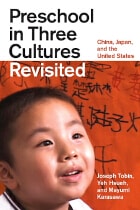
Preschool in Three Cultures Revisited
China, Japan, and the United StatesJoseph Tobin, Yeh Hsueh, and Mayumi Karasawa
University of Chicago Press, 2009
Published twenty years ago, the original Preschool in Three Cultures was a landmark in the study of education: a profoundly enlightening exploration of the different ways preschoolers are taught in China, Japan, and the United States. Here, lead author Joseph Tobin—along with new collaborators Yeh Hsueh and Mayumi Karasawa—revisits his original research to discover how two decades of globalization and sweeping social transformation have affected the way these three cultures educate and care for their youngest pupils. Putting their subjects’ responses into historical perspective, Tobin, Hsueh, and Karasawa analyze the pressures put on schools to evolve and to stay the same, discuss how the teachers adapt to these demands, and examine the patterns and processes of continuity and change in each country.
Featuring nearly one hundred stills from the videotapes, Preschool in Three Cultures Revisited artfully and insightfully illustrates the surprising, illuminating, and at times entertaining experiences of four-year-olds—and their teachers—on both sides of the Pacific.
Presumed Incompetent
The Intersections of Race and Class for Women in Academiaedited by Gabriella Gutiérrez y Muhs, Yolanda Flores Niemann, Carmen G. González, and Angela P. Harris
Utah State University Press, 2012
Presumed Incompetent is a pathbreaking account of the intersecting roles of race, gender, and class in the working lives of women faculty of color. Through personal narratives and qualitative empirical studies, more than 40 authors expose the daunting challenges faced by academic women of color as they navigate the often hostile terrain of higher education, including hiring, promotion, tenure, and relations with students, colleagues, and administrators. The narratives are filled with wit, wisdom, and concrete recommendations, and provide a window into the struggles of professional women in a racially stratified but increasingly multicultural America.
Privilege and Prejudice
The Life of a Black PioneerClifton R. Wharton
Michigan State University Press, 2015
Producing Success
The Culture of Personal Advancement in an American High SchoolPeter Demerath
University of Chicago Press, 2009
Middle- and upper-middle-class students continue to outpace those from less privileged backgrounds. Most attempts to redress this inequality focus on the issue of access to financial resources, but as Producing Success makes clear, the problem goes beyond mere economics. In this eye-opening study, Peter Demerath examines a typical suburban American high school to explain how some students get ahead.
Demerath undertook four years of research at a Midwestern high school to examine the mercilessly competitive culture that drives students to advance. Producing Success reveals the many ways the community’s ideology of achievement plays out: students hone their work ethics and employ various strategies to succeed, from negotiating with teachers to cheating; parents relentlessly push their children while manipulating school policies to help them get ahead; and administrators aid high performers in myriad ways, even naming over forty students “valedictorians.” Yet, as Demerath shows, this unswerving commitment to individual advancement takes its toll, leading to student stress and fatigue, incivility and vandalism, and the alienation of the less successful. Insightful and candid, Producing Success is an often troubling account of the educationally and morally questionable results of the American culture of success.
Productivity in Higher Education
Edited by Caroline M. Hoxby and Kevin Stange
University of Chicago Press, 2019
Professing Criticism
Essays on the Organization of Literary StudyJohn Guillory
University of Chicago Press, 2022
As the humanities in higher education struggle with a labor crisis and with declining enrollments, the travails of literary study are especially profound. No scholar has analyzed the discipline’s contradictions as authoritatively as John Guillory. In this much-anticipated new book, Guillory shows how the study of literature has been organized, both historically and in the modern era, both before and after its professionalization. The traces of this volatile history, he reveals, have solidified into permanent features of the university. Literary study continues to be troubled by the relation between discipline and profession, both in its ambivalence about the literary object and in its anxious embrace of a professionalism that betrays the discipline’s relation to its amateur precursor: criticism.
In a series of timely essays, Professing Criticism offers an incisive explanation for the perennial churn in literary study, the constant revolutionizing of its methods and objects, and the permanent crisis of its professional identification. It closes with a robust outline of five key rationales for literary study, offering a credible account of the aims of the discipline and a reminder to the professoriate of what they already do, and often do well.

Professing Literature
An Institutional HistoryGerald Graff
University of Chicago Press, 1987
Professing Literature
An Institutional History, Twentieth Anniversary EditionGerald Graff
University of Chicago Press, 2007
Updated with a new preface by the author that addresses many of the provocative arguments raised by its initial publication, Professing Literature remains an essential history of literary pedagogy and a critical classic.
“Graff’s history. . . is a pathbreaking investigation showing how our institutions shape literary thought and proposing how they might be changed.”— The Norton Anthology of Theory and Criticism
Professional Communities and the Work of High School Teaching
Milbrey W. McLaughlin and Joan E. Talbert
University of Chicago Press, 2001
With wide-ranging implications for educational practice and policy, this unprecedented look into teacher communities is essential reading for educators, administrators, and all those concerned with U. S. High Schools.
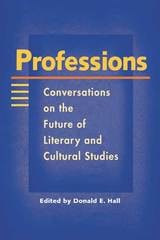
Professions
Conversations on the Future of Literary and Cultural StudiesEdited by Donald E. Hall
University of Illinois Press, 2001
This volume bares professional concerns, relationships, ambitions, and insecurities about working in academe. Professions provides hard-to-get insider information for students contemplating an academic career. It also challenges professional scholars to retrieve the intellectual curiosity that drew them to scholarship in the first place while demonstrating how disagreement on controversial issues can be conducted with respect, good humor, and an open mind.
Professions features:
Jane Tompkins and Gerald Graff
John McGowan and Regenia Gagnier
James Phelan and James Kincaid
Marjorie Perloff and Robert von Hallberg
Judith Jackson Fossett and Kevin Gaines
Dennis W. Allen and Judith Roof
Niko Pfund, Gordon Hutner, and Martha Banta
Geoffrey Galt Harpham
Donald E. Hall and Susan S. Lanser
J. Hillis Miller, Herbert Lindenberger, Sandra Gilbert, Bonnie Zimmerman, Nellie Y. McKay, and Elaine Marks

Proposed
The University of the United StatesEdgar Wesley
University of Minnesota Press, 1936
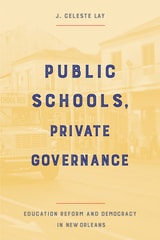
Public Schools, Private Governance
Education Reform and Democracy in New OrleansJ. Celeste Lay
Temple University Press, 2022
Two months after Hurricane Katrina, Louisiana took control of nearly all the public schools in New Orleans. Today, all of the city’s public schools are charter schools. Although many analyses mark the beginning of education reform in New Orleans with Katrina, in Public Schools, Private Governance, J. Celeste Layargues that the storm merely accelerated the timeline for reforms that had inched along incrementally over the previous decade. Both before and after Katrina, white reformers purposely excluded Black educators, community members, and parents.
Public Schools, Private Governance traces the slow, deliberate dismantling of New Orleans’ public schools, and the processes that have maintained the reforms made in Katrina’s immediate aftermath, showing how Black parents and residents were left without a voice and the officials charged with school governance, most of whom are white, with little accountability. Lay cogently explains how political minorities disrupted systems to create change and keep reforms in place, and the predictable political effects—exclusion, frustration, and resignation—on the part of those most directly affected.
Putting the Humanities PhD to Work
Thriving in and beyond the ClassroomKatina L. Rogers
Duke University Press, 2020