Results by title
200 books match the query 'Sociology of Religion' and 7 start with p
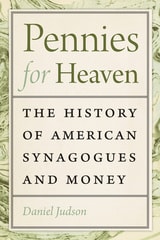
Pennies for Heaven
The History of American Synagogues and MoneyDaniel Judson
Brandeis University Press, 2018

Portugal and Brazil in Transition
Raymond S. Sayers, Editor
University of Minnesota Press, 1968
Portugal and Brazil in Transition was first published in 1968. Minnesota Archive Editions uses digital technology to make long-unavailable books once again accessible, and are published unaltered from the original University of Minnesota Press editions.
Through a series of essays on various aspects of Portuguese and Brazilian culture, this book presents an enlightening picture of contemporary civilization in the two countries and a forecast of what the next twenty years or so may bring. The authors discuss subjects in such basic fields as literature, linguistics, history, the social sciences, geography, the fine arts, music, and natural science. Taken as a whole, the contents demonstrate the logic of organizing a volume not around a geographical concept but, rather, around a historical concept, in this case "the world the Portuguese created," as Gilberto Freyre described it.
The essays are based on papers that were given at the Sixth International Colloquium of Luso-Brazilian Studies, held in the United States in 1966. In addition to the essays, the book contains the text of comments and discussion about the papers. There are twenty-seven major essays by as many contributors and comments by a number of discussants.
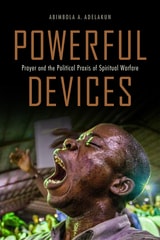
Powerful Devices
Prayer and the Political Praxis of Spiritual WarfareAbimbola Adunni Adelakun
Rutgers University Press, 2023
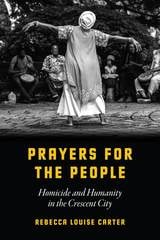
Prayers for the People
Homicide and Humanity in the Crescent CityRebecca Louise Carter
University of Chicago Press, 2019
Inspired by ministers and guided by grieving mothers who hold birthday parties for their deceased sons, Prayers for the People traces the emergence of a powerful new African American religious ideal at the intersection of urban life, death, and social and spiritual change. Carter frames this sensitive ethnography within the complex history of structural violence in America—from the legacies of slavery to free but unequal citizenship, from mass incarceration and overpolicing to social abandonment and the unequal distribution of goods and services. And yet Carter offers a vision of restorative kinship by which communities of faith work against the denial of Black personhood as well as the violent severing of social and familial bonds. A timely directive for human relations during a contentious time in America’s history, Prayers for the People is also a hopeful vision of what an inclusive, nonviolent, and just urban society could be.
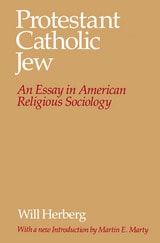
Protestant--Catholic--Jew
An Essay in American Religious SociologyWill Herberg
University of Chicago Press, 1983
"In Protestant-Catholic-Jew Will Herberg has written the most fascinating essay on the religious sociology of America that has appeared in decades. He has digested all the relevant historical, sociological and other analytical studies, but the product is no mere summary of previous findings. He has made these findings the basis of a new and creative approach to the American scene. It throws as much light on American society as a whole as it does on the peculiarly religious aspects of American life. Mr. Herberg. . . illumines many facets of the American reality, and each chapter presents surprising, and yet very compelling, theses about the religious life of this country. Of all these perhaps the most telling is his thesis that America is not so much a melting pot as three fairly separate melting pots."—Reinhold Niebuhr, New Yorks Times Book Review
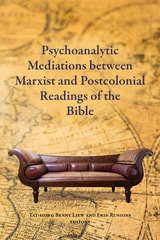
Psychoanalytic Mediations between Marxist and Postcolonial Reading of the Bible
Tat-siong Benny Liew
SBL Press, 2016
The first sustained conversation between Marxism, postcolonialism, and psychoanalysis in biblical studies
This volume pursues critical readings of the Bible that put psychoanalysis into conversation with Marxist and postcolonial criticism. In these essays psychoanalysis provides a way to mediate between Marxism's materialist groundings and postcolonialism's resistance against empire. The essays in the volume illuminate the way empire has shaped the biblical text by looking at the biblical texts' silences, ruptures, oversights, over-emphases, and inexplicable elements. These details are read as symptoms of a set of oppressive material relations that shaped and continue to haunt the text in the ascendancy of the text in the name of the West.
Features:
- Essays and responses from multiple perspectives and geographical locations, including Africa, Australia, Oceania, Latin America, and North America
- Psychoanalysis that considers how the traumas of colonialism manifest both materially and psychically
- Close readings of biblical texts
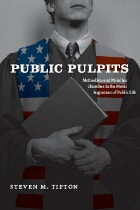
Public Pulpits
Methodists and Mainline Churches in the Moral Argument of Public LifeSteven M. Tipton
University of Chicago Press, 2008
Documenting a wide range of reactions to two radically different events—the invasion of Iraq and the creation of the faith-based initiatives program—Tipton charts the new terrain of religious and moral argument under the Bush administration from Pat Robertson to Jim Wallis. He then turns to the case of the United Methodist Church, of which President Bush is a member, to uncover the twentieth-century history of their political advocacy, culminating in current threats to split the Church between liberal peace-and-justice activists and crusaders for evangelical renewal. Public Pulpits balances the firsthand drama of this internal account with a meditative exploration of the wider social impact that mainline churches have had in a time of diverging fortunes and diminished dreams of progress.
An eminently fair-minded and ethically astute analysis of how churches keep moral issues alive in politics, Public Pulpits delves deep into mainline Protestant efforts to enlarge civic conscience and cast clearer light on the commonweal and offers a masterly overview of public religion in America.