141 books match the query 'Space Science' and 17 start with p
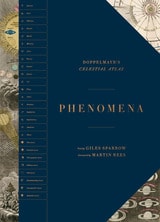
cover of Phenomena: Doppelmayr's Celestial Atlas

Phenomena

Doppelmayr's Celestial Atlas

Giles Sparrow

University of Chicago Press, 2022

Lavishly illustrated volume revealing the intricacies of a 1742 map of the cosmos.
 
The expansive and intricate Atlas Coelestis, created by Johann Doppelmayr in 1742, set out to record everything known about astronomy at the time, covering constellations, planets, moons, comets, and more, all rendered in exquisite detail. Through stunning illustrations, historical notes, and scientific explanations, Phenomena contextualizes Doppelmayr’s atlas and creates a spectacular handbook to the heavens.
 
Phenomena begins by introducing Doppelmayr’s life and work, placing his extraordinary cosmic atlas in the context of discoveries made in the Renaissance and Enlightenment and highlighting the significance of its publication. This oversized book presents thirty beautifully illustrated and richly annotated plates, covering all the fundamentals of astronomy—from the dimensions of the solar system to the phases of the moon and the courses of comets. Each plate is accompanied by expert analysis from astronomer Giles Sparrow, who deftly presents Doppelmayr’s references and cosmological work to a modern audience. Each plate is carefully deconstructed, isolating key stars, planets, orbits, and moons for in-depth exploration. A conclusion reflects on the development of astronomy since the publication of the Atlas and traces the course of the science up to the present day. Following the conclusion is a timeline of key discoveries from ancient times onward along with short biographies of the key players in this history.  
 
[more]
cover of Picturing the Cosmos: Hubble Space Telescope Images and the Astronomical Sublime

Picturing the Cosmos

Hubble Space Telescope Images and the Astronomical Sublime

Elizabeth A. Kessler

University of Minnesota Press, 2012

The vivid, dramatic images of distant stars and galaxies taken by the Hubble Space Telescope have come to define how we visualize the cosmos. In their immediacy and vibrancy, photographs from the Hubble show what future generations of space travelers might see should they venture beyond our solar system. But their brilliant hues and precise details are not simply products of the telescope’s unprecedented orbital location and technologically advanced optical system. Rather, they result from a series of deliberate decisions made by the astronomers who convert raw data from the Hubble into spectacular pictures by assigning colors, adjusting contrast, and actively composing the images, balancing the desire for an aesthetically pleasing representation with the need for a scientifically valid one.

In Picturing the Cosmos, Elizabeth A. Kessler examines the Hubble’s deep space images, highlighting the remarkable resemblance they bear to nineteenth-century paintings and photographs of the American West and their invocation of the visual language of the sublime. Drawing on art history and the history of science, as well as interviews with astronomers who work on the Hubble Heritage Project, Kessler traces the ways that the sublime, with its inherent tension between reason and imagination, not only forms the appearance of the images, but also operates on other levels. The sublime informs the dual expression—numeric and pictorial—of digital data and underpins the relevance of the frontier for a new era of exploration performed by our instruments rather than our bodies. Through their engagement with the sublime the Hubble images are a complex act of translation that encourages an experience of the universe as simultaneously beyond humanity’s grasp and within the reach of our knowledge.

Strikingly illustrated with full-color images, this book reveals the scientific, aesthetic, and cultural significance of the Hubble pictures, offering a nuanced understanding of how they shape our ideas—and dreams—about the cosmos and our places within it.
[more]
cover of Placing Outer Space: An Earthly Ethnography of Other Worlds

Placing Outer Space

An Earthly Ethnography of Other Worlds

Lisa Messeri

Duke University Press, 2016
In Placing Outer Space Lisa Messeri traces how the place-making practices of planetary scientists transform the void of space into a cosmos filled with worlds that can be known and explored. Making planets into places is central to the daily practices and professional identities of the astronomers, geologists, and computer scientists Messeri studies. She takes readers to the Mars Desert Research Station and a NASA research center to discuss ways scientists experience and map Mars. At a Chilean observatory and in MIT's labs she describes how they discover exoplanets and envision what it would be like to inhabit them. Today’s planetary science reveals the universe as densely inhabited by evocative worlds, which in turn tells us more about Earth, ourselves, and our place in the universe.
 
[more]
cover of Planetary Astrobiology

Planetary Astrobiology

Edited by Victoria S. Meadows, Giada N. Arney, Britney E. Schmidt, and David J. Des Marais

University of Arizona Press, 2020

Are we alone in the universe? How did life arise on our planet? How do we search for life beyond Earth? These profound questions excite and intrigue broad cross sections of science and society. Answering these questions is the province of the emerging, strongly interdisciplinary field of astrobiology. Life is inextricably tied to the formation, chemistry, and evolution of its host world, and multidisciplinary studies of solar system worlds can provide key insights into processes that govern planetary habitability, informing the search for life in our solar system and beyond. Planetary Astrobiology brings together current knowledge across astronomy, biology, geology, physics, chemistry, and related fields, and considers the synergies between studies of solar systems and exoplanets to identify the path needed to advance the exploration of these profound questions.

Planetary Astrobiology represents the combined efforts of more than seventy-five international experts consolidated into twenty chapters and provides an accessible, interdisciplinary gateway for new students and seasoned researchers who wish to learn more about this expanding field. Readers are brought to the frontiers of knowledge in astrobiology via results from the exploration of our own solar system and exoplanetary systems. The overarching goal of Planetary Astrobiology is to enhance and broaden the development of an interdisciplinary approach across the astrobiology, planetary science, and exoplanet communities, enabling a new era of comparative planetology that encompasses conditions and processes for the emergence, evolution, and detection of life.

[more]
cover of Planetary Rings

Planetary Rings

Richard Greenberg

University of Arizona Press, 1984

Published in 1985, Planetary Rings brought together scientist from a variety of disciplines to the study of planetary rings to provide a textbook for graduate students and researchers in related fields. It introduced newcomers to the subject and addressed issues at the forefront of ring research at the time.

At the time of it's publication, the editors wrote, "it is our hope that this book will become out-of-date quickly, that new observations and theoretical connections will continue to revolutionize our knowledge of planetary rings."
[more]
cover of Planetary Satellites

Planetary Satellites

Joseph A. Burns

University of Arizona Press, 1977
Published in 1977, this source book on natural satellites brings together thirty-four distinguished contributors from various fields of satellite astronomy to offer a thorough examination of Orbits and Dynamical Evolution.
[more]
cover of Planets and Perception: Telescopic Views and Interpretations, 1609-1909

Planets and Perception

Telescopic Views and Interpretations, 1609-1909

William Sheehan

University of Arizona Press, 1988
Do we really know what we see through a telescope? How does the ocular system construct planetary images, and how does the brain interpret them? Drawing on both astronomical and psychological data, William Sheehan now offers the first systematic analysis of the perceptual and cognitive factors that go into the initial structuring of a planetary image and its subsequent elaboration. Sheehan details the development of lunar and planetary astronomy beginning with Galileo's study of the moon, and focuses particularly on the discover of "canals" on Mars. Through each episode he underscores a perceptual or psychological theme, such as the importance of differences in vision, tachistoscopic perceptual effects, the influence of expectation and suggestion on what one sees, and the social psychology of scientific discovery. Planets and Perception is a provocative book that will intrigue anyone who has ever looked through a telescope. In addition, it offers the psychologically-oriented reader a case history in the processes of perception unlike any other in the literature.
[more]
cover of Planets, Stars and Nebulae Studied with Photopolarimetry

Planets, Stars and Nebulae Studied with Photopolarimetry

Edited by T. Gehrels

University of Arizona Press, 1974

“The polarization study of celestial objects is a valuable part of optical astronomy, and the author has done exceptionally well in bringing together contributions treating all aspects of the polarimetry field. . . . The first section contains a fine introduction and an excellent and definitive history of the subject. . . . The volume is well illustrated. . . . Highly recommended.”—Choice

“The high quality of this book is clearly due to strict editorial attention to each paper and the discussions. Gehrels’s book will surely stand for many years as the fundamental reference source for polarization studies in astronomy as well as in atmospheric physics.”—Journal of the Association of Lunar and Planetary Observers
[more]
cover of Pluto and Charon

Pluto and Charon

Edited by S. Alan Stern and David J. Tholen

University of Arizona Press, 1997

For almost five decades after its discovery in 1930, the planet Pluto remained an enigma. However, several events have helped to lift the veil of mystery surrounding the ninth planet. The discovery of its satellite, Charon, in 1978 permitted occultation observations that allowed scientists to determine the size of both bodies. Astronomers also detected the presence of an atmosphere, and the Hubble Space Telescope provided views in unprecedented detail. In addition to these two fortuitous events, advances in telescopic instrumentation and computational methods led to exciting observational and theoretical discoveries.

This Space Science Series volume focuses on the scientific issues associated with Pluto and Charon. Fifty collaborating authors here review the latest research on the Pluto-Charon binary, from bulk properties, surfaces, and interiors to atmospheric structure, composition, and dynamics. They also provide historical perspectives on Pluto-Charon research and discuss the population of the trans-Neptunian region and the origin of the Pluto-Charon binary. Also included are prefatory remarks by Pluto's and Charon's discoverers, Clyde Tombaugh and James Christy.

Pluto and Charon offers the most comprehensive available compendium of research work for understanding these far-off members of our solar system, at a time following dramatic developments in our knowledge but before that knowledge can be advanced by spacecraft missions.

Originally published in 1997; now available as an e-book

[more]
cover of Practical Mystic: Religion, Science, and A. S. Eddington

Practical Mystic

Religion, Science, and A. S. Eddington

Matthew Stanley

University of Chicago Press, 2007

Science and religion have long been thought incompatible. But nowhere has this apparent contradiction been more fully resolved than in the figure of A. S. Eddington (1882–1944), a pioneer in astrophysics, relativity, and the popularization of science, and a devout Quaker. Practical Mystic uses the figure of Eddington to shows how religious and scientific values can interact and overlap without compromising the integrity of either.

Eddington was a world-class scientist who not only maintained his religious belief throughout his scientific career but also defended the interrelation of science and religion while drawing inspiration from both for his practices. For instance, at a time when a strict adherence to deductive principles of physics had proved fruitless for understanding the nature of stars, insights from Quaker mysticism led Eddington to argue that an outlook less concerned with certainty and more concerned with further exploration was necessary to overcome the obstacles of incomplete and uncertain knowledge.

By examining this intersection between liberal religion and astrophysics, Practical Mystic questions many common assumptions about the relationship between science and spirituality. Matthew Stanley’s analysis of Eddington’s personal convictions also reveals much about the practice, production, and dissemination of scientific knowledge at the beginning of the twentieth century.
[more]
cover of Principles of Stellar Evolution and Nucleosynthesis

Principles of Stellar Evolution and Nucleosynthesis

Donald D. Clayton

University of Chicago Press, 1984

Donald D. Clayton's Principles of Stellar Evolution and Nucleosynthesis remains the standard work on the subject, a popular textbook for students in astronomy and astrophysics and a rich sourcebook for researchers. The basic principles of physics as they apply to the origin and evolution of stars and physical processes of the stellar interior are thoroughly and systematically set out. Clayton's new preface, which includes commentary and selected references to the recent literature, reviews the most important research carried out since the book's original publication in 1968.
[more]
cover of Protostars and Planets

Protostars and Planets

Tom Gehrels

University of Arizona Press, 1979
Originally published in 1979, at the time of it's publication this work was a unique source book on star formation and the origin of planetary systems from some 35 distinguished authors. Topics include the formation of stars from the cloudy to the stellar to the planetary state. Special emphasis on stars believed capable of producing planets. This foundational work sought to define a new discipline and set the course for the University of Arizona Space Science series.
[more]
cover of Protostars and Planets II

Protostars and Planets II

David C. Black

University of Arizona Press, 1985
Based on meetings held in Tucson, Arizona in 1984, this volume brought up-to-date recent advances and research on the cosmogony of stars and planets. This book presents the written thoughts of the principle speakers (and their colleagues) from the 1984 meeting. This work continued work started in 1978 to investigate the problems of star formation and the formation of the solar system.
[more]
cover of Protostars and Planets III

Protostars and Planets III

Eugene Levy

University of Arizona Press, 1993

Previous Space Science Series volumes Protostars and Planets (1978) and Protostars and Planets II (1985) were among the most timely offerings of this illustrious collection of technical works. Protostars and Planets III continues to address fundamental questions concerning the formation of stars and planetary systems in general and of our solar system in particular. Drawing from advances in observational, experimental, and theoretical research, it summarizes our understanding of these processes and addresses major open questions and research issues. Among the more notable subjects covered in the more than three dozen chapters are the collapse of clouds and the formation and evolution of stars and disks; nucleosynthesis and star formation; the occurrence and properties of disks around young stars; T Tauri stars and their accretion disks; gaseous accretion and the formation of the giant planets; comets and the origin of the Solar-System; and the long-term dynamical evolution and stability of the solar system.

Protostars and Planets III reflects the enormous progress made in understanding star and planet formation as a result of new observational capabilities and cooperative research among scientists from diverse fields.
[more]
cover of Protostars and Planets IV

Protostars and Planets IV

Vince Mannings

University of Arizona Press, 2000

Atextbook and a status report for every facet of research into the formation of stars and planets, Protostars and Planets IV brings together 167 authors who report on the most significant advances in the field since the publication of the previous volume in 1993. Protostars and Planets IV reflects improvements in observational techniques and the availability of new facilities such as the Infrared Space Observatory, the refurbished Hubble Space Telescope, and the 10-m Keck telescopes. Advances in computer technology and modeling methods have benefited theoretical studies of molecular clouds, star formation, and jets and disks, while recent analyses of meteorites yield important insights into conditions and processes within our Sun's early protoplanetary disk. The 49 chapters describe context and progress for observational and theoretical studies of the structure, chemistry, and dynamics of molecular clouds; the collapse of cores and the formation of protostars; the formation and properties of young binary stars; the properties of winds, jets, and molecular outflows from young stellar objects; the evolution of circumstellar envelopes and disks; grain growth in disks and the formation of planets; and the properties of the early Solar nebula.

Protostars and Planets IV is also the first book to include chapters describing the discoveries of extrasolar planets, brown dwarfs, and Edgeworth-Kuiper Belt objects, and the first to include high-resolution optical and near-infrared images of protoplanetary disks. Protostars and Planets IV is an unsurpassed reference not only for established researchers but also for younger scientists whose imagination and work will lead to tomorrow's discoveries.
[more]
cover of Protostars and Planets V

Protostars and Planets V

Edited by Bo Reipurth, David Jewitt, and Klaus Keil

University of Arizona Press, 2007
Increasing discoveries of new planets beyond our solar system are invigorating the quest for new knowledge and understanding of the birth of stars and planets. This new volume in the Space Science Series, with 249 contributing authors, builds on the latest results from recent advances in ground and space-based astronomy and in numerical computing techniques to offer the most detailed and up-to-date picture of star and planet formation, including the formation of our own solar system. This book emphasizes the cross-disciplinary aspects of the field, with a particular focus on the early evolution of our solar system. Protostars and Planets V is the new foundation for further advancement in the fields of stellar and planetary formation, making it an indispensable resource for researchers and students in astronomy, planetary science, and the study of meteorites.
[more]
cover of Protostars and Planets VI

Protostars and Planets VI

Edited by Henrik Beuther, Ralf S. Klessen, Cornelis P. Dullemond, and Thomas Henning

University of Arizona Press, 2014

The revolutionary discovery of thousands of confirmed and candidate planets beyond the solar system brings forth the most fundamental
question: How do planets and their host stars form and evolve? Protostars and Planets VI brings together more than 250 contributing authors at the forefront of their field, conveying the latest results in this research area and establishing a new foundation for advancing our understanding of stellar and planetary formation.

Continuing the tradition of the Protostars and Planets series, this latest volume uniquely integrates the cross-disciplinary aspects of this broad field. Covering an extremely wide range of scales, from the formation of large clouds in our Milky Way galaxy down to small chondrules in our solar system, Protostars and Planets VI takes an encompassing view with the goal of not only highlighting what we know but, most importantly, emphasizing the frontiers of what we do not know.

As a vehicle for propelling forward new discoveries on stars, planets, and their origins, this latest volume in the Space Science Series is an indispensable resource for both current scientists and new students in astronomy, astrophysics, planetary science, and the study of meteorites.
 
[more]