Results by title
63 books match the query 'Statistics' and 4 start with p
Political Essay on the Kingdom of New Spain, Volume 1
A Critical EditionAlexander von Humboldt
University of Chicago Press, 2019
Alexander von Humboldt was the most celebrated modern chronicler of North and South America and the Caribbean, and this translation of his essay on New Spain—the first modern regional economic and political geography—covers his travels across today’s Mexico in 1803–1804. The work canvases natural-scientific and cultural-scientific objects alike, combining the results of fieldwork with archival research and expert testimony.
To show how people, plants, animals, goods, and ideas moved across the globe, Humboldt wrote in a variety of styles, bending and reshaping familiar writerly conventions to keep readers attentive to new inputs. Above all, he wanted his readers to be open-minded when confronted with cultural and other differences in the Americas. Fueled by his comparative global perspective on politics, economics, and science, he used his writing to support Latin American independence and condemn slavery and other forms of colonial exploitation. It is these voluminous and innovative writings on the New World that made Humboldt the undisputed father of modern geography, early American studies, transatlantic cultural history, and environmental studies.
This two-volume critical edition—the third installment in the Alexander von Humboldt in English series—is based on the full text, including all footnotes, tables, and maps, of the second, revised French edition of Essai politique sur le royaume de de Nouvelle Espagne from 1825 to 1827, which has never been translated into English before. Extensive annotations and full-color atlases are available on the series website.

Political Essay on the Kingdom of New Spain, Volume 2
A Critical EditionAlexander von Humboldt
University of Chicago Press, 2019
Alexander von Humboldt was the most celebrated modern chronicler of North and South America and the Caribbean, and this translation of his essay on New Spain—the first modern regional economic and political geography—covers his travels across today’s Mexico in 1803–1804. The work canvases natural-scientific and cultural-scientific objects alike, combining the results of fieldwork with archival research and expert testimony.
To show how people, plants, animals, goods, and ideas moved across the globe, Humboldt wrote in a variety of styles, bending and reshaping familiar writerly conventions to keep readers attentive to new inputs. Above all, he wanted his readers to be open-minded when confronted with cultural and other differences in the Americas. Fueled by his comparative global perspective on politics, economics, and science, he used his writing to support Latin American independence and condemn slavery and other forms of colonial exploitation. It is these voluminous and innovative writings on the New World that made Humboldt the undisputed father of modern geography, early American studies, transatlantic cultural history, and environmental studies.
This two-volume critical edition—the third installment in the Alexander von Humboldt in English series—is based on the full text, including all footnotes, tables, and maps, of the second, revised French edition of Essai politique sur le royaume de de Nouvelle Espagne from 1825 to 1827, which has never been translated into English before. Extensive annotations and full-color atlases are available on the series website.
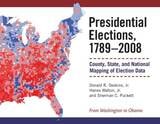
Presidential Elections, 1789-2008
County, State, and National Mapping of Election DataDonald R. Deskins, Jr., Hanes Walton, Jr., and Sherman C. Puckett
University of Michigan Press, 2010
"Hanes Walton, Donald Deskins, and Sherman Puckett have produced a highly impressive collection and valuable contribution to the literature on American electoral politics. This work is indispensable for academic libraries, political scientists, historians, and serious students of American government."
---Immanuel Ness, Professor, Department of Political Science, Brooklyn College, City University of New York
"Massive amounts of information about presidential elections which are not readily available elsewhere. Unprecedented coverage in one volume of every single American presidential election."
---James Gimpel, Professor of Government, University of Maryland
"This is an extraordinary research endeavor; the most comprehensive set of aggregate election data ever assembled. Painstakingly researched, this color-coded volume presents data for every presidential election from 1789 to 2008. Unlike most, the wide ranging narrative for this atlas identifies racial patterns in the vote. Everyone who studies or is interested in presidential elections should have this impressive collection of statistical data in their libraries. A visual gem for the digital age."
---Robert Smith, Professor of Political Science, San Francisco State University
"Presidential Elections, 1789-2008 is a genuine tour de force that captures in an extremely accessible and comprehensive way the electoral geography of America's presidential elections, from Washington to Obama. An invaluable addition to the library of all those interested in presidential elections and U.S. politics."
---Marion Orr, Frederick Lippitt Professor of Public Policy and Professor of Political Science, Brown University
"This volume sets an extraordinarily high standard in scholarship, completeness, description, and explanation of our political process. It has been said that all politics are local, but never before has this been demonstrated with such clarity and panache, using the simple method of standardized tables summarizing voting, then showing state and county breakdowns of the numbers, greatly strengthened by beautiful full-color maps and cartograms. Every scholar of politics and democracy will benefit from the work laid out in this volume."
---Keith Clarke, Professor of Geography, University of California, Santa Barbara
Presidential Elections is an almanac of the popular vote in every presidential election in American history, analyzed at the county level with histories of each campaign, graphs, and stunning four-color maps. Most Americans are familiar with the crude red state/blue state maps used by commentators and campaign strategists---and even, for want of an alternative, by many academics. In providing a higher-resolution view of voting behavior the authors of this new volume enable examination of local and regional political trends that are invisible in state-level aggregations.
Presidential Elections will enable scholars to more subtly analyze voting behavior, campaigns, and presidential politics; commentators will use it to analyze trends and trace the historical evolution of new coalitions and voting blocs; strategists will use it to plan campaigns and mobilize constituencies. Presidential Elections will become the standard almanac on the subject: a required resource for academic and public libraries, as well as for scholars, consultants, and pundits nationwide.
Donald R. Deskins, Jr., is a political geographer and Emeritus Professor of Sociology and a former Associate Dean of the Horace H. Rackham School of Graduate Studies at the University of Michigan.
Hanes Walton, Jr., is Professor of Political Science at the University of Michigan. He also holds positions as Senior Research Scientist at the Center for Political Studies and as a faculty member in the Center for Afroamerican and African Studies.
Probably Overthinking It
How to Use Data to Answer Questions, Avoid Statistical Traps, and Make Better DecisionsAllen B. Downey
University of Chicago Press, 2023
Statistics are everywhere: in news reports, at the doctor’s office, and in every sort of forecast, from the stock market to the weather. Blogger, teacher, and computer scientist Allen B. Downey knows well that people have an innate ability both to understand statistics and to be fooled by them. As he makes clear in this accessible introduction to statistical thinking, the stakes are big. Simple misunderstandings have led to incorrect medical prognoses, underestimated the likelihood of large earthquakes, hindered social justice efforts, and resulted in dubious policy decisions. There are right and wrong ways to look at numbers, and Downey will help you see which are which.
Probably Overthinking It uses real data to delve into real examples with real consequences, drawing on cases from health campaigns, political movements, chess rankings, and more. He lays out common pitfalls—like the base rate fallacy, length-biased sampling, and Simpson’s paradox—and shines a light on what we learn when we interpret data correctly, and what goes wrong when we don’t. Using data visualizations instead of equations, he builds understanding from the basics to help you recognize errors, whether in your own thinking or in media reports. Even if you have never studied statistics—or if you have and forgot everything you learned—this book will offer new insight into the methods and measurements that help us understand the world.