Results by title
454 books match the query 'Study and teaching (Higher)' and 32 start with p

Passing and Pedagogy
THE DYNAMICS OF RESPONSIBILITYPamela L. Caughie
University of Illinois Press, 1999
Caughie's discussion of passing illuminates a recent phenomenon in academic writing and popular culture that revolves around identities and the ways in which they are deployed, both in the arts and in lived experience. Through a wide variety of texts—novels, memoirs, film, drama, theory, museum exhibits, legal cases—she demonstrates the dynamics of passing, presenting it not as the assumption of a fraudulent identity but as the recognition that the assumption of any identity, including for the purposes of teaching, is a form of passing.
Astutely addressing the relevance of passing for pedagogy, Caughie presents the possibility of a dynamic ethics responsive to the often polarizing difficulties inherent in today's culture. Challenging and thought-provoking, Passing and Pedagogy offers insight and inspiration for teachers and scholars as they seek to be responsible and effective in a complex, rapidly changing intellectual and cultural environment.

Past Or Portal? Enhancing Undergraduate Learning Through
Eleanor Mitchell
Assoc of College & Research Libraries, 2012
Past or Portal
Enhancing Undergraduate Learning through Special Collections and ArchivesEleanor Mitchell
Assoc of College & Research Libraries, 2012
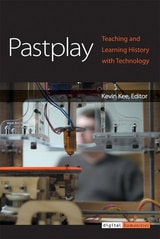
Pastplay
Teaching and Learning History with TechnologyKevin Kee, editor
University of Michigan Press, 2014
In the field of history, the Web and other technologies have become important tools in research and teaching of the past. Yet the use of these tools is limited—many historians and history educators have resisted adopting them because they fail to see how digital tools supplement and even improve upon conventional tools (such as books). In Pastplay, a collection of essays by leading history and humanities researchers and teachers, editor Kevin Kee works to address these concerns head-on. How should we use technology? Playfully, Kee contends. Why? Because doing so helps us think about the past in new ways; through the act of creating technologies, our understanding of the past is re-imagined and developed. From the insights of numerous scholars and teachers, Pastplay argues that we should play with technology in history because doing so enables us to see the past in new ways by helping us understand how history is created; honoring the roots of research, teaching, and technology development; requiring us to model our thoughts; and then allowing us to build our own understanding.
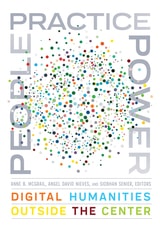
People, Practice, Power
Digital Humanities outside the CenterAnne B. McGrail
University of Minnesota Press, 2021
An illuminating volume of critical essays charting the diverse territory of digital humanities scholarship
The digital humanities have traditionally been considered to be the domain of only a small number of prominent and well-funded institutions. However, through a diverse range of critical essays, this volume serves to challenge and enlarge existing notions of how digital humanities research is being undertaken while also serving as a kind of alternative guide for how it can thrive within a wide variety of institutional spaces.
Focusing on the complex infrastructure that undergirds the field of digital humanities, People, Practice, Power examines the various economic, social, and political factors that shape such academic endeavors. The multitude of perspectives comprising this collection offers both a much-needed critique of the existing structures for digital scholarship and the means to generate broader representation within the field.
This collection provides a vital contribution to the realm of digital scholarly research and pedagogy in acknowledging the role that small liberal arts colleges, community colleges, historically black colleges and universities, and other underresourced institutions play in its advancement. Gathering together a range of voices both established and emergent, People, Practice, Power offers practitioners a self-reflexive examination of the current conditions under which the digital humanities are evolving, while helping to open up new sustainable pathways for its future.
Contributors: Matthew Applegate, Molloy College; Taylor Arnold, U of Richmond; Eduard Arriaga, U of Indianapolis; Lydia Bello, Seattle U; Kathi Inman Berens, Portland State U; Christina Boyles, Michigan State U; Laura R. Braunstein, Dartmouth College; Abby R. Broughton; Maria Sachiko Cecire, Bard College; Brennan Collins, Georgia State U; Kelsey Corlett-Rivera, U of Maryland; Brittany de Gail, U of Maryland; Madelynn Dickerson, UC Irvine Libraries; Nathan H. Dize, Vanderbilt U; Quinn Dombrowski, Stanford U; Ashley Sanders Garcia, UCLA; Laura Gerlitz; Erin Rose Glass; Kaitlyn Grant; Margaret Hogarth, Claremont Colleges; Maryse Ndilu Kiese, U of Alberta; Pamella R. Lach, San Diego State U; James Malazita, Rensselaer Polytechnic Institute; Susan Merriam, Bard College; Chelsea Miya, U of Alberta; Jamila Moore Pewu, California State U, Fullerton; Urszula Pawlicka-Deger, Aalto U, Finland; Jessica Pressman, San Diego State U; Jana Remy, Chapman U; Roopika Risam, Salem State U; Elizabeth Rodrigues, Grinnell College; Dylan Ruediger, American Historical Association; Rachel Schnepper, Wesleyan U; Anelise Hanson Shrout, Bates College; Margaret Simon, North Carolina State U; Mengchi Sun, U of Alberta; Lauren Tilton, U of Richmond; Michelle R. Warren, Dartmouth College.
Performing Antiracist Pedagogy in Rhetoric, Writing, and Communication
Frankie Condon
University Press of Colorado, 2017
In Performing Antiracist Pedagogy, Frankie Condon and Vershawn Ashanti Young seek to help create openings to address race and racism not only in course readings and class discussion in writing, rhetoric, and communication courses but also in wider public settings. The contributors to this collection, drawn from a wide range of disciplines, urge readers to renew their commitment to intelligently and publicly deliberate race and to counteract the effects of racism. The book is both theoretically rigorous and practical, providing readers with insightful analyses of race and racism and useful classroom suggestions and examples.
Contributors: Chiara Bacigalupa, Sophia Bell, Susan Leigh Brooks, Frankie Condon, Rasha Diab, John Dean, Thomas Ferrell, Beth Godbee, Dae-Joong Kim, Timothy Lensmire, Calvin M. Logue, Aja Y. Martinez, Rebecca Nathan, Bobbi Olson, Jessica Parker, Charise Pimentel, Octavio Pimentel, Mya Poe, Neil Simpkins, Nathan Snaza, Deatra Sullivan, Vershawn Ashanti Young
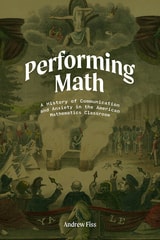
Performing Math
A History of Communication and Anxiety in the American Mathematics ClassroomAndrew Fiss
Rutgers University Press, 2021
Peripheral Visions for Writing Centers
Jackie Grutsch McKinney
Utah State University Press, 2013
McKinney argues that this grand narrative neglects the extent to which writing center work is theoretically and pedagogically complex, with ever-changing work and conditions, and results in a straitjacket for writing center scholars, practitioners, students, and outsiders alike. Peripheral Visions for Writing Centers makes the case for a broader narrative of writing center work that recognizes and theorizes the various spaces of writing center labor, allows for professionalization of administrators, and sees tutoring as just one way to perform writing center work.
McKinney explores possibilities that lie outside the grand narrative, allowing scholars and practitioners to open the field to a fuller, richer, and more realistic representation of their material labor and intellectual work.

Personal Librarian
From Resources to RelationshipsRichard Moniz
American Library Association, 2014
Personally Speaking
Experience as Evidence in Academic DiscourseCandace Spigelman
Southern Illinois University Press, 2004
Responding to contemporary discussion about using personal accounts in academic writing, Personally Speaking: Experience as Evidence in Academic Discourse draws on classical and current rhetorical theory, feminist theory, and relevant examples from both published writers and first-year writing students to illustrate the advantages of blending experiential and academic perspectives.
Candace Spigelman examines how merging personal and scholarly worldviews produces useful contradictions and contributes to a more a complex understanding in academic writing. This rhetorical move allows for greater insights than the reading or writing of experiential or academic modes separately does. Personally Speaking foregrounds the semi-fictitious nature of personal stories and the rhetorical possibilities of evidence as Spigelman provides strategies for writing instructors who want to teach personal academic argument while supplying practical mechanisms for evaluating experiential claims.
The volume seeks to complicate and intensify disciplinary debates about how compositionists should write for publication and what kinds of writing should be taught to composition students. Spigelman not only supplies evidence as to why the personal can count as evidence but also relates how to use it effectively by including student samples that reflect particular features of personal writing. Finally, she lays the groundwork to move narrative from its current site as confessional writing to the domain of academic discourse.
Pil 58,Center For Learning
Writing Centers & LibrariesJames Elmborg
Assoc of College & Research Libraries, 2011
Pivotal Strategies
Claiming Writing Studies as DisciplineLynn C. Lewis
Utah State University Press, 2024
Because undergraduate degrees in writing studies are relatively new, claiming the discipline has required reinvention and revision at personal and professional levels far different than any other discipline. Suspicions about the viability of the discipline linger in many departments and universities, as well as outside the academy, leading writing studies scholars to develop innovative strategies to deal with covertly hostile attitudes. Within the collection, contributors name explicit claiming strategies from the discipline’s beginnings to the contemporary moment, locating opportune spaces, negotiating identities and fostering resilience, and developing allegiances by foregrounding their embodiment as underrepresented members of academia through a commitment to social justice and equity.
Responding to current conversations on the worth of education with honest stories about the burdens and joys of becoming and being an academic, Pivotal Strategies features a spectrum of voices across racial, gender, class, and age categories. This collection not only makes the discipline more visible but also helps map the contemporary state of writing studies.
Poetries - Politics
A Celebration of Language, Art, and LearningJenevieve DeLosSantos
Rutgers University Press, 2023
Reproduced in full color and with the accompanying poems in both their original language and a translation, this catalogue commemorates the incredible creative spirit of the project and provides a new way of contemplating these great poetic works.

Point of Pines
A History of the University of Arizona Archaeological Field SchoolEmil W. Haury
University of Arizona Press, 1989
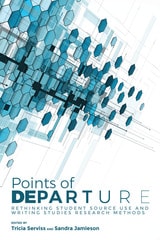
Points of Departure
Rethinking Student Source Use and Writing Studies Research MethodsTricia Serviss
Utah State University Press, 2017
The contributors offer methodologies, techniques, and suggestions for research that move beyond decontextualized guides to grapple with the messiness of research-in-process, as well as design, development, and expansion. Serviss and Jamieson’s model of RAD writing studies research is transcontextual and based on hybridized or mixed methods. Among these methods are citation context analysis, research-aloud protocols, textual and genre analysis, surveys, interviews, and focus groups, with an emphasis on process and knowledge as contingent. Chapters report on research projects at different stages and across institution types—from pilot to multi-site, from community college to research university—focusing on the methods and artifacts employed.
A rich mosaic of research about research, Points of Departure advances knowledge about student writing and serves as a guide for both new and experienced researchers in writing studies.
Contributors: Crystal Benedicks, Katt Blackwell-Starnes, Lee-Ann Kastman Breuch, Kristi Murray Costello, Anne Diekema, Rebecca Moore Howard, Sandra Jamieson, Elizabeth Kleinfeld, Brian N. Larson, Karen J. Lunsford, M. Whitney Olsen, Tricia Serviss, Janice R. Walker
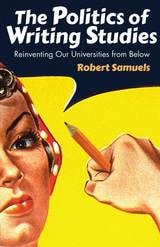
Politics of Writing Studies
Reinventing Our Universities from BelowRobert Samuels
Utah State University Press, 2017
A friendly critique of the field, The Politics of Writing Studies examines a set of recent pivotal texts in composition to show how writing scholarship, in an effort to improve disciplinary prestige and garner institutional resources, inadvertently reproduces structures of inequality within American higher education. Not only does this enable the exploitation of contingent faculty, but it also puts writing studies—a field that inherently challenges many institutional hierarchies—in a debased institutional position and at odds with itself.
Instead of aligning with the dominant paradigm of research universities, where research is privileged over teaching, theory over practice, the sciences over the humanities, and graduate education over undergraduate, writing studies should conceive itself in terms more often associated with labor. By identifying more profoundly as workers, as a collective in solidarity with contingent faculty, writing professionals can achieve solutions to the material problems that the field, in its best moments, wants to address. Ultimately, the change compositionists want to see in the university will not come from high theory or the social science research agenda; it must come from below.
Offering new insight into a complex issue, The Politics of Writing Studies will be of great interest to writing studies professionals, university administrators, and anyone interested in the political economy of education and the reform of institutions of higher education in America.
Post-Truth Rhetoric and Composition
Bruce Mccomiskey
Utah State University Press, 2017
Post-Truth Rhetoric and Composition is a timely exploration of the increasingly widespread and disturbing effect of “post-truth” on public discourse in the United States. Bruce McComiskey analyzes the instances of bullshit, fake news, feigned ethos, hyperbole, and other forms of post-truth rhetoric employed in recent political discourse.
The book frames “post-truth” within rhetorical theory, referring to the classic triad of logos, ethos, and pathos. McComiskey shows that it is the loss of grounding in logos that exposes us to the dangers of post-truth. As logos is the realm of fact, logic, truth, and valid reasoning, Western society faces increased risks—including violence, unchecked libel, and tainted elections—when the value of reason is diminished and audiences allow themselves to be swayed by pathos and ethos. Evaluations of truth are deferred or avoided, and mendacity convincingly masquerades as a valid form of argument.
In a post-truth world, where neither truth nor falsehood has reliable meaning, language becomes purely strategic, without reference to anything other than itself. This scenario has serious consequences not only for our public discourse but also for the study of composition.
Postprocess Postmortem
M. Kristopher Lotier
University Press of Colorado, 2021
In Postprocess Postmortem, Kristopher M. Lotier surveys the postprocess era-that-never-was, its end, and its after-lives. Employing cutting-edge digital research tools to track the circulation of texts and shifting scales from the global to the local and back again, he offers a revisionist history of a largely unchronicled past. From one perspective, the history of postprocess might seem to be a history of failure: what could have become The Next Big Thing in composition and writing studies during the 1990s and early 2000s never quite ascended. Today, few writing studies scholars apply the term postprocess to their own research or self-identify with a postprocess movement. And yet, as Lotier demonstrates, numerous core postprocess tenets have attained disciplinary centrality. The result: whether they admit to doing so or not, many contemporary scholars employ a postprocess vocabulary, allowing the ideas underlying this important movement/theory/period/attitude to live on.
Practical Pedagogy For Library Instructors
17 InnovativeDouglas Cook
Assoc of College & Research Libraries, 2011

Practicing Transnationalism
American Studies in the Middle EastEdited Eileen T. Lundy and Edward J. Lundy
University of Texas Press, 2016
Practicing Transnationalism explores the challenges of teaching American studies in the Middle East during a time of tension and conflict between the United States and the region.
In the first decade of the twenty-first century, American studies programs began to spread in the Middle East. During a time of rising anti-American sentiment, ten major programs were established in the region. What impulses propelled universities in the Middle East to establish these centers and programs? What motivated students to take courses and pursue degrees in American studies? In part, American studies programs developed as a way to “know the enemy,” to better understand America’s ubiquitous influence in foreign relations, technology, and culture; however, some programs grew because residents admired the ideals set forth as American, including democracy and free speech.
Practicing Transnationalism investigates these issues and others, using the experiences and research of the editors and contributors, who worked either directly in these programs or as adjunct to them. These scholars seek to understand what American power means to people in the Middle East. They examine the challenge of developing American studies programs in a transnational paradigm, striving to build programs that are separate from and critical of American imperialism without simply becoming anti-American. In the essays, the contributors provide context for how the field of American studies has grown and developed, and they offer views of cultural interactions and classroom situations, demonstrating the problems instructors faced and how they worked to address them.
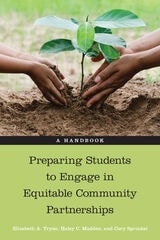
Preparing Students to Engage in Equitable Community Partnerships
A HandbookElizabeth A. Tryon
Temple University Press, 2023
Preparing Students to Engage in Equitable Community Partnerships provides a wealth of valuable resources and activities to help impart ideas of identity, privilege, oppression, bias, and power dynamics to best support students and community in these relationships. Believing that authenticity only comes about in an atmosphere of mutual respect and self-awareness, the authors argue for cultural and intellectual humility.
Each chapter looks at topics and issues through different lenses, complete with underlying theories, and relates those discussions to concrete classroom activities, facilitation strategies, and scholarly frames. In addition, the authors include contributions from a diverse group of practitioners at community colleges, private colleges, historically Black colleges and universities, and minority-serving institutions.
Preparing Students to Engage in Equitable Community Partnerships is a much-needed, comprehensive resource for community-engaged professionals as they prepare students for building relationships when entering a community for learning or research purposes.
Privacy Matters
Conversations about Surveillance within and beyond the ClassroomEstee Beck
Utah State University Press, 2020
This collection offers practical analyses of surveillance and privacy as they occur within classrooms and communities. Organized by themes—surveillance and classrooms, surveillance and bodies, surveillance and culture—Privacy Matters provides writing, rhetoric, and communication scholars and teachers with specific approaches, methods, inquiries, and examinations into the impact tracking and monitoring has upon people’s habits, bodies, and lived experiences.
While each chapter contributes a new perspective in the discipline and beyond, Privacy Matters affirms that these analyses remain inconclusive. This collection is a call for scholars, researchers, activists, and educators within rhetoric and composition to continue the scholarly conversation because privacy matters to all of us.
Contributors: Christina Cedillo, Jenae Cohn, Dànielle Nicole DeVoss, Dustin Edwards, Norah Fahim, Ann Hill Duin, Gavin P. Johnson, John Peterson, Santos Ramos, Colleen A. Reilly, Jennifer Roth Miller, Jason Tham, Stephanie Vie
Process This
Undergraduate Writing in Composition StudiesNancy C. DeJoy
Utah State University Press, 2004
In Process This, Nancy DeJoy argues that even recent revisions to composition studies, cultural studies, service learning, and social process movements--continue to repress the subjects and methodologies that should be central, especially at the level of classroom practice. Designed to move student discourses beyond the classroom, these approaches nonetheless continue to position composition students (and teachers) as mere consumers of the discipline. This means that the subjects, methodologies, and theory/practice relationships that define the field are often absent in composition classrooms.
Arguing that the world inside and outside of the academy cannot be any different if the profession stays the same, DeJoy creates a pedagogy and a plan for faculty development that revisions the prewrite/write/rewrite triad to open spaces for participation and contribution to all members of first-year writing classrooms.

Professing Literature
An Institutional HistoryGerald Graff
University of Chicago Press, 1987
Professing Literature
An Institutional History, Twentieth Anniversary EditionGerald Graff
University of Chicago Press, 2007
Updated with a new preface by the author that addresses many of the provocative arguments raised by its initial publication, Professing Literature remains an essential history of literary pedagogy and a critical classic.
“Graff’s history. . . is a pathbreaking investigation showing how our institutions shape literary thought and proposing how they might be changed.”— The Norton Anthology of Theory and Criticism
Professionalizing Multimodal Composition
Santosh Khadka
Utah State University Press, 2023
Academic leaders, scholars, and faculty who have successfully designed and launched academic programs or faculty development initiatives discuss the theoretical and logistical questions considered in their design, the outcomes they achieved, and how others can emulate them. This exchange of knowledge, insight, experiences, and lessons learned among community members is critical for enabling or inspiring other programs, departments, and institutions to conceive, design, and launch academic programs or faculty development initiatives for their own faculty.
The larger goal of professionalizing is to work with teaching faculty to increase their interactional expertise with multimodal composition, and this collection offers a set of models for how faculty can do that at their own institutions and in their own programs.
Professions
Conversations on the Future of Literary and Cultural StudiesEdited by Donald E. Hall
University of Illinois Press, 2001
This volume bares professional concerns, relationships, ambitions, and insecurities about working in academe. Professions provides hard-to-get insider information for students contemplating an academic career. It also challenges professional scholars to retrieve the intellectual curiosity that drew them to scholarship in the first place while demonstrating how disagreement on controversial issues can be conducted with respect, good humor, and an open mind.
Professions features:
Jane Tompkins and Gerald Graff
John McGowan and Regenia Gagnier
James Phelan and James Kincaid
Marjorie Perloff and Robert von Hallberg
Judith Jackson Fossett and Kevin Gaines
Dennis W. Allen and Judith Roof
Niko Pfund, Gordon Hutner, and Martha Banta
Geoffrey Galt Harpham
Donald E. Hall and Susan S. Lanser
J. Hillis Miller, Herbert Lindenberger, Sandra Gilbert, Bonnie Zimmerman, Nellie Y. McKay, and Elaine Marks
Provocations of Virtue
Rhetoric, Ethics, and the Teaching of WritingJohn Duffy
Utah State University Press, 2018
Drawing upon Aristotle’s Nicomachean Ethics and the branch of philosophical inquiry known as “virtue ethics,” Provocations of Virtue calls for the reclamation of “rhetorical virtues” as a core function in the writing classroom. Duffy considers what these virtues actually are, how they might be taught, and whether they can prepare students to begin repairing the broken state of public argument. In the discourse of the virtues, teachers and scholars of writing are offered a common language and a shared narrative—a story that speaks to the inherent purpose of the writing class and to what is at stake in teaching writing in the twenty-first century.
This book is a timely and historically significant contribution to the field and will be of major interest to scholars and administrators in writing studies, rhetoric, composition, and linguistics as well as philosophers and those exploring ethics.
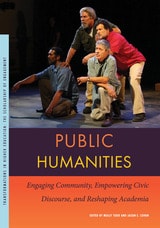
Public Humanities
Engaging Community, Empowering Civic Discourse, and Reshaping AcademiaMolly Todd
Michigan State University Press, 2025
Public Scholarship in Communication Studies
Edited by Thomas J Billard and Silvio Waisbord
University of Illinois Press, 2024
Thomas J Billard and Silvio Waisbord curate essays from a wide range of specialties within the study of communication. Aimed at scholars and students alike, the contributors use approaches from critical meditations to case studies to how-to guides as they explore the possibilities of seeing shared knowledge not as a gift to be granted but as an imperative urging readers to address the problems of the world. Throughout the volume, the works show that a pivot to ideas of scholarship as public service is already underway in corners of communication studies across the country.
Visionary and provocative, Public Scholarship in Communication Studies proposes a needed reconsideration of knowledge and a roadmap to its integration with community.
Contributors: Elaine Almeida, Becca Beets, Thomas J Billard, Danielle K. Brown, Aymar Jean Christian, Stacey L. Connaughton, Paula Gardner, Larry Gross, Amy Jordan, Daniel Kreiss, Rachel Kuo, Susan Mancino, Shannon C. McGregor, Philip M. Napoli, Todd P. Newman, Srividya Ramasubramanian, Chad Raphael, Sue Robinson, Silvio Waisbord, Yidong Wang, and Holley Wilkin
Putting Assessment Into Action
Selected ProjectsEric Ackermann
Assoc of College & Research Libraries, 2015
Putting Assessment into Action
Selected Projects from the First Cohort of the Assessment in Action GrantEric Ackermann
Assoc of College & Research Libraries, 2015