Results by title
83 books match the query 'Treatment' and 7 start with p
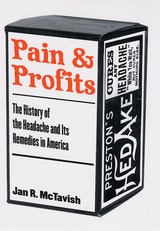
Pain and Profits
The History of the Headache and Its Remedies in AmericaMcTavish, Jan R.
Rutgers University Press, 2004
Pain and Profits tells the story of how a common ailment—the headache—became the center of a multibillion dollar pharmaceutical industry in the United States. Despite the increasing authority of the medical profession in the twentieth century, treatment of this condition has remained largely in the hands of the public. Using the headache as a case study, and advertising as a significant source of information, Jan McTavish traces the beginnings of the modern over-the-counter industry.
The American pharmaceutical industry developed from nineteenth-century suppliers of plant-derived drugs for both professional and home care. Two branches of the industry evolved over time—the ethical branch, which sold products only with prescriptions, and the nostrum branch, which was noted for its energetic marketing techniques. At the end of the century, they were joined by German companies that combined a strong commitment to science with aggressive salesmanship. Since German drugs were both highly effective in treating headaches and commonly available, sufferers wanting quick relief could easily obtain them. The result was a new kind of “legitimate” pharmaceutical industry that targeted consumers directly.
Historians of medicine as well as more general readers interested in the history of the headache will enjoy this fascinating account of the creation of the modern pharmaceutical industry.
Pandemic Power
The Covid Response and the Erosion of Democracy - A Liberal CritiqueMuriel Blaive
Central European University Press, 2025
Panic Diaries
A Genealogy of Panic DisorderJackie Orr
Duke University Press, 2006
Orr, who has experienced panic attacks herself, kept a diary of her participation as a research subject in clinical trials for the Upjohn Company’s anti-anxiety drug Xanax. This “panic diary” grounds her study and suggests the complexity of her desire to track the diffusion and regulation of panic in U.S. society. Orr’s historical research, theoretical reflections, and biographical narrative combine in this remarkable and compelling genealogy, which documents the manipulation of panic by the media, the social sciences and psychiatry, the U.S. military and government, and transnational drug companies.
Para-States and Medical Science
Making African Global HealthP. Wenzel Geissler, editor
Duke University Press, 2015
Contributors. Uli Beisel, Didier Fassin, P. Wenzel Geissler, Rene Gerrets, Ann Kelly, Guillaume Lachenal, John Manton, Lotte Meinert, Vinh-Kim Nguyen, Branwyn Poleykett, Susan Reynolds Whyte

Portraits of Violence
War and the Aesthetics of DisfigurementSuzannah Biernoff
University of Michigan Press, 2017
Suzannah Biernoff draws on a wide variety of sources mainly from WWI but also contemporary photography and computer games. Each chapter revolves around particular images: Marine Wedding is discussed alongside Stuart Griffiths’ portraits of British veterans; Henry Tonks’ drawings of WWI facial casualties are compared to the medical photographs in the Gillies Archives; the production of portrait masks for the severely disfigured is approached through the lens of documentary film and photography; and finally the haunting image of one of Tonks’s patients reappears in BioShock, a highly successful computer game. The book simultaneously addresses a neglected area in disability studies; puts disfigurement on the agenda for art history and visual studies; and makes a timely and provocative contribution to the literature on the First World War.
Precision Radiation Oncology
Haffty, Bruce G
Rutgers University Press, 2018
By describing current existing clinical and pathologic features, and focusing on the ability to improve outcomes in cancer using radiation therapy, this book discusses incorporating novel genomic- or biology-based biomarkers in the treatment of patients moving radiation oncology into precision/personalized medicine. Precision Radiation Oncology provides readers with an overview of the new developments of precision medicine in radiation oncology, further advancing the integration of new research findings into individualized radiation therapy and its clinical applications.

Presidential Accountability in Wartime
President Bush, the Treatment of Detainees, and the Laws of WarStuart Streichler
University of Michigan Press, 2023
The American presidency has long tested the capacity of the system of checks and balances to constrain executive power, especially in times of war. While scholars have examined presidents starting military conflicts without congressional authorization or infringing on civil liberties in the name of national security, Stuart Streichler focuses on the conduct of hostilities. Using the treatment of war-on-terror detainees under President George W. Bush as a case study, he integrates international humanitarian law into a constitutional analysis of the repercussions of presidential war powers for human rights around the world.
Putting President Bush’s actions in a wider context, Presidential Accountability in Wartime begins with a historical survey of the laws of war, with particular emphasis on the 1949 Geneva Conventions and the Nuremberg Tribunal. Streichler then reconstructs the decision-making process that led to the president’s approval of interrogation methods that violated Geneva’s mandate to treat wartime captives humanely. While taking note of various accountability options—from within the executive branch to the International Criminal Court—the book illustrates the challenge in holding presidents personally responsible for violating the laws of war through an in-depth analysis of the actions taken by Congress, the Supreme Court, and the public in response. In doing so, this book not only raises questions about whether international humanitarian law can moderate wartime presidential behavior but also about the character of the presidency and the American constitutional system of government.