Results by title
109 books match the query 'United States. Army' and 7 start with p
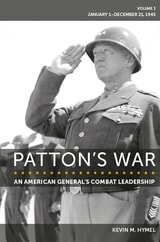
Patton's War
An American General's Combat Leadership Volume 3: January 1-December 21, 1945Kevin M. Hymel
University of Missouri Press, 2026
The third and final volume of Kevin Hymel’s Patton’s War trilogy finds Lieutenant General George S. Patton on January 1, 1945, as the master of the battlefield in World War II Europe. Throughout the war, Patton showed the same kind of aggressive leadership and battlefield smarts that made his name synonymous with victory. Patton’s leadership was almost flawless as he led his men through enemy fire and one of the worst winters in European history.
As with his previous volume, Hymel relies on Patton’s original diaries (not the transcribed, embellished versions historians have relied on for many years) and personal letters to tell the general’s story. Hymel also mined various archives to explain Patton’s encounters with soldiers, government officials, civilians, and reporters to expand on his narrative.
Throughout this three-volume work, Patton emerges not as a larger-than-life myth, but as a human being, one held back by the personal prejudices and antisemitism that ultimately proved to be his demise. Despite these personal failings, Patton was, above all, as Hymel reveals, a commander bent on winning, or, as the general himself might have put it, getting the enemy to dance to his tune.
[more]
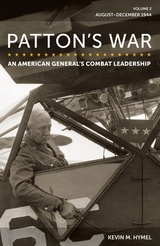
Patton's War
An American General's Combat Leadership, Volume 2: August–December 1944Kevin M. Hymel
University of Missouri Press, 2023
Winner of the 2023 Army Historical Foundation Distinguished Writing Award for Biography
Finalist for the 2023 Gilder Lehrman Military History Prize
This second of three volumes of Patton’s War picks up where the first one left off, examining General George S. Patton’s leadership of the U.S. Third Army. The book follows Patton’s contributions to both the Normandy and Brittany campaigns—the closing of the Falaise Pocket in Normandy, and racing to the port cities in Brittany. It ends with Patton and his corps rescuing the besieged town of Bastogne in the Battle of the Bulge.
As he did in the preceding volume, Hymel relies not only on Patton’s diaries and letters, but countless veteran interviews, surveys, and memoirs. He also provides a unique insight missed by previous Patton scholars. Instead of using Patton’s transcribed diaries, which were heavily edited and embellished, he consults Patton’s original, hand-written diaries to uncover previously unknown information about the general.
This second volume of Hymel’s groundbreaking work shows Patton at the height of his generalship, successfully leading his army without the mistakes and caustic behavior that almost got him sent home earlier—even if we also see a Patton still guided at times by racism and antisemitism.
[more]
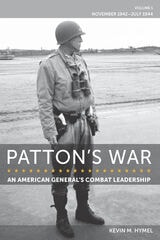
Patton's War
An American General's Combat Leadership, Volume I: November 1942–July 1944Kevin M. Hymel
University of Missouri Press, 2021
George S. Patton Jr. lived an exciting life in war and peace, but he is best remembered for his World War II battlefield exploits. Patton’s War: An American General’s Combat Leadership: November 1942–July 1944, the first of three volumes, follows the general from the beaches of Morocco to the fields of France, right before the birth of Third Army on the continent. In highly engaging fashion, Kevin Hymel uncovers new facts and challenges long-held beliefs about the mercurial Patton, not only examining his relationships with his superiors and fellow generals and colonels, but also with the soldiers of all ranks whom he led. Using new sources unavailable to previous historians and through extensive research of soldiers’ memoirs and interviews, Hymel adds a new dimension to the telling of Patton’s WWII story.
[more]
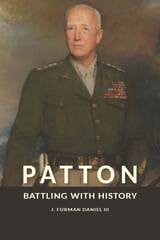
Patton
Battling with HistoryJ. Furman Daniel
University of Missouri Press, 2025
General George S. Patton Jr. is one of the most successful yet misunderstood figures in American military history. Despite the many books and articles written about him, none considers in depth how his love of history shaped the course of his life. In this thematic biography, Furman Daniel traces Patton’s obsession with history and argues that it informed and contributed to many of his successes, both on and off the battlefield.
Patton deliberately cultivated the image of himself as a warrior from ages past; the more interesting truth is that he was an exceptionally dedicated student of history. He was a hard worker and voracious reader who gave a great deal of thought to how military history might inform his endeavors. Most scholars have overlooked this element of Patton’s character, which Daniel argues is essential to understanding the man’s genius.
Patton deliberately cultivated the image of himself as a warrior from ages past; the more interesting truth is that he was an exceptionally dedicated student of history. He was a hard worker and voracious reader who gave a great deal of thought to how military history might inform his endeavors. Most scholars have overlooked this element of Patton’s character, which Daniel argues is essential to understanding the man’s genius.
[more]
Peacekeeping on the Plains
Army Operations in Bleeding KansasTony R. Mullis
University of Missouri Press, 2004
Historians have written on “Bleeding Kansas” and on the frontier army as a constabulary force, but little scholarship exists on how the army performed its peacekeeping operations in the 1850s. In Peacekeeping on the Plains, Tony R. Mullis is one of the first scholars to detail the military concerns associated with peace enforcement in Kansas and the trans-Missouri West.
Between 1854 and 1856, the Franklin Pierce administration called upon the U.S. Army to conduct a series of peace operations in the newly formed Kansas and Nebraska territories. The army responded to the president’s call by successfully completing a mission against the Lakota Sioux in 1855 and by aiding civil authorities in the imposition of peace among competing factions in Kansas during 1856.
Although these police duties were not always popular with the soldiers that conducted them, the purpose behind them remained constant—the maintenance of peace, order, and security. Given Americans’ misgivings about a standing army and their limited expectations for it as a domestic peacekeeper, its use in this fashion during the 1850s was a delicate proposition.
By drawing on diverse sources, including official army correspondence, personal papers of key military and political leaders, and local accounts of army activities, Mullis shows how peace operations were conducted by the U.S. Army long before the second half of the twentieth century. He alsopresents a thorough analysis of the professional dilemmas confronted by army officers, as well as the delicate command and control issues associated with the different types of peace operations.
Mullis’s assessment of the army’s peacekeeping efforts in the mid-1850s offers a full understanding of the constraints and frustrations involved. Many of the dilemmas faced by the army in Kansas parallel those encountered in various spots around the globe today. Peacekeeping on the Plains will provide any reader with a better insight into the nuances of peace operations in the 1850s and assist military historians in their understanding of these activities as they relate to the twenty-first century.
[more]
Place the Headstones Where They Belong
Thomas Neibaur, World War 1 SoldierSherman L. Fleek
Utah State University Press, 2008
After a long journey from Sugar City, Idaho, to France’s Argonne Forest France during World War I,
young Thomas Neibaur found himself in the core of the American Expeditionary Force’s most important offensive.
After becoming separated in advance of his unit, he, despite serious wounds, single-handedly stopped a German
counterattack at a critical hill known as Côte de Châtillon. For this remarkable feat of valor, he received the Medal of
Honor and other awards, becoming the first Idaho and first Mormon recipient of the nation’s highest combat award.
But after a heroic return and brief celebrity, his life followed a tragic downward arc, culminating in his attempt to return
his medal because, as he put it, it could not feed his family.
[more]
Practicing Medicine in a Black Regiment
The Civil War Diary of Burt G. Wilder, 55th MassachusettsRichard M. Reid
University of Massachusetts Press, 2010
In early 1863, in the aftermath of Abraham Lincoln's Emancipation Proclamation, Massachusetts began recruiting black soldiers to serve in the Civil War. Although the first regiment formed, the 54th Massachusetts, would become the best-known black regiment in the war, the second regiment raised, the 55th Massachusetts Volunteer Infantry, performed equally valuable service in the Union Army.
Burt Green Wilder, a Boston-born, Harvard-educated doctor-in-training, was among the first white officers commissioned to staff the 55th Massachusetts. Like other officers serving in the state's African American units, Wilder was selected for his military experience, his "firm Anti-Slavery principles," and his faith in the value of black troops. From the time he joined the 55th in May 1863 until the regiment was discharged in September 1865, Wilder recorded his experiences and observations. He described the day-to-day activities of a Civil War surgeon, the indignities suffered by black enlisted men at the hands of a War Department that denied them the same treatment offered to white troops, and the role of the regiment in the campaign around Charleston and in Florida.
Service in the southern states also allowed Wilder to indulge a passion for natural science and comparative anatomy, including the collection of unusual species, one of which—the spider known as Nephila wilderi—still bears his name. After the war he completed his medical studies at Harvard and joined the faculty of Cornell University, where he became a distinguished professor of zoology as well as an outspoken advocate of racial equality.
In his introduction to the volume, Richard M. Reid analyzes Burt Wilder's diary and places it within the context of the war, the experience of African American troops, and Wilder's life and career.
[more]