Results by title
147 books match the query 'Urban & Land Use Planning' and 14 start with p
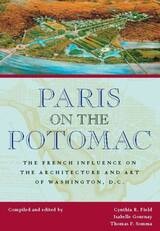
Paris on the Potomac
The French Influence on the Architecture and Art of Washington, D.C.Cynthia R. Field
Ohio University Press, 2007
In 1910 John Merven Carrère, a Paris-trained American architect, wrote, “Learning from Paris made Washington outstanding among American cities.” The five essays in Paris on the Potomac explore aspects of this influence on the artistic and architectural environment of Washington, D.C., which continued long after the well-known contributions of Peter Charles L’Enfant, the transplanted French military officer who designed the city’s plan.
Isabelle Gournay’s introductory essay provides an overview and examines the context and issues involved in three distinct periods of French influence: the classical and Enlightenment principles that prevailed from the 1790s through the 1820s, the Second Empire style of the 1850s through the 1870s, and the Beaux-Arts movement of the early twentieth century. William C. Allen and Thomas P. Somma present two case studies: Allen on the influence of French architecture, especially the Halle aux Blés, on Thomas Jefferson’s vision of the U.S. Capitol; and Somma on David d’Angers’s busts of George Washington and the Marquis de Lafayette. Liana Paredes offers a richly detailed examination of French-inspired interior decoration in the homes of Washington’s elite in the late nineteenth and early twentieth centuries. Cynthia R. Field concludes the volume with a consideration of the influence of Paris on city planning in Washington, D.C., including the efforts of the McMillan Commission and the later development of the Federal Triangle complex.
The essays in this collection, the latest addition to the series Perspectives on the Art and Architectural History of the United States Capitol, originated in a conference held by the U.S. Capitol Historical Society in 2002 at the French Embassy’s Maison Française.
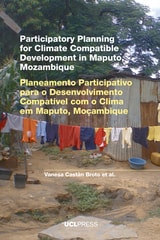
Participatory Planning for Climate Compatible Development in Maputo, Mozambique
Edited by Vanesa Castán Broto, Jonathan Ensor, Emily Boyd, Charlotte Allen, Carlos Seventine, and Domingos Augusto Macucule
University College London, 2015
Pathways to Sustainability
Collaborative Solutions for a Resilient FutureEdited by Timothy L. Killeen, Donald J. Wuebbles, and Jason E. Lane
University of Illinois Press, 2025
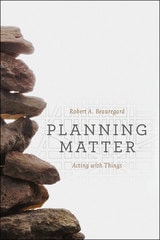
Planning Matter
Acting with ThingsRobert A. Beauregard
University of Chicago Press, 2015
In the ambitious and provocative Planning Matter, Robert A. Beauregard sets out to offer a new materialist perspective on planning practice that reveals the many ways in which the nonhuman things of the world mediate what planners say and do. Drawing on actor-network theory and science and technology studies, Beauregard lays out a framework that acknowledges the inevitable insufficiency of our representations of reality while also engaging more holistically with the world in all of its diversity—including human and nonhuman actors alike.
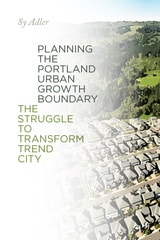
Planning the Portland Urban Growth Boundary
The Struggle to Transform Trend CitySy Adler
Oregon State University Press, 2022
In this companion volume to his 2012 book Oregon Plans: The Making of an Unquiet Land-Use Revolution, Sy Adler offers readers a deep analysis of planning Portland’s Urban Growth Boundary. Required by one of Oregon’s nineteen statewide planning goals, a boundary in the Portland metropolitan area was intended to separate urban land and land that would be urbanized from commercially productive farmland. After adopting the goals, approving the Portland growth boundary in 1979 was the most significant decision the Oregon Land Conservation and Development Commission has ever made, and, more broadly, is a significant milestone in American land-use planning.
Planning the Portland Urban Growth Boundary primarily covers the 1970s. Innovative regional planning institutions were established in response to concerns about sprawl, but planners working for those institutions had to confront the reality that various plans being developed and implemented by city and county governments in metro Portland would instead allow sprawl to continue. Regional planners labeled these as “Trend City” plans, and sought to transform them during the 1970s and thereafter.
Adler discusses the dynamics of these partially successful efforts and the conflicts that characterized the development of the Portland UGB during the 1970s—between different levels of government, and between public, private, and civic sector advocates. When the regional UGB is periodically reviewed, these conflicts continue, as debates about values and technical issues related to forecasting future amounts of population, economic activity, and the availability of land for urban development over a twenty-year period roil the boundary planning process.
Planning the Portland Urban Growth Boundary is an authoritative history and an indispensable resource for anyone actively involved in urban and regional planning—from neighborhood associations and elected officials to organizations working on land use and development issues throughout the state.
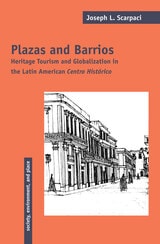
Plazas and Barrios
Heritage Tourism and Globalization in the Latin American Centro HistóricoJoseph L. Scarpaci
University of Arizona Press, 2004
This book explores how heritage tourism and globalization are reshaping the Latin American centro histórico, analyzing the transformation of the urban core from town plaza to historic center in nine cities: Bogotá, Colombia; Buenos Aires, Argentina; Cartagena, Colombia; Cuenca, Ecuador; Havana, Cuba; Montevideo, Uruguay; Puebla, Mexico; Quito, Ecuador; and Trinidad, Cuba. It tells how these pressures, combined with the advantage of a downtown location, have raised the potential of redeveloping these inner city areas but have also created the dilemma of how to restore and conserve them while responding to new economic imperatives.
In an eclectic and interdisciplinary study, Joseph Scarpaci documents changes in far-flung corners of the Latin American metropolis using a broad palette of tools: urban morphology profiles, an original land-use survey of 30,000 doorways in nine historic districts, numerous photographs, and a review of the political, economic, and globalizing forces at work in historic districts. He examines urban change as reflected in architectural styles, neighborhood growth and decline, real estate markets, and local politics in order to show the long reach of globalization and modernity.
Plazas and Barrios spans all of Spanish-speaking America to address the socio-political dimensions of urban change. It offers a means for understanding the tensions between the modern and traditional aspects of the built environment in each city and provides a key resource for geographers, urban planners, architectural historians, and all concerned with the implications of the emerging global economy.
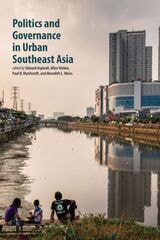
Politics and Governance in Urban Southeast Asia
Edited by Edward Aspinall, Allen Hicken, Paul D. Hutchcroft, and Meredith Weiss
National University of Singapore Press, 2026
As Southeast Asia’s cities continue to swell, this timely volume analyzes urban politics in the region.
Why have some Southeast Asian cities become laboratories of reform while others remain mired in old patterns of patronage politics and substandard public services? This has become an important question now that over half of Southeast Asia’s population lives in urban areas, transforming the politics of the region. Quintessentially urban problems—traffic congestion, sanitation, public transport, housing, and the like—increasingly preoccupy policymakers, while the region’s swelling urban middle classes expect their mayors and city governments to provide ever-better infrastructure and amenities.
Drawing on close case studies of a diverse set of seventeen urban areas across four Southeast Asian countries—Indonesia, Malaysia, the Philippines, and Thailand—this volume offers fresh insights into how the region’s urban politics are changing. It provides a new framework for understanding why some cities are flourishing and others are not. Exploring the factors that shape distinct local governance regimes in these cities, Politics and Governance in Urban Southeast Asia also throws light on how urban residents use community associations, informal networks, and other political mechanisms to access the public services they want and need.
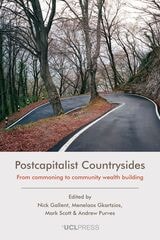
Postcapitalist Countrysides
From Commoning to Community Wealth BuildingEdited by Nick Gallent, Menelaos Gkartzios, Mark Scott, and Andrew Purves
University College London, 2025
Postcapitalist Countrysides exposes the entrenched inequalities that capitalism has imposed on rural communities and charts a path toward more just and sustainable futures. Built upon case studies from around the world, the book critiques the failures of privatization and market-driven development while showcasing alternative economic models that reclaim land and wealth for the many, not the few.
Through analyses of land reform and community wealth building, contributors depict how local initiatives can reshape rural economies and empower communities when reinforced by structural change. From challenging exploitative land ownership to confronting the encroachment of platform capitalism, this volume engages with urgent global crises while offering tangible strategies for transformation. Postcapitalist Countrysides presents a bold vision for rural life beyond capitalism—one rooted in collective prosperity and resilience.
Postcolonial Dublin
Imperial Legacies And The Built EnvironmentAndrew Kincaid
University of Minnesota Press, 2006
Postwar Architecture Between Italy and the UK
Exchanges and Transcultural InfluencesEdited by Lorenzo Ciccarelli and Clare Melhuish
University College London, 2021
In the aftermath of World War II’s devastation, Italy and the United Kingdom reimagined urban space. Post-war Architecture Between Italy and the UK explores how architects, urbanists, and historians in both countries collaborated around the shared need to rebuild. The authors discuss the far-reaching effects of this cultural exchange, including the influence of historic Italian town centers on British public space and the origin of postmodernism in clashes between British critics and Italian architects. Drawing on a wealth of archival materials, this volume offers new insights into architectural history in post-war Europe.

Practising Ethics
A poethic infrastructure for architectural and urban researchersEdited by Jane Rendell, David Roberts, and Yael Padan
University College London, 2026
This book presents a conceptual framework that introduces architectural and urban researchers and practitioners to core ethical concepts and principles.
Grappling with ethics can disorient and disturb your peace of mind in the small hours of the night. Practising Ethics transforms ethics from an obstacle to an opportunity by offering a poethic infrastructure to guide the development of ethical practice in architectural and urban research.
Practising Ethics bridges the gap between research volume and textbook. The book’s two-part structure creates a dialogue between ethical concepts derived from decolonial, ecological, feminist, and queer theory and lived ethical experiences that are explored through specific situations. A series of opening essays present hotspots, touchstones, keystones, blindspots, moonshots, and milestones as different ethical orientations in a six-point methodology. This is followed by six case studies in which practitioners and researchers navigate these orientations through narrative figurations that describe ethical deliberations arising from social science, humanities, practice-led and participatory art, and architectural design research in El Salvador, India, Nigeria, Peru, and the United Kingdom.
The book acts as a companion to an award-winning online toolkit and is illustrated by Judit Ferencz, who offers creative exercises for readers to develop their own poethic infrastructures.
Prairie Crossing
Creating an American Conservation CommunityJohn Scott Watson
University of Illinois Press, 2016
The first comprehensive look at an American conservation community, Prairie Crossing goes beyond windmills and nest boxes to examine an effort to connect adults to the land while creating a healthy and humane setting for raising a new generation attuned to nature. John Scott Watson places Prairie Crossing within the wider context of suburban planning, revealing how two first-time developers implemented a visionary new land ethic that saved green space by building on it. The remarkable achievements include a high rate of resident civic participation, the reestablishment of a thriving prairie ecosystem, the reintroduction of endangered and threatened species, and improved water and air quality. Yet, as Watson shows, considerations like economic uncertainty, lack of racial and class diversity, and politics have challenged, and continue to challenge, Prairie Crossing and its residents.
Preserving and Enhancing Communities
A Guide for Citizens, Planners, and PolicymakersElisabeth M. Hamin
University of Massachusetts Press, 2007
This book starts from the premise that each community chooses its future every day, through the incremental decisions made by planning and zoning boards and other citizen volunteers, as well as professional staff. The challenge is to ensure that these decisions support the preservation of what is special about the community, while still fostering necessary and appropriate growth.
In this volume, twenty-nine experts from a variety of fields describe in very practical terms the “community preservation” approach to these issues. As opposed to the top-down regulatory mechanisms that are sometimes used to manage growth, the contributors favor a more flexible, locally based approach that has proven successful in Massachusetts and elsewhere. They show how residents can be empowered to become involved in local decision-making, building coalitions and expressing their views on a wide range of issues, such as zoning, water and land protection, transportation, historic preservation, economic diversity, affordable housing, and reuse of brown-fields. When done properly, development can enhance the sense of place and provide needed homes and jobs. Done improperly, it can generate sprawl and a multitude of problems.
Preserving and Enhancing Communities will be particularly useful to members of planning and other regulatory boards, as well as students of community planning. The book covers not just typical ways of doing things, but also the full spectrum of innovative and emerging practices. Each chapter includes illustrations and case studies, some from Massachusetts and many from other states. The volume concludes with a set of indicators that communities can use to track their progress in community preservation and enhancement.
Purging the Poorest
Public Housing and the Design Politics of Twice-Cleared CommunitiesLawrence J. Vale
University of Chicago Press, 2013