Results by title
64 books match the query 'Vocational guidance' and 3 start with p

Poor Dancer's Almanac
Managing Life & Work in the Performing ArtsDavid R. White, Lise Friedman, and Tia Tibbitts Levinson, eds.
Duke University Press, 1993
Combining how-to information with voices of working artists, Poor Dancer's Almanac is an essential resource tool and source of inspiration for all independent artists—choreographers, performance artists, dancers producers, managers. Created in 1975 and revised again in 1984 this handbook has come to serve as one of the most crucial references for the arts community. In the most up-to-date and comprehensive edition yet, a broad range of issues affecting performers and producers is addressed, interwoven with newly added, more personal contributions from major figures in the performance world.
Organized and compiled by Dance Theater Workshop in New York and authored by more than fifty leading professionals in the field, Poor Dancer's Almanac offers in-depth discussions of everything from personal livelihood to professional career development, from medical care, housing, and unemployment insurance to management, touring, and legal issues. Each chapter is followed by an appendix containing extensive and varied listings, giving names and addresses for finding internship programs, videotaping, flooring, grant-writing, and reference publications. Although centered on New York the Almanac includes lists of resources and contacts for many other states—California, Washington D.C, Illinois, Minnesota, North Carolina, Texas, Florida, and Ohio. An entirely new section has been added dealing with health issues and the crisis of AIDS.
In personal anecdotes and essays various performers offer their own insights and stories—both of struggles and of successes—to bring to life the practical realities of working in the arts. We hear from Merce Cunningham, Eric Bogosian, Karen Finley, Paul Zaloom, and Bill T. Jones, among others. Illustrated with original drawings by Janie Geiser, this thoroughly revised and updated edition of the Poor Dancer's Almanac will continue to serve as one of the leading sources for those concerned with managing life and work in the performing arts.
[more]
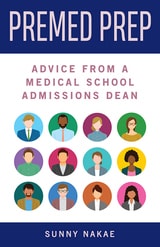
Premed Prep
Advice from a Medical School Admissions DeanSunny Nakae
Rutgers University Press, 2021
If you’re a student hoping to apply to medical school, you might be anxious or stressed about how best to prepare. What classes should you take? What kinds of research, clinical, and volunteer opportunities should you be pursuing? What grades and MCAT scores do you need? How can you stand out among thousands of applicants?
Premed Prep answers all these questions and more, with detailed case studies and insider tips that can help premed students authentically prepare and enjoy the journey from the very beginning. Sunny Nakae draws from her many years of experience as a medical school admissions dean to offer wise and compassionate advice that can help premed students of all backgrounds. She also has specific tips for students who are first-generation, minority, non-traditional, and undocumented.
Both forthright and supportive, Nakae’s advice is offered in a keep-it-real style that gives premed students a unique window into how admissions committees view and assess them. Premed Prep covers how to approach preparation with a focus on exploration and growth, and how to stop obsessing over med school application checklists. This book will do more than help you get a seat in medical school; it will start you on the process of becoming a successful future physician.
[more]
Promoting Positive Transition Outcomes
Effective Planning for Deaf and Hard of Hearing Young AdultsPamela Luft
Gallaudet University Press, 2016
Many students struggle with the transition from high school to the next stage of their lives. For deaf and hard of hearing (DHH) students, that struggle can be intensified by barriers and discriminatory attitudes they face in their communities, schools, and workplaces. Though much progress has been made, they are often underemployed and underpaid, and they receive postsecondary training at lower rates than other disability groups. Author Pamela Luft explores the reasons for these statistics and offers strategies and resources that can improve outcomes.
Promoting Positive Transition Outcomes is the most comprehensive discussion of transition planning and results for DHH students now available. Luft begins with an overview of the historical and current challenges to DHH students and their academic and vocational potential. She explores the importance of forming an identity and building foundational social and problem-solving skills. She then reviews the history of rehabilitation and workforce legislation, which now mandates that every student with an individualized education plan (IEP) have a transition plan in place by the age of 16. Most schools, however, are not equipped to meet the needs of a population as diverse as DHH students. She examines the services that are currently available in high schools and offers recommendations for strengthening transition team planning by reaching out to external experts. The volume concludes with suggestions for creating a framework to address the challenges of transition planning for deaf and hard of hearing students and offers guidance on building effective plans.
[more]