Results by title
272 books match the query 'Work' and 20 start with p
Package Deal
Marriage, Work And Fatherhood In Men'S LivesNicholas W. Townsend
Temple University Press, 2002
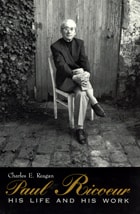
Paul Ricoeur
His Life and His WorkCharles E. Reagan
University of Chicago Press, 1996
"A valuable introduction to Ricoeur; highly recommended."—Library Journal
"[A] lively introduction to the life and thought of one of this century's most notable philosophers."—Norman Wirzba, Christian Century
"Reagan lucidly explains Ricoeur's difficult philosophy while shining overdue light on the personality behind it."—Carlin Romano, Philadelphia Inquirer
"Combines biographical and philosophical essays with a more personal memoir that makes Ricoeur's humane and magnanimous nature abundantly evident. Four revealing interviews, coupled with photographs, and an extensive bibliography of primary and secondary sources, complete this illuminating study."—Choice
Persistent Callings
Seasons of Work and Identity on the Oregon CoastJoseph E. Taylor
Oregon State University Press, 2019
The Nestucca Valley is a small watershed, tucked away in one corner of a county in far western Oregon. There are no incorporated towns, and cows outnumber humans. It has long been a place without a written history, yet its past offers many surprising twists on received wisdom about rural economies. In crisp prose and succinct chapters, Persistent Callings carries readers from aboriginal times to the present, illustrating the wisdom of seasonal labor, the complex relationships between work and identity, and the resilience of rural economics across more than a century of almost continual change.
Life in this watershed, known to locals as “South County,” has always been demanding. Farming, fishing, and logging were difficult occupations, but work had deeper meanings. Challenges arrived in many forms, including climate shifts, market crashes, regulatory changes, and industry consolidations. Residents’ ability to innovate was their greatest resource, and their persistence helps us to recognize the callings they pursued.
During the late twentieth and early twenty-first centuries, disruptions came more quickly, and they coincided with infusions of capital that dramatically altered the structure of employment, with devastating results for the valley’s hardest working residents. Unemployment and poverty skyrocketed while health and life expectancy dropped to alarming levels. Moreover, the arrival of retirees and rise of environmental amenities actually exacerbated some ecological problems. Little in this history plays out as expected, and much of it will make readers reconsider how they think about the social, economic, and environmental contours of rural life in the American West.

Philip Johnson
Life and WorkFranz Schulze
University of Chicago Press, 1996
The only child of a wealthy Midwestern family, Philip Johnson was a millionaire by the time he graduated from Harvard, and in 1932 he helped stage the historic International Style exhibition at the Museum of Modern Art. A patron of the arts and a political activists who flirted with the politics of Hitler, Huey Long, and Father Coughlin, he went on to create controversial and historical structures such as the Glass House, the Roofless Church, the AT & T Building, the Crystal Cathedral, and many more. Johnson's personal charms paired with his manipulative ploys—like his "borrowing" of designs—shine through in this biography.
Drawing on Johnson's correspondence, personal photographs, and speeches, and on interviews with his friends and contemporaries, Schulze fills the biography with fascinating information on the architect's family, travels, friends and lovers, and his many buildings and spaces themselves.
Franz Schulze is a professor of art at Lake Forest College. He is the author of Fantastic Images: Chicago Art since 1945, One Hundred Years of Chicago Architecture, and Mies van der Rohe: A Critical Biography.

Photography and Work
Kevin Coleman, Daniel James, and Jayeeta Sharma, special issue editors
Duke University Press, 2018
Contributors: Siobhan Angus, Ian Bourland, Oliver Coates, Kevin Coleman, Clare Corbould, Adrian De Leon, Rick Halpern, Daniel James, Tong Lam, Walter Benn Michaels, Jessica Stites Mor, Carol Quirke, Jayeeta Sharma, Erica Toffoli, Daniel Zamora
Pickin’ Cotton on the Way to Church
The Life and Work of Father Boniface Hardin, OSBNancy Van Note Chism
Indiana Historical Society Press, 2019
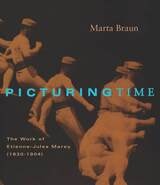
Picturing Time
The Work of Etienne-Jules Marey (1830-1904)Marta Braun
University of Chicago Press, 1992
Braun offers a fascinating look at how Marey's chronophotography was used to express the profound transformation in understanding and experiencing time that occurred in the late nineteenth century. Featuring 335 illustrations, Picturing Time includes many unpublished examples of Marey's chronophotographs and cinematic work. It also contains a complete bibliography of his writings and the first catalog of his films, photographic prints, and recently discovered negatives.
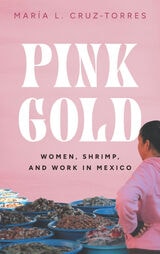
Pink Gold
Women, Shrimp, and Work in MexicoMaria L. Cruz-Torres
University of Texas Press, 2023
A rich, long-term ethnography of women seafood traders in Mexico.
The "shrimp ladies," locally known as changueras in southern Sinaloa, Mexico, sell seafood in open-air markets, forming an extralegal but key part of the economy built around this "pink gold.” Over time, they struggled to evolve from marginalized peddlers to local icons depicted in popular culture, even as they continue to work at an open-air street market.
Pink Gold documents the shrimp traders' resilience and resourcefulness, from their early conflicts with the city, state, and federal authorities and forming a union, to carving out a physical space for a seafood market, and even engaging in conflicts with the Mexican military. Drawing from her two decades of fieldwork, María L. Cruz-Torres explores the inspiring narrative of this overlooked group of women involving grassroots politics, trans-border and familial networking, debt and informal economic practices, personal sacrifices, and simple courage. She argues that, amid intense economic competition, their success relies on group solidarity that creates interlocking networks of mutual trust, or confianza, that in turn enable them to cross social and political boundaries that would typically be closed to them. Ultimately, Pink Gold offers fresh insights into issues of gender and labor, urban public space, the street economy, commodities, and globalization.

Places/Everyone
Jim Daniels
University of Wisconsin Press, 1985
Jim Daniels, in his first book of poems, draws upon his experiences in living and working in his native Detroit to present a start, realistic picture of urban, blue-collar life. Daniels, his brothers, his father, and his grandfather have all worked in the auto industry, and that background seeps into nearly all these poems.
The first of the book’s three sections sketches out this background, then moves into a neighborhood full of people whose lives are so linked to the ups and downs of the auto industry that they have to struggle to find their own lives; in "Still Lives in Detroit, #2," Daniels writes, "There’s a man in this picture. / No one can find him." The second section contains the "Digger" poems, a series on the lives of a Detroit auto worker and his family which tries to capture the effects of the work on life outside the factory. Here, we listen to Digger think, dream, wander on psychological journeys while he moves through his routines, shoveling the snow, mowing the lawn, and so forth. In section three, the poems move into the workplace, whether that be a liquor store, a hamburger joint, or a factory.
These poems, sometimes dark, sometimes humorous, concentrate on the efforts of workers to rise above the often depressing work of blue-collar or minimum-wage jobs, to salvage some pride and dignity. The poems in this book try to give a voice to those who are often shut out of poetry. They are important. These lives are important, and the poems, more than anything, say that.
Placing the Academy
Essays on Landscape, Work, and Identityedited by Jennifer Sinor and Rona Kaufman
Utah State University Press, 2007
Twenty-one writers answer the call for literature that addresses who we are by understanding where we are--where, for each of them, being in some way part of academia. In personal essays, they imaginatively delineate and engage the diverse, occasionally unexpected play of place in shaping them, writers and teachers in varied environments, with unique experiences and distinctive world views, and reconfiguring for them conjunctions of identity and setting, here, there, everywhere, and in between.
Contents
I Introduction Writing Place, Jennifer Sinor
II Here
Six Kinds of Rain: Searching for a Place in the Academy, Kathleen Dean Moore and Erin E. Moore
The Work the Landscape Calls Us To, Michael Sowder
Valley Language, Diana Garcia
What I Learned from the Campus Plumber, Charles Bergman
M-I-Crooked Letter-Crooked Letter, Katherine Fischer
On Frogs, Poems, and Teaching at a Rural Community College, Sean W. Henne
III There
Levittown Breeds Anarchists Film at 11:00, Kathryn T. Flannery
Living in a Transformed Desert, Mitsuye Yamada
A More Fortunate Destiny, Jayne Brim Box
Imagined Vietnams, Charles Waugh
IV Everywhere
Teaching on Stolen Ground, Deborah A. Miranda
The Blind Teaching the Blind: The Academic as Naturalist, or Not, Robert Michael Pyle
Where Are You From? Lee Torda
V In Between
Going Away to Think, Scott Slovic
Fronteriza Consciousness: The Site and Language of the Academy and of Life, Norma Elia Cantu
Bones of Summer, Mary Clearman Blew
Singing, Speaking, and Seeing a World, Janice M. Gould
Making Places Work: Felt Sense, Identity, and Teaching, Jeffrey M. Buchanan
VI Coda
Running in Place: The Personal at Work, in Motion, on Campus, and in the Neighborhood, Rona Kaufman
Planet Work
Rethinking Labor and Leisure in the AnthropoceneRyan Hediger
Bucknell University Press, 2023

Plastic Materialities
Politics, Legality, and Metamorphosis in the Work of Catherine MalabouBrenna Bhandar and Jonathan Goldberg-Hiller, editors
Duke University Press, 2015
Contributors. Brenna Bhandar, Silvana Carotenuto, Jonathan Goldberg-Hiller, Jairus Victor Grove, Catherine Kellogg, Catherine Malabou, Renisa Mawani, Fred Moten, Alain Pottage, Michael J. Shapiro, Alberto Toscano
Poor Dancer's Almanac
Managing Life & Work in the Performing ArtsDavid R. White, Lise Friedman, and Tia Tibbitts Levinson, eds.
Duke University Press, 1993
Organized and compiled by Dance Theater Workshop in New York and authored by more than fifty leading professionals in the field, Poor Dancer's Almanac offers in-depth discussions of everything from personal livelihood to professional career development, from medical care, housing, and unemployment insurance to management, touring, and legal issues. Each chapter is followed by an appendix containing extensive and varied listings, giving names and addresses for finding internship programs, videotaping, flooring, grant-writing, and reference publications. Although centered on New York the Almanac includes lists of resources and contacts for many other states—California, Washington D.C, Illinois, Minnesota, North Carolina, Texas, Florida, and Ohio. An entirely new section has been added dealing with health issues and the crisis of AIDS.
In personal anecdotes and essays various performers offer their own insights and stories—both of struggles and of successes—to bring to life the practical realities of working in the arts. We hear from Merce Cunningham, Eric Bogosian, Karen Finley, Paul Zaloom, and Bill T. Jones, among others. Illustrated with original drawings by Janie Geiser, this thoroughly revised and updated edition of the Poor Dancer's Almanac will continue to serve as one of the leading sources for those concerned with managing life and work in the performing arts.
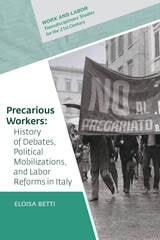
Precarious Workers
History of Debates, Political Mobilization, and Labor Reforms in ItalyEloisa Betti
Central European University Press, 2023
The recent vast upsurge in social science scholarship on job precarity has generally little to say about earlier forms of this phenomenon. Eloisa Betti’s monograph convincingly demonstrates on the example of Italy that even in the post-war phase of Keynesian stability and welfare state, precarious labor was an underlying feature of economic development. She examines how in this short period exceptional politics of labor stability prevailed. The volume then presents the processes whereby labor precarity regained momentum— under the name of flexibility— in the post-Fordist phase from the early 1980s, taking on new forms in the Craxi and Berlusconi eras.
Multiple actors are addressed in the analysis. The book gives voice to intellectuals, scholars, politicians and trade unionists as they have framed the concept and debates on precarious work from the 1950s onwards. Views of labor law experts, politicians and public servants are investigated in regard to labor regulations. Positions of the very precarians are explored, ranging from rural women, industrial homeworkers and blue-collar workers to physicians, university researchers and trainees, unveiling the emergence of anti-precarity social movements. The continuous role of women’s associations and feminist groups in opposing labor precarity since the 1950s is prominently exposed.
Professional Communities and the Work of High School Teaching
Milbrey W. McLaughlin and Joan E. Talbert
University of Chicago Press, 2001
With wide-ranging implications for educational practice and policy, this unprecedented look into teacher communities is essential reading for educators, administrators, and all those concerned with U. S. High Schools.
Puerto Rican Women and Work
Bridges in Transnational Laboredited by Altagracia Ortiz
Temple University Press, 1996
Puerto Rican Women and Work: Bridges in Transnational Labor is the only comprehensive study of the role of Puerto Rican women workers in the evolution of a transnational labor force in the twentieth century.
This book examines Puerto Rican women workers, both in Puerto Rico and on the U.S. mainland. It contains a range of information--historical, ethnographic, and statistical. The contributors provide insights into the effects of migration and unionization on women's work, taking into account U.S. colonialism and globalization of capitalism throughout the century as well as the impact of Operation Bootstrap. The essays are arranged in chronological order to reveal the evolutionary nature of women's work and the fluctuations in migration, technology, and the economy. This one-of-a-kind collection will be a valuable resource for those interested in women's studies, ethnic studies, and Puerto Rican and Latino studies, as well as labor studies.
Putting Descriptive Standards to Work
Christopher Prom
Society of American Archivists, 2017
Putting Poor People to Work
How the Work-First Idea Eroded College Access for the PoorKathleen M. Shaw
Russell Sage Foundation, 2006
Putting the Humanities PhD to Work
Thriving in and beyond the ClassroomKatina L. Rogers
Duke University Press, 2020
Putting the Invisible Hand to Work
Concepts and Models for Service Learning in EconomicsKimMarie McGoldrick and Andrea L. Ziegert, Editors
University of Michigan Press, 2002
The two parts of this volume provide a theoretical basis for service learning and offer lessons gleaned from applying it in the classroom. The theoretical chapters outline the learning theory and models of service learning as they can be applied in economics. Service learning is introduced here as a technique that teaches students to "do economics." Also included are specific models of service learning and an overview of assessment issues. The applications chapters detail various examples of using service to enhance learning. These range from using a single service experience in a class to courses that use service experiences as the focus and context for learning economics. Course topics cover environmental and natural resources, statistics, econometrics and research methods, principles and economic issues, labor, the economics of gender, forensic economics, and development economics. Each application provides details regarding the institutional environment in which it was implemented, type of course, enrollment, and process through which student learning was enhanced. Handouts and abbreviated syllabi are included.
Economics educators have a stake in improving their students' long-term economic literacy. Service learning offers significant benefits beyond those offered by pedagogies traditionally found in economics classrooms and should be considered as a teaching strategy by economics professors everywhere.
Kim Marie McGoldrick is Associate Professor of Economics, University of Richmond. Andrea L. Ziegert is Associate Professor of Economics, Denison University.